
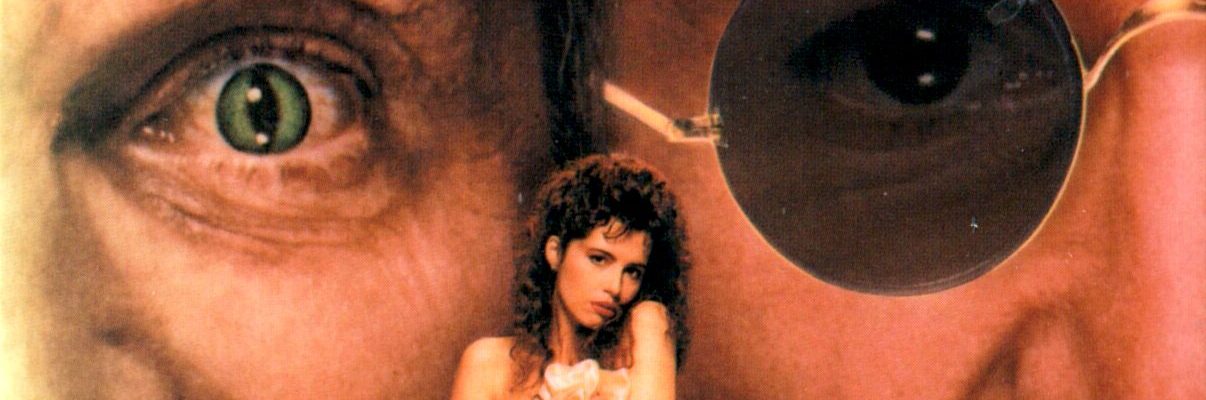
Pardon me, but your teeth are in my neck – Matty chows down on a decent vampire romp from producer Greg H. Sims and director Deran Sarafian.
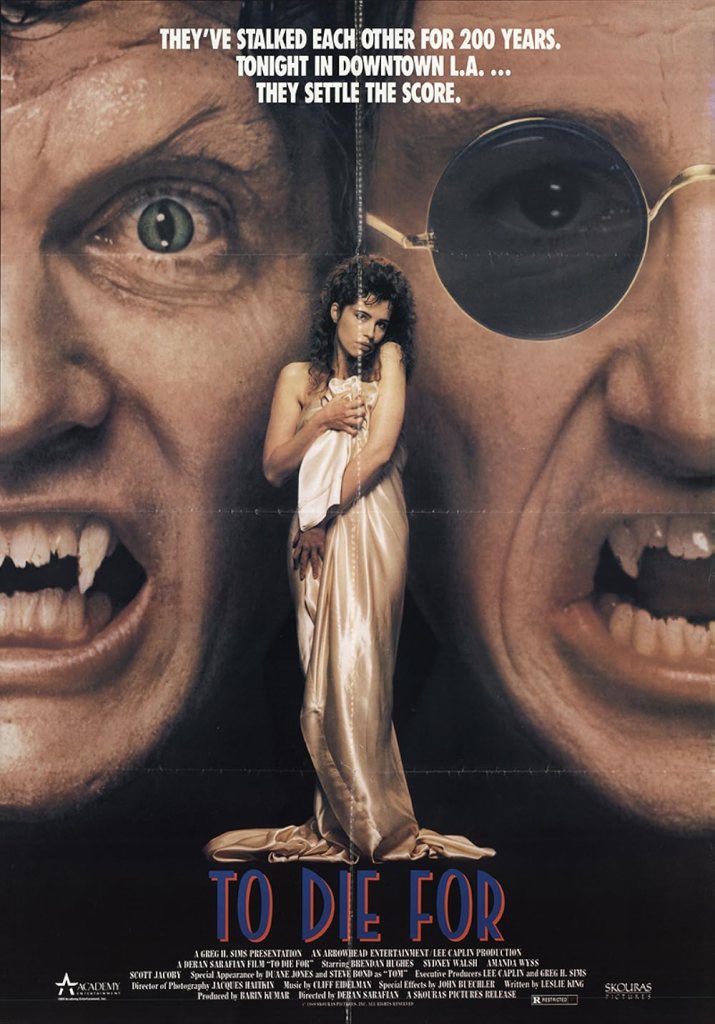
In several interviews over the intervening decades, Deran Sarafian — son of cult auteur Richard Sarafian and the nephew of Robert Altman — has stated how he spent much of his early career serving as a ghost director, helping to fix floundering projects. In a cruel twist of fate, the director suffered production difficulties of his own on his sophomore feature, Interzone (1987). An admittedly dreadful Mad Max (1979) riff, Interzone’s producers, Trans World, were unhappy with Sarafian’s footage and temporarily ousted him before mooted replacement Fred Olen Ray and the film’s star, Bruce Abbott, concocted a plan to help Sarafian keep his job [1]. By the time Interzone shuffled onto U.S. video in September 1989, Sarafian was editing his fourth picture, the awesome Van Damme-starring biff-’em-up Death Warrant (1990). The film he shepherded between Interzone and Death Warrant, vampire flick TO DIE FOR (1988), was also ready to hit tape.
Though Sarafian has kept shtum about the specifics of To Die For’s making, the overall quality of the finished film suggests a happy and harmonious experience. That said, the possibility of interference is certainly there given how hands-on producer Greg H. Sims was with the project. As detailed in a compact yet comprehensive piece in the May ‘89 issue of Cinefantastique (Vol. 19, No. 4), Sims had wanted to adapt Bram Stoker’s iconic horror romp, Dracula, for a number of years. And despite being a fan of the Universal and Hammer Dracs, Sims, fresh from steering tepid slasher spoof Return to Horror High (1987), felt the text’s romantic elements were frequently nixed in favour of the plasma drinking. Thus, as far as the wannabe mogul was concerned, a sensual – and, indeed, contemporary – take on Stoker’s influential classic could be a massive success, especially in a world rocked by sexy thrillers a la Body Heat (1981), Jagged Edge (1985), and Fatal Attraction (1987). In retrospect, Sims clearly wasn’t alone in this belief. To Die For dropped in the middle of a run of steamy, relationship-driven fang-bangers rounded out by Dracula’s Widow (1988), Vampire’s Kiss (1989), Dance of the Damned (1989), and Graveyard Shift 1 & 2 (1987 & 1988).
Sarafian is a good fit for the material and seemingly hip to Sims’ vision. While different in tone, the straighter-faced To Die For finds the helmer returning to the people-centric weirdness of his debut proper, comedic sci-shocker Alien Predators (1986). Neither have wholly perfect scripts. Writer Leslie King’s dialogue in To Die For, for instance, sometimes feels laboured, and the story’s structure is a little skew-whiff. However, both it and Alien Predators demonstrate Sarafian’s flair for juggling horror and the dramatic, at least in terms of general emotional impact. To Die For’s suspense, chills and smatterings of gore – supplied by make-up wiz John Carl Buechler [2] – resound because of Sarafian’s unrelenting focus on the folk experiencing them, even if his ensemble-y footing isn’t quite as tight as it would be in his later epics, Back in the U.S.S.R. (1992) and Roadflower (1994).
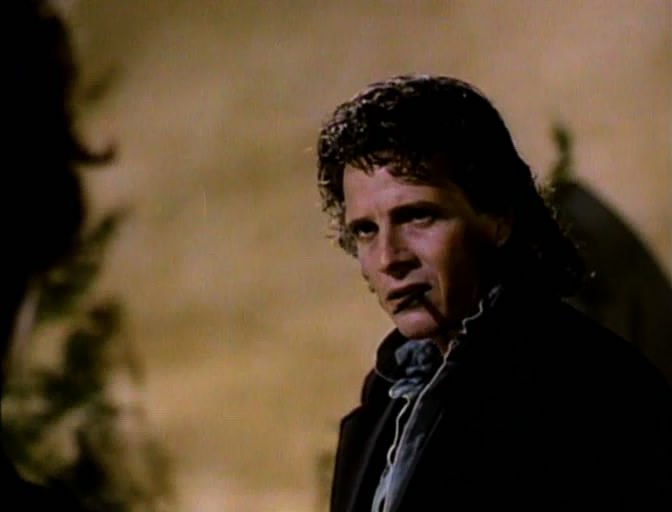
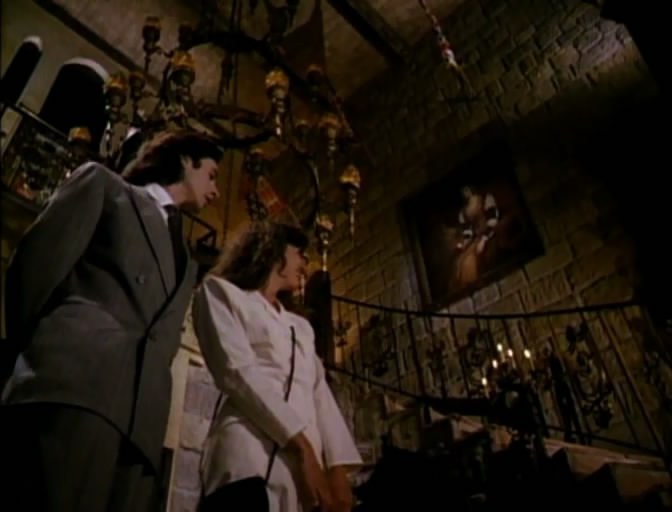
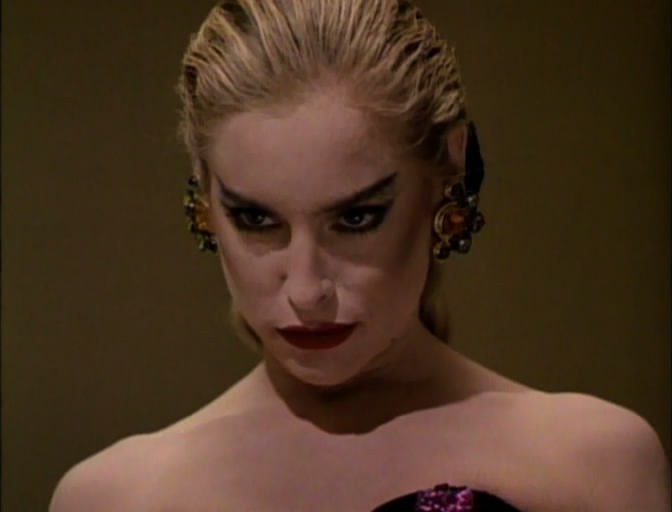
At the core of the film is Vlad Tepes (Return to Horror High’s Brendan Hughes, who’d don fangs again for Anthony Hickox’s bloodsucking western Sundown: The Vampire in Retreat (1989)). Better known as Vlad the Impaler and Vlad Dracula, the real-life Tepes is, of course, cited among Stoker’s inspirations for his titular ghoul – and in a pleasingly meta flourish, a Stoker shout-out is shoehorned into one of To Die For’s expository passages. In any case, Sarafian, Sims and King present Tepes as The Count in all but name, and they utilise, deploy and retool every bit of lore save for the Demeter. The rest of the cast follow suit: Kate (Sydney Walsh, A Nightmare on Elm Street Part 2: Freddy’s Revenge (1985)) is Mina and Jonathan Harker combined; Walsh’s Elm Street predecessor, Amanda Wyss, is essentially a hybrid of Lucy Westenra and Renfield; and everyone else are various shades of Van Helsing, Arthur Holmwood, Quincey Morris, and Dr. Seward. Thrillingly, Duane Jones appears in a small part. Jones’ final role prior to his untimely death, aged fifty-one, on 22nd July 1988, I’ve always hoped the Night of the Living Dead (1968) hero was hired as a subtle triple reference, in honour of his game-changing work in George Romero’s masterpiece, and his turns in a pair of lesser-known sanguine slurpers, the seldom seen Vampires (1986) and Bill Gunn’s ace Ganja & Hess (1973).
Unrelated to Stoker, at the more Anne Rice end of the undead spectrum, is To Die For’s antagonist, Tom (Steve Bond). Half Severen from Near Dark (1987), half Clint Eastwood pastiche, the crux of the film’s plot rests on Tom and Tepes’ centuries-long rivalry which has led to them crossing paths at a number of after-dark parties in late-’80s L.A. — where, quelle surprise, they vie for Kate’s attention (she’s the spitting dab of their old lost love, natch).
Like Alien Predators, Death Warrant and Roadflower, Sarafian uses space and location to emphasise characters and their motivations. In To Die For, eye-catching Los Angeles venues such as Hodges Castle anchor his musings on desire, connection and acceptance, and the atmospheric photography of Jacques Haitkin – another Elm Street tether – nicely bridges macabre pomp with Sarafian’s humanism.
Lensed in spring 1988, shortly after Sarafian flexed his acting muscles in Italian splatter titan Lucio Fulci’s chaotic gut-muncher Zombi 3 (1988), To Die For premiered at the inaugural Virginia Festival of American Film in Charlottesville on 28th October of the same year. The film failed to get the wide theatrical release Sims craved but distributor Skouras Pictures did nudge To Die For into a few U.S. cinemas, opening it in L.A. on 12th May 1989. Suitable, considering the story’s setting.
To promote To Die For, Sims commissioned Blackthorne Publishing to create a one-shot, tie-in comic book (published March ‘89), and Academy Entertainment subsequently issued the film on video in the U.S. on 9th November ‘89. To Die For arrived in the U.K. via Colourbox, joining such labelmates as Bad Taste (1987), Sorority Babes in the Slimeball Bowl-O-Rama (1988), and Hollywood Chainsaw Hookers (1988) by Sarafian’s Interzone switch, Fred Olen Ray. It fared well on cassette, and Sims, King, Buechler, Wyss and Bond reconvened for a Sarafian-less sequel, Son of Darkness: To Die For II (1991) [3]. Weirdly, when To Die For surfaced on U.S. DVD in 2005, co-producer Lee Caplin — owner of the disc’s distro, the Picture Entertainment Corporation — retitled it ‘Bram Stoker’s Dracula: The Love Story to Die For’ and completely scrubbed mention of Sims from the film’s newly rendered digital credits.
[1] Per Ray: “I did the script for the new shoot but the shoot wasn’t going to happen without Bruce. I was pissed because Trans World were willing to give me a lot of money for a car chase to try and make Interzone better, and it annoyed me that the money they were prepared to pay in order to try and save this thing was much more than the budgets Trans World had given me for my movies. I just didn’t want to do it! So I called Bruce and said that, because the whole deal depended on him being the star, if he told Trans World he wasn’t going to do it, the reshoots would be cancelled. So Bruce, out of loyalty to Deran, said he wasn’t going to do any reshoots unless Deran was the director, and I told Trans World that, well, no Deran, no Bruce, and no movie.”
[2] The highlight? A decapitation into a stake-induced meltdown. Icky and uproarious, it’s a true ‘fuck yeah!’ moment which deserves hailing alongside fellow Buechler standouts Re-Animator (1985), TerrorVision (1986), Cellar Dweller (1987), and Carnosaur (1993).
[3] Sims and Buechler also reunited on The Fear (1995) and The Fear 2: Halloween Night (1999).


[…] the wide theatrical release or critical acclaim producer Greg H. Sims desired, but vampire flick To Die For (1988) was seen by at least one right person. Proving that you never know who’s watching, legend goes […]
LikeLike