

It may have been adapted multiple times for the stage and screen, but Dave thinks that this CBS iteration of Robert Thomas’ play belongs in the TVM hall of fame.
“Originality is nothing but judicious plagiarism” – Mark Twain
When Piège Pour un Homme Seul (Trap for a Single Man) made its bow at the Théâtre des Bouffes-Parisiens on 28th January 1960, the reaction was one of universal acclaim.
It’s an impeccably crafted piece which sees a newlywed on his honeymoon report his missing wife to the police. His concern for her wellbeing is tempered with the arrival of a local priest, who assures the man that his wayward bride is safe and well and that she simply sought a period of reflection in the sanctity of his church. All seems fine and dandy – but when the couple reunite, the groom states that he has no recollection of this woman and accuses her of being an imposter. Is he right? Or is he losing his mind?
The play’s success transformed the life of Robert Thomas, its thirty-three year old Provence-born author. His work was swiftly translated for performances in other countries, and the playwright even landed himself a meeting with Alfred Hitchcock, who was keen to option the rights.
The interest from the Master of Suspense ultimately came to nothing, which makes you wonder if suggestions of Thomas being a little light-fingered in terms of his inspiration for Piège Pour un Homme Seul put the kibosh on Universal – or any other major studio – taking a punt. Thomas seemed to have lifted a number of plot points from the Humphrey Bogart movie Conflict (1945), which itself appeared to borrow from Killer’s Keeper, a 1940 short story penned by the prolific David X. Manners. In fact, Manners’ tale would find its way into Thomas’ vicinity in 1950 with a reprint in the French crime fiction publication Mystère magazine.
Whatever the semantics, the desire to film Thomas’ play gathered momentum towards the end of the sixties which yielded the first of three American adaptations, all made for television. ABC aired the first two, switching gender roles for Honeymoon with a Stranger (1969) and (ironically) casting Hitchcock favourite Janet Leigh in the lead. Seven years later, Jack Klugman took the main role in One of My Wives is Missing (1976), which was adapted by the Oscar winning screenwriter Peter Stone (Charade (1963), Father Goose (1964)).
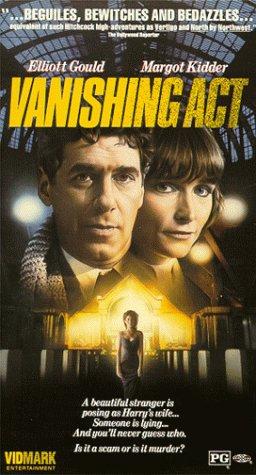
The best was saved for last with VANISHING ACT. Adapted by small screen royalty in the shape of Columbo creators William Link and Richard Levinson, it cast former M*A*S*H star Mike Farrell as the befuddled male lead and Margot Kidder as the woman who may or may not be his spouse. The towering frame of Fred Gwynne fills the role of the local priest – but it’s an earmuff bedecked Elliott Gould who walks away with the picture thanks to a star turn as Lt. Rudameyer [1].
“What does he look like?” asks Farrell’s panicked character before he sets off in search of the police chief.
“He looks a lot like his name.”
Farrell happens across him on the runway of the Rocky Mountain hamlet, taking delivery of a corned beef sandwich that he had shipped in from a West 87th Street delicatessen in New York. It’s that level of quirkiness which dominates the first half of Vanishing Act, with rat-tat-tat dialogue ricocheting between the four principals – all of it interwoven with a pulsating level of snark and wit.
The film dips ever-so-slightly after the hour mark, perhaps to give the audience a brief window to draw breath, before building to a climax that’s sure to have anyone who appreciates a well-constructed script punching the air in euphoric delight.
Shot entirely in the popular Canadian tourist spot of Banff, Alberta during January and February 1985, Vanishing Act faced a mountain as big the ones that surrounded its location when it came to the premiere. Bafflingly scheduled by CBS against the ratings behemoths of North & South, Book II, and the Ted Bundy telepic Deliberate Stranger (1986), this ‘comédie policière’ as it was originally christened failed to match the impact of its peers. This was despite both Gould and Farrell making themselves available for extensive press coverage too.
“It’s the TV equivalent of sitting down with a good book,” remarked Farrell to The Shreveport Times. “A real romp for the audience. I call it a fun excursion into the area of the whodunnit, with tongue planted firmly in cheek.” [2]
Romps?
Whodunnits?
“Harry, you sound like a B-movie,” says Lt. Rudameyer to Farrell’s character.
And that’s exactly what Vanishing Act is; a masterful one.
USA ● 1986 ● Thriller, TVM ● 90mins
Mike Farrell, Margot Kidder, Fred Gwynne, Elliott Gould ● Dir. David Greene ● Wri. Richard Levinson, William Link, based on the play by Robert Thomas
[1] Not everyone was impressed. Asbury Park Press labelled Gould’s schtick as “artificial whimsy.”
[2] Actor Finds Vanishing Act Fun by Lane Crockdett, The Shreveport Times, 3rd May 1986.

