Welcome to Short Ends. Quick (ish) reviews of a handful (ish) of movies. Sometimes connected by a theme, sometimes not. Today, Matty yaps about a few flicks he’s name-dropped in a bunch of recent audio commentaries. And no, he ain’t going to tell you what releases they’re for.
Robots, sequels, an Italian rip-off, and some Jim Wynorski and Corman. Buckle up!
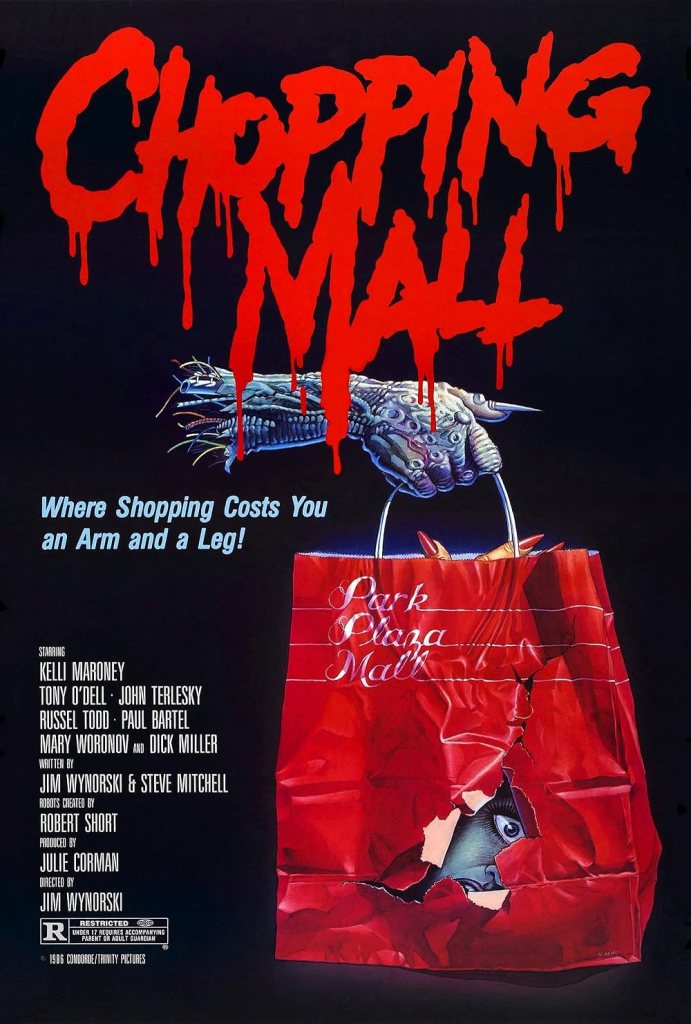
CHOPPING MALL (1986)
“Why don’t you call it Chopping Mall?”
And with that – the excitable cry of a mysterious electrician, earwigging on a post-screening chat between producer Roger Corman and director Jim Wynorski – B-movie history was made.
As the story goes, Corman tested Chopping Mall under its original name, ‘Killbots’, but audiences didn’t bite. The flick started its U.S. theatrical run in September 1986, rebranded, and its cult status was quickly earned thanks to good ol’ VHS.
Today Chopping Mall remains Wynorski’s best-known film. He’s unleashed better ones, obviously. Quality-wise, The Haunting of Morella (1990), 976-EVIL II (1991), Sorceress (1995), and fellow robo-caper Storm Trooper (1998) are all technically, stylistically and dramatically superior. However, Chopping Mall is totemic. Lively, fun-as-hell, packed with nods and winks to the type of pictures that inspired it (the Paul Bartel and Mary Woronov/Eating Raoul (1982) cameo is as hilarious as it is indulgent)… But Wynorski’s master stroke is the film’s slyly satirical bent.
On the surface, Wynorski’s output – particularly his more waggish and extravagant fare – tends to exist in its own universe; an exaggerated, Russ Meyer-esque hyper-reality typified by big boobs, broad performances, and bawdy humour (cf. Deathstalker II (1987), The Return of Swamp Thing (1989)). To that end, his skills as a storyteller and, on occasion, a social commentator are often ignored in favour of the baser pleasures. Like subsequent standout Against the Law (1997) (which, incidentally, also comes from the pen of Steve Mitchell), Chopping Mall exquisitely balances genre thrills with fierce intelligence. The film holds a mirror up to the age in which it unfolds. The shopping centre setting and homicidal security droids at the story’s core take aim at the endless consumption of the Reagan era, rendering Chopping Mall as potent a greed parable as John Carpenter’s They Live (1988) and Brian Yuzna’s Society (1989).
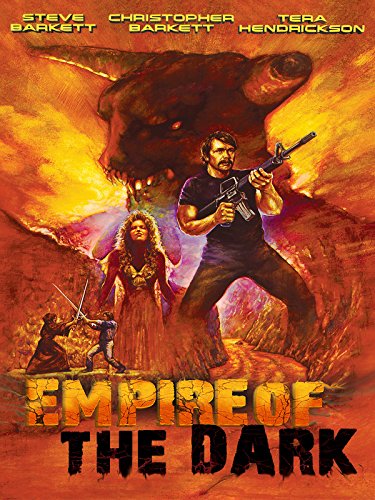
EMPIRE OF THE DARK (1990)
Before Tommy Wiseau and Neil Breen there was the late, great Steve Barkett.
Born in Oklahoma and a movie nut from an early age, Barkett parlayed his interest in film into the ramshackle making of two mesmerically lousy yet heavily auteurist vanity vehicles. The first is dizzying post-apocalyptic howler The Aftermath (1982) (aka ‘Zombie Aftermath’), which gained a measure of infamy here in the U.K. thanks to its status as lower-league video nasty (it was on the Section 3 list of supplementary titles liable for seizure). The second is this fried gold good-time, Empire of the Dark: a fruity, belief-beggaring blend of family saga, satanic panic, and swords n’ sorcery.
Writing, producing, directing, editing, choreographing the stunts, and starring — Barkett is the very definition of a jack of all trades. A cynic might finish that sentence. And in Empire of the Dark, Barkett’s, erm, ‘creativity’ is glorious.
From the corporate training video-style photography and emphysema-inducing overuse of smoke machines, to editing which seems as though someone let Stevie Wonder loose with a pair of scissors, Barkett’s sophomore lark is a midnight tonic. His self-penned script is unintentionally uproarious. Every line is either screeching exposition or, in the case of Barkett’s lead role, Mary Sue grandstanding. Because his character – a cop turned private detective/ bounty hunter (!), out to rescue an ex-love from a devil-worshipping warlock — can do EVERYTHING. Kung-fu, swordsmanship, pulling the ladies, beating the bad guys — you name it, Barkett’s got the t-shirt.
Now, it’s not all giddy – forgive me – ‘schlocky’ thrills. There’s some genuinely impressive craft on display, not least the amazing demon FX and the incredible, otherworldly production design of Robert Stromberg (who’d graduate from homebrew productions to the big budget likes of Avatar and The BFG (2016)). Post Empire of the Dark, Barkett likewise worked his way up the movie ladder: he spent the ‘90s appearing in the output of Empire of the Dark’s credited co-producer, Fred Olen Ray.
KISS ME A KILLER (1991)
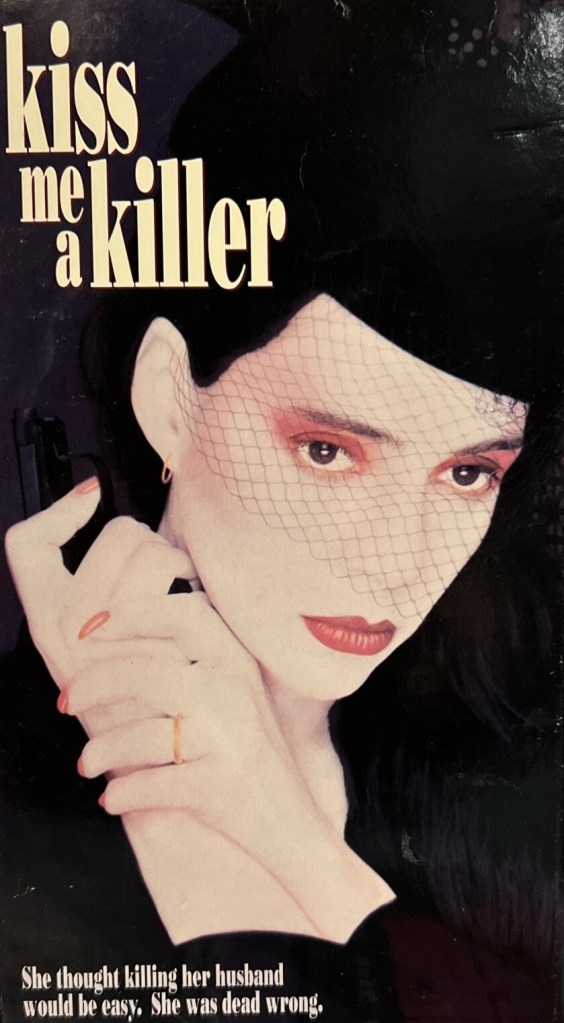
As early as 1991, fatigue was setting in at the bottom end of the erotic thriller spectrum. While the likes of the Body Chemistry series – which, a la Kiss Me a Killer, was produced by Roger Corman – and the distinguished work of smut auteurs Jag Mundhra and Gregory Dark continued to sizzle, ho-hum junk such as this was surfacing with as much regularity.
And that’s not to say Kiss Me a Killer is entirely bad either.
It boasts decent technical credentials, with cinematographer Nancy Schreiber’s atmospheric use of lighting and colour lending the moody drama a great, highly stylised look. Of further interest is the Latino flavour co-writer/director Marcus De Leon sprinkles throughout — though his unfocused jabs at Catholicism and the racism downtown L.A.’s Hispanic community have to endure barely register. The rest of Kiss Me a Killer flounders because of the total lack of development between any of the characters. There’s no motivation or reason; people do things and major plot points just kind of happen.
Julie Carmen stars as a beleaguered wife who gets jiggy with a handsome drifter (Robert Beltran), the pair of them eventually deciding to kill her drunken, bar-owning hubby (Guy Boyd). Carmen and Beltran submit bold performances, and it’s a solid watch – but, as a whole, Corman made a better (Blood)fist of the material when he tasked Dan Golden with retooling it for Saturday Night Special (1994).
THE RETURN OF SWAMP THING (1989)
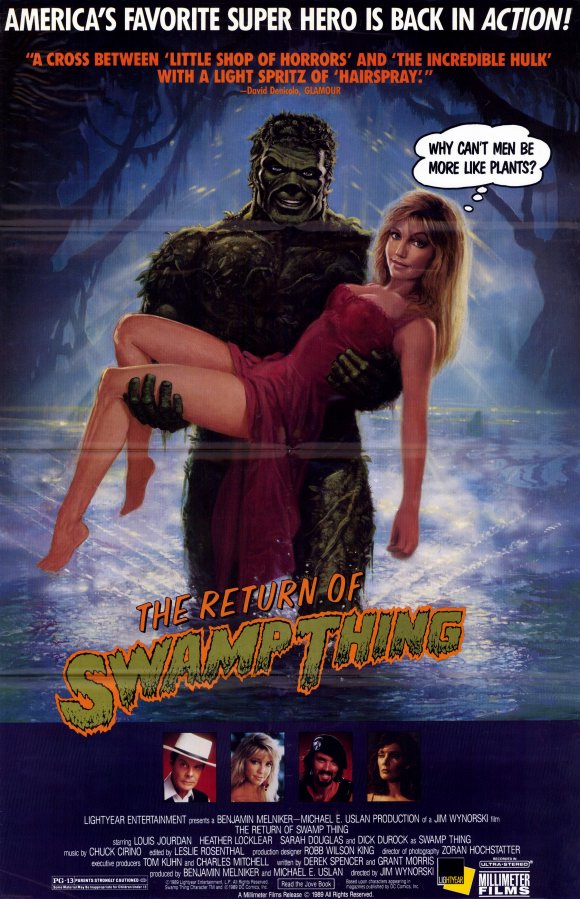
A superior sequel, comic book adap The Return of Swamp Thing exhibits the sort of plucky, good-time swagger its predecessor lacks. While Wes Craven’s original Swamp Thing (1982) isn’t without charm, it is, comparatively, stuffier. Sure, Craven’s valiant swing for Superman (1978)-style box office has plenty of moments and is solid enough – it’s just that, ultimately, the future A Nightmare on Elm Street (1984) maestro would make a better fist of splash panel aesthetics and stylisation with several of his later projects, specifically Shocker (1989), The People Under the Stairs (1991), Vampire in Brooklyn (1995), and, indeed, The Hills Have Eyes Part 2 (1984).
By his own admission, The Return of Swamp Thing’s director, Jim Wynorski, is a comic book guy through and through. However, as well as being au fait with the material (Return was supposedly inspired by Swampy’s acclaimed Alan Moore era), Wynorski’s entire sensibility is spectacle and energy-driven; tactics employed as much out of necessity as they are a trademark.
Brilliantly lensed by Wynorski regular Zoran Hochstätter, The Return of Swamp Thing is a comic book come to life. An incredibly visual experience, you could take stills of every shot and make it into a flick book and it’d still tell a coherent and compelling story. As with the aforementioned Chopping Mall, Wynorski has made more well-rounded films. But, again, The Return of Swamp Thing is another iconic text on the filmmaker’s resume. Its pleasures are bolstered by sprightly turns, fabulous monster FX, and an ace Chuck Cirino score.
Produced by Lightyear Entertainment – a former offshoot of RCA Video Productions, and co-producers of the Jane Fonda Workout franchise — and ushered into U.S. cinemas by Miramax’s Dimension antecedent, Millimeter Films, The Return of Swamp Thing hit the big screen a month before comic book movie game-changer Batman (1989) – which, incidentally, was the golden goose of Swamp Thing saga producers, Benjamin Melniker and Michael E. Uslan. The film landed in U.K. cinemas via Medusa on 22nd December ‘89, four months after Batman’s British bow. As an aside, Craven’s Swamp Thing had tardily been sent direct-to-video in the U.K., arriving in April ‘87 as the fright master’s Deadly Friend (1986) bounced around Blighty theatres.
SHOCKING DARK (1989)
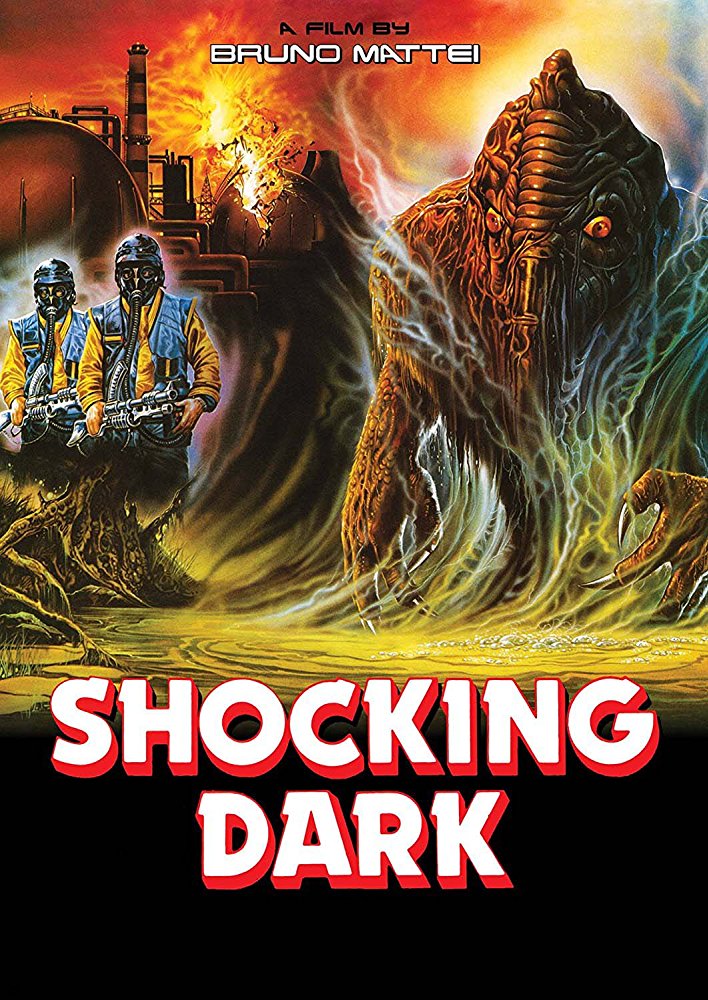
A somewhat legendary title in Italian exploitation circles, spaghetti sci-fi horror Shocking Dark was going to be released in the U.S. by Imperial Entertainment at the back end of the ‘80s before the outfit quickly bailed on the project for legal reasons. Because when you’re calling yourself ‘Terminator 2’ in your homeland — well, you’re asking for trouble aren’t you?
In addition to riding The Terminator’s (1984) arse, Shocking Dark also swipes from Blade Runner (1982), Phillip Kaufman’s Invasion of the Body Snatchers (1978), John Carpenter’s The Thing (1982), and — most shamelessly — Aliens (1986). Indeed, the bulk of the plot and its characters are virtually identical to the latter, to the point where, between that and The Terminator riffing, it’s no wonder the film was ruled problematic on American soil. James Cameron’s attorneys must have been circling it like sharks…
Helmed by the incomparable Bruno Mattei — a man accustomed to flagrant rip-offs (hello, Cruel Jaws (1995)) — Shocking Dark is messy and haphazardly paced, but it certainly sports an appealing rhythm and mood all of its own. Credited to the helmer’s ‘Vincent Dawn’ pseudonym and penned by his frequent collaborator/fellow ‘trash’ auteur Claudio Fragrasso, Shocking Dark is Mattei’s second robo-schlocker following the similarly diverting Terminator/Predator (1987) hybrid, Robowar (1989). It’s make-up, gore and creature effects (by Franco Di Girolamo and Francesco and Gaetano Paolocci) are fantastically rubbery; the industrial subterranean sets (read: warehouse spaces and boiler room tunnels) lend the film a nice sense of insularity and claustrophobia; and the weirdly sincere performances add an amusing air of poker-faced lunacy that enlivens the draggy bits.
Tasty junk food — and, in its own peculiar way, essential.
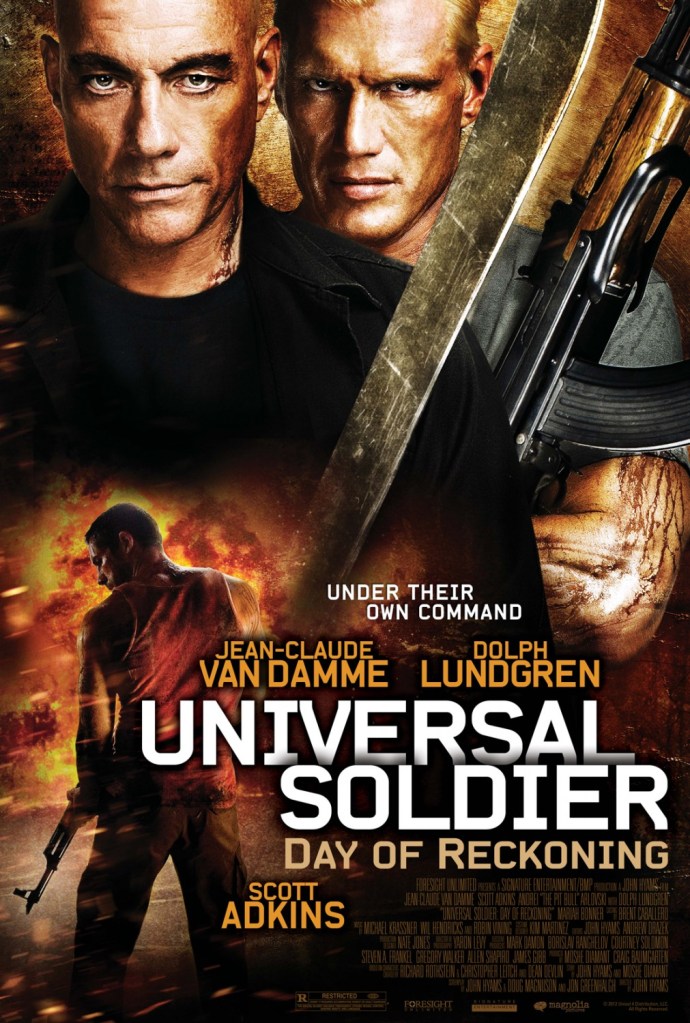
UNIVERSAL SOLDIER: REGENERATION (2009) & UNIVERSAL SOLDIER: DAY OF RECKONING (2012)
Another two for the ‘awesome sequels’ folder.
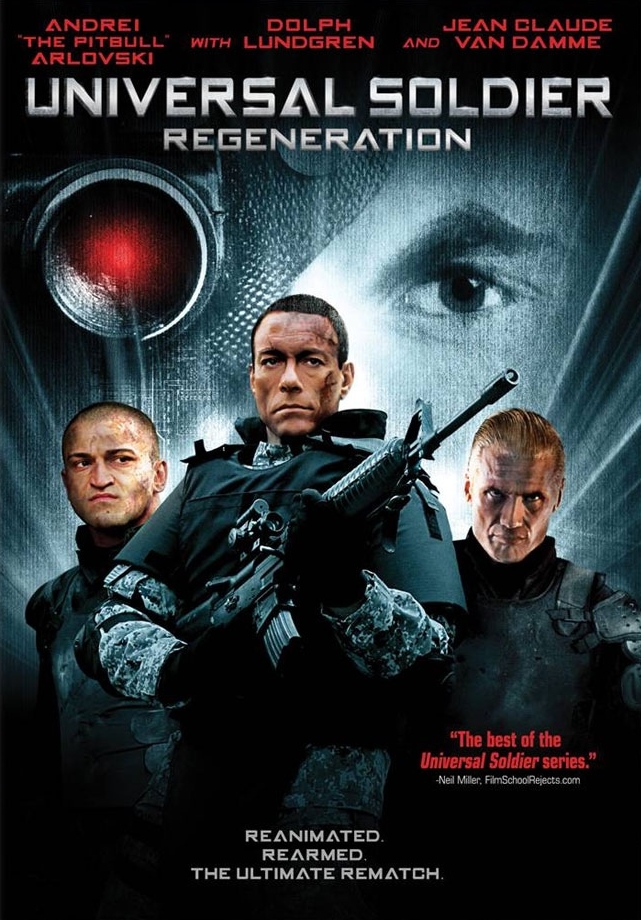
Universal Soldier: Regeneration and Universal Soldier: Day of Reckoning are helmed by John Hyams; the son of Outland (1981) director Peter Hyams who had, of course, directed UniSol franchise star Jean-Claude Van Damme in Timecop (1994), Sudden Death (1995), and, later, Enemies Closer (2013). Amusingly, the elder Hyams serves as Regeneration’s cinematographer as well. Regeneration and Day of Reckoning are also produced by Craig Baumgarten – a long-time architect of the series, having marshalled Universal Soldier (1992) and Universal Soldier: The Return (1999) – and Moshe Diamant. The former head of ‘80s video outfit Trans World Entertainment, Diamant had a hand in several preceding Van Damme capers (Double Impact (1991), Hard Target (1993), Timecop, Sudden Death, The Quest (1996), Maximum Risk (1996), Double Team (1997)) and even exec’d a few movies featuring saga co-star Dolph Lundgren (I Come in Peace (1990), Joshua Tree (1994), Men at War (1994)).
Electing to ignore the events of The Return – just as The Return bypassed the Van Damme-and-Lundgren-less TVMs, Universal Soldier II: Brothers in Arms (1998) and Universal Soldier III: Unfinished Business (1998) – Regeneration finds JCVD’s decommissioned bot-thing, Luc Deveraux, being reinstated in order to thwart a gaggle of terrorists threatening to detonate Chernobyl or something. It’s wafer thin stuff – but, my Lord, the action! Oh, the action! Though I object to the lazy, more ‘mainstream’ belief that Regeneration redefined the parameters of DTV spectacle (you know, as if PM Entertainment, Nu Image and Albert Pyun hadn’t happened), the film is a barn-burner. Intense, gritty, pummelling and precise – it’s bollock-knotting and pulse-quickening. Every set piece falls somewhere between a violent dance and jazzy military manoeuvres. That said, Regeneration does falter somewhat in that it’s so dour. It’s a dark and extremely serious film, completely bereft of the humour and playful eccentricities of the o.g. Universal Soldier and The Return.
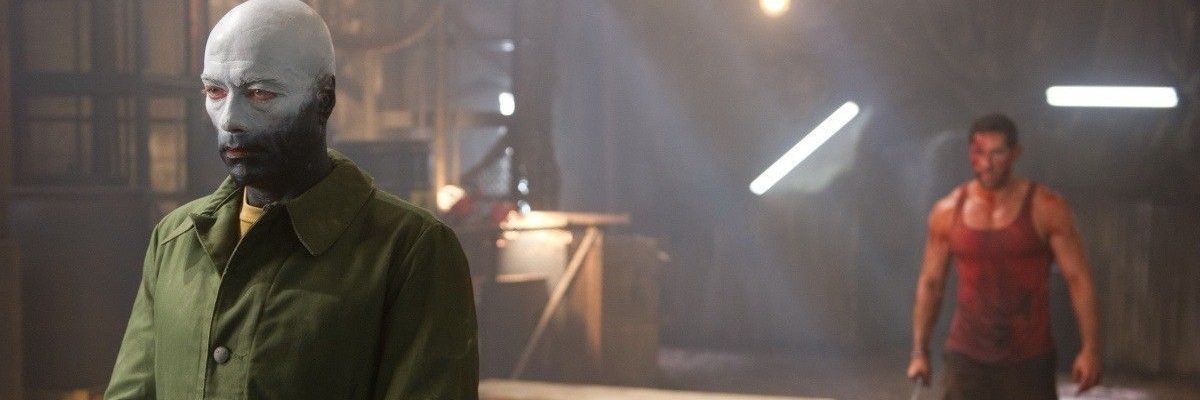
The po-faced tone carries over to Day of Reckoning, which also falters due to Hyams’ bizarre decision to never have Van Damme and Lundgren share a scene together. Nevertheless, for the most part, Day of Reckoning is sublime. Despite several sources labelling it as another restart, this wild and wacky mood piece is a full-blown follow-up. The dense, Stygian plot serves is the logical extension of Deveraux’s engaging character arc. In Regeneration, he was trying to figure out who he is. Here, he knows, and his initial voyage of discovery is mirrored by modern martial arts fav Scott Adkins’ identity-based odyssey as Day of Reckoning’s hero.
Like its immediate predecessor, Day of Reckoning’s action is stupendous. Moreover, its emotional impact is devastating. The film’s final stretch is particularly impressive and ruinous: early doors, there’s a jaw-dropping car chase and a scuffle in a sports shop, and the last act – wherein Adkins goes toe-to-toe with Lundgren and, finally, Van Damme – is pure, blood-splattered poetry. And yet, Day of Reckoning isn’t an outright action movie. While undoubtedly among the genre’s apex, it’s an equally great horror flick. Flirting with themes of fate and inevitability, it unspools in the manner of a Lynchian nightmare. Gorgeously shot and richly atmospheric, there’s a ghostly quality to Day of Reckoning; an eerie, suffocating sensibility a la Lost Highway (1997) and Mulholland Drive (2000), as Adkins haunted family man treks deeper and deeper into Hyams’ meticulously constructed hellscape.