
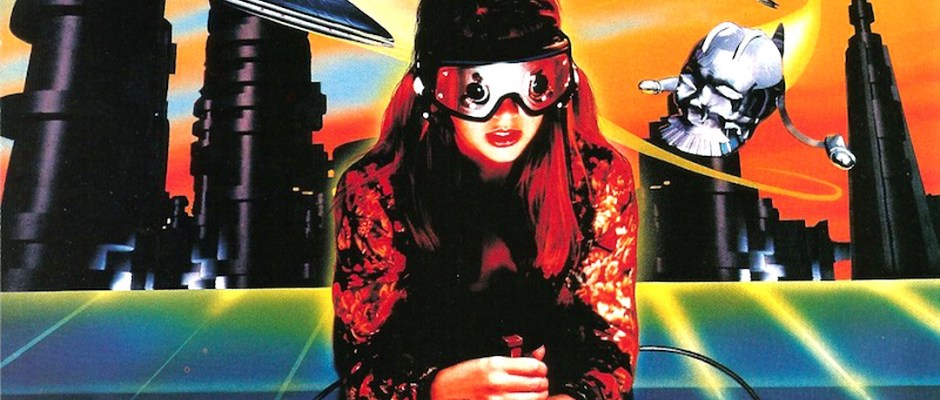
Fondly regarded by many Full Moon fans, Matty has always struggled with helmer Albert Pyun’s third – and final – Charles Band assignment. Here’s why.
A quick story:
Years ago, while trawling my local car boot sale 2002 or 2003 time (Redcar racecourse represent!), I happened across a battered VHS copy of ARCADE (1993). I didn’t buy it — something very strange in retrospect, what with me and my booty-loving mate, Mr. Jonny Batey, being massive fans of the film’s producers, Full Moon [1]. But the guy flogging it was a card.
“Arcade!” he said in a giddy Geordie twang. “It’s like a nasty version of Tron (1982).”
That quote — and, indeed, the weird little fella’s unfulfilled promise to return to the concourse the following week with “all the Hellraisers” (pronounced ‘Hel-ray-zez’) in tow — lives in my head rent free and remains a vocal stim.
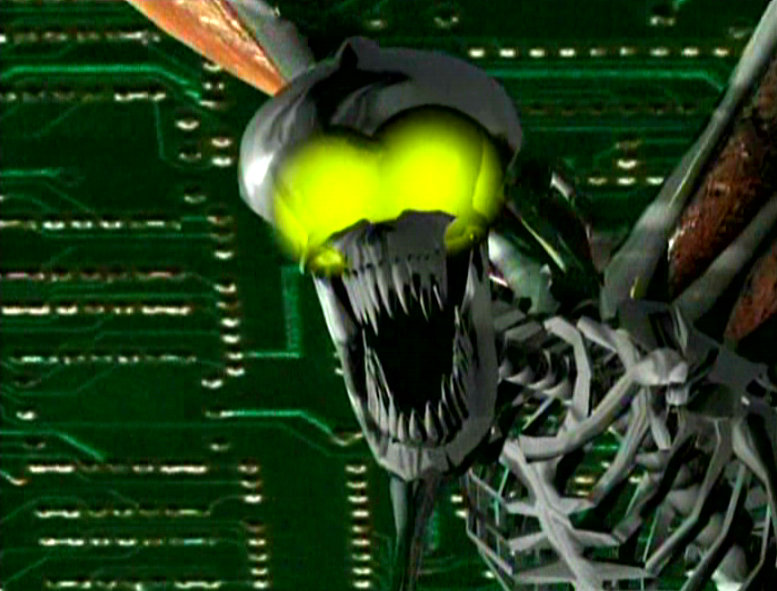
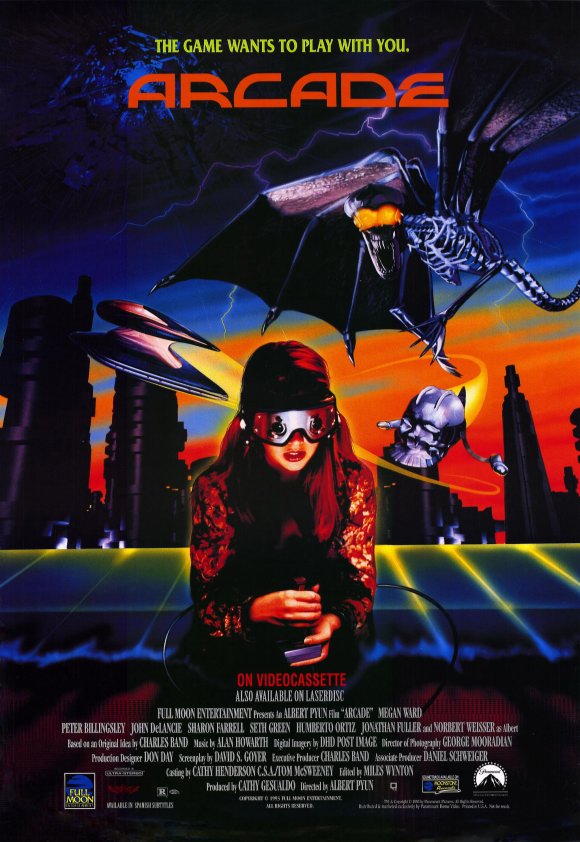
Fittingly, it was Arcade’s flagrant similarities to Tron that were at least partly responsible for its protracted post-production period. Shot back-to-back with Dollman (1991) in February and March 1991 by director Albert Pyun, Arcade finally hit U.S. and U.K. shelves in March 1994, via Paramount and Entertainment in Video respectively. In between, the film supposedly fell afoul of Disney’s legal team who objected to how it resembled the house of mouse’s pioneering sci-fi opus. As such, Arcade’s extensive CGI effects — which’d already pushed the project’s $750,000 budget to breaking point — had to be redone.
However, other accounts suggest the CGI was tweaked due to Full Moon boss Charles Band’s dissatisfaction with the first cut of Arcade plonked in front of him. The late Pyun freely admitted that he left Arcade in disarray, ditching it during editing in order to make his long-gestating cyberpunk actioner, Nemesis (1992), at Full Moon contemporary Imperial instead. Purportedly, Band was livid — and likely especially so since Pyun funnelled bits from both Dollman and Arcade into Nemesis’ development (themes, resources, and a prospective lead in the form of Full Moon ingénue Megan Ward (Crash and Burn (1990), Trancers II (1991)). As detailed in It Came From the Video Aisle!: Inside Charles Band’s Full Moon Entertainment Studio, Pyun’s departure resulted in the film having to be taken over by co-star Peter Billingsley and Full Moon fixers Daniel Schweiger and Robert Burnett in a desperate attempt to finish it. Pyun subsequently reflected on his conduct. He stated that it was unprofessional and lamented the end of his and Band’s relationship; the latter a particularly big regret as Band was an inspiration on Pyun’s own shingle, Filmwerks [2].
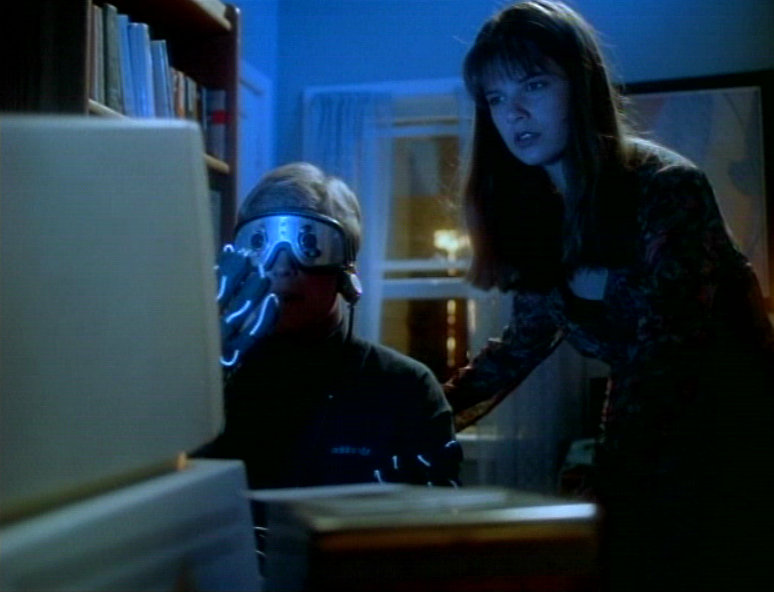

Of the three pictures Pyun shepherded for Band — a trilogy rounded out by Vicious Lips (1986) for Full Moon antecedent Empire — Arcade is the weakest. Dollman is solid stuff. And Vicious Lips might be a mess, but it’s charismatic. Arcade is a beige affair. Mustard coloured slacks on a shelf of Levi’s denim, if you will. Initially conceived as a straighter, simpler ghost flick (I dare say Band’s proposed concept, a haunted arcade, wouldn’t be too dissimilar to Empire’s ‘haunted jail’ shocker, Prison (1987), or Full Moon’s ‘haunted casino’ romp, Dead Man’s Hand (2007)), Pyun and his Kickboxer 2: The Road Back (1991) scribe, David S. Goyer, envisioned the film as a sprawling sci-fi adventure about virtual reality [3]. Despite shoehorning in a vengeful spirit for good measure — and, presumably, to satisfy Band — their take on Arcade is essentially an adolescent twist on Videodrome (1983) and Halloween III: Season of the Witch (1982). Control, manipulation, and the perils of media and technology filtered through a Tron veneer. A couple of weighty dramatic moments dwell on the nature of loss and grief. Alas, nothing hangs. Pyun and Goyer’s ambition exceeds their reach and the whole film just plods along, lurching from one scene to the next; a symptom probably worsened by Arcade’s chaotic production.
In any case, Arcade isn’t without interest. Aspects of Goyer’s convoluted script predate the Polybius myth — a post-internet urban legend concerning a mysterious video game with ties to the government and sinister conglomerates — and the narrative’s teen-footing calls to mind Pyun’s earlier school-based thriller, Dangerously Close (1986). Band-wise, Arcade is ostensibly a ‘90s update of his 1984 fantasy portmanteau, The Dungeonmaster. Quest-oriented in terms of plot mechanics, in The Dungeonmaster Jeffrey Byron has to save his beloved from the clutches of the titular wizard through a series of challenges; in Arcade the aforementioned Megan Ward has to save her pals from the eponymous diabolical game cabinet in much the same way. And where The Dungeonmaster exploited its era’s thirst for RPGs and swords and sorcery (winky face), Arcade taps into its decade’s growing obsession with VR and cyberspace (cf. The Lawnmower Man (1992), Virtuosity (1995), Johnny Mnemonic (1995), eXistenZ (1999), The Matrix (1999)) [4].
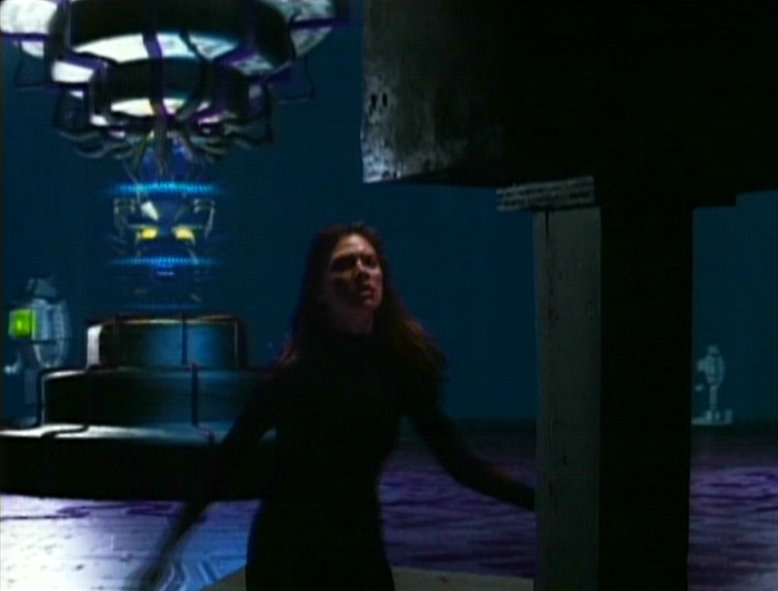
A la most Pyun joints, Arcade is visually slick. Lensed by frequent collaborator George Mooradian, the sequences set in the actual arcade within the movie, Dante’s Inferno, are atmospherically brilliant. They’re smoky and shadowy bursts of ghoulish comic book horror, and their swagger is mirrored by the enthusiastic mugging of the ever-reliable John de Lancie as Arcade the game’s kooky hype-man [5]. And though Pyun can’t lay claim to it because of the sodding off, Arcade’s CGI is charmingly dated and exudes kitsch-y pleasure; an aesthetic and textural commonality shared with the chintzy FX work in another slight, female-fronted lark of his, Alien From L.A. (1988).
[1] For those who care, I eventually saw Arcade half a decade later, after acquiring the dubious Full Moon Classics Vol. 1 boxset from — ahem — ‘Australian distributor’, Kangaroo Video. I hope I’m not alone in fondly recalling the days when Charles Band had to resort to ludicrous deception to get his old wares out there.
[2] The original CGI is visible in the vintage behind-the-scenes VideoZone featurette included on Paramount’s tape, and promo cassettes of the original cut with the original CGI and dialogue were issued to dealers. The original cut also surfaced in several foreign territories. In fact, an Argentinian rip of Arcade is readily available online.
[3] Band hired Goyer to pen Demonic Toys (1992), which contains a lot of overlap: a strong female lead, a malevolent child, siege movie conventions…
[4] Recently, Band has returned to the well with a new spate of tech-y cautionary tales: Quadrant (2024), Death Streamer (2025), and Prompt (2025).
[5] To be fair, Arcade is energetically performed, nearly beyond the call of duty. The supporting cast features Don Stark, a young Seth Green, The People Under the Stairs’ (1991) A.J. Langer, the vocal talents of Jonathan Fuller (who’d go on to occupy the beast of the title in Full Moon’s Castle Freak (1995)) as Arcade, and a fascinating turn from Pyun perennial Norbert Weisser. Occupying the role of the game’s programmer, there’s an unmistakable whiff of autobiography to the Pyun-coded part; a quirky and sensitive creative hindered by the greed of his employers. The character’s name? Albert. I mean, c’mon!


Those days of scouring Redcar carboot together live fondly in my heart, something much more fulfilling about finding dross in the wild.
I too am still salty about “Ya Hellraizah’s”
LikeLike