
Matty shares his love for one of the quintessential DTV horror flicks of the VHS era.
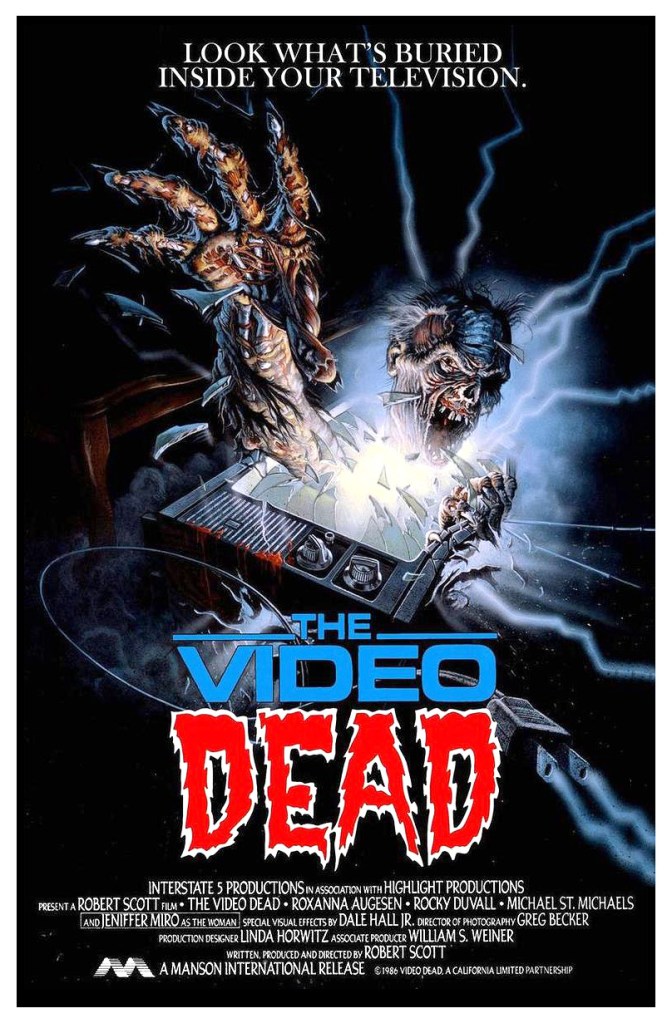
Among the most fondly regarded DTV shockers of the 1980s, I’d dare say much of THE VIDEO DEAD’s (1987) legacy stems from its stunning cover art. A cursory glance at IMDb and Reddit reveals a multitude of folk lured in by it back in the day. And who wouldn’t be? Released on tape stateside by Embassy Home Entertainment on 21st October 1987, the art is an eye-catching all-timer – and us Brits were given twice the pleasure when the mighty Medusa issued their U.K. rental cassette with a gorgeous double sleeve featuring an equally striking alternative visual [1].
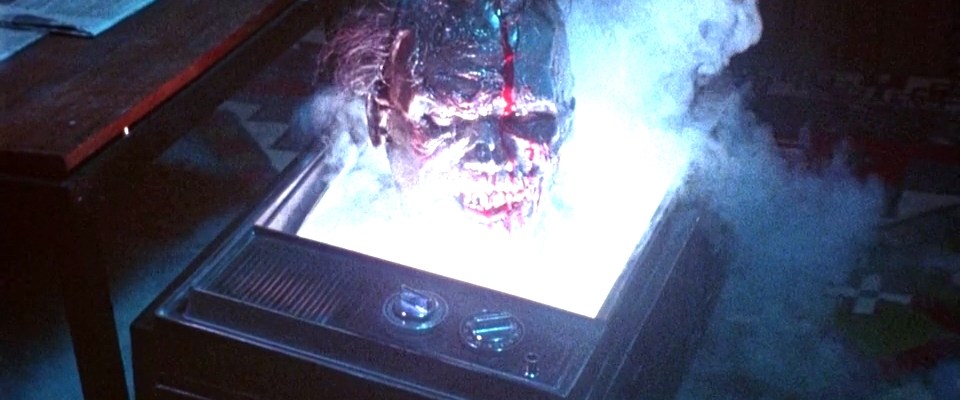
Suitably, the actual film’s weird imagery is its strongest attribute. According to producer/writer/director Robert Scott in the audio commentary included on Scream Factory’s 2013 Blu-ray, his goal was to conjure horror from the ordinary. Criticisms of The Video Dead’s sedentary aesthetic miss the point. Today a TV production manager with episodes of 13 Reasons Why, The Rookie, and Rescue: HI-Surf to his credit, Scott wanted the film to sport the bland sheen of a commercial in order to accentuate the fruitier flights of fancy. By and large he succeeds. The horror moments look extraordinary. Though The Video Dead peaks early, when, six minutes in, we’re presented with the incredible cover shot – a rotting zombie rising from an upturned television, its hideous visage bathed in dry ice and an eerie glow – the rest is carried by Scott contrasting his titular ghouls with purposefully mundane photography. Better yet is that the film oozes atmosphere. There’s a strange and unsettling vibe to The Video Dead. It’s uncanny valley horror; it seems to unfold in a bizarre dream realm, in a flat, stale world at once familiar yet terrifyingly alien. Even before the zombies show up – before they invade our reality via a haunted TV set, per the footing of the plot – everything is slightly off; everything is heightened.
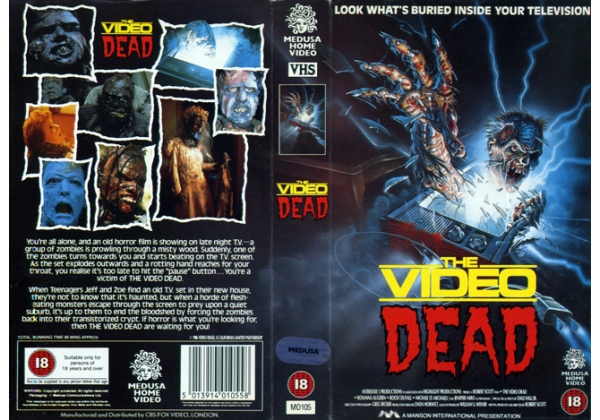
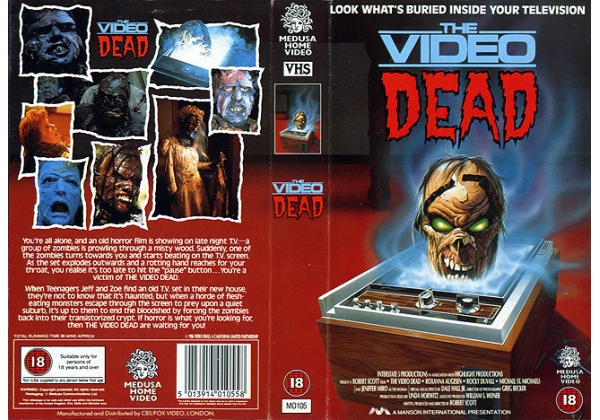
Dem tasty, tasty U.K. covers yo.
The cracks in The Video Dead’s script can be explained by dream logic. Conventionally speaking, there’s bad dialogue and an irksome dip in momentum during the third act. However, these flaws bolster the film’s oneiric, stream-of-consciousness rhythm. In addition to this, The Video Dead’s ‘rules’ – that zombies hate mirrors, that they feed on fear, and that they go crazy and cannibalise themselves when they’re trapped in tight spaces – exude a dizzying peculiarity. Their novel and feverish conceptual quality is augmented by their poker-faced delivery which, in turn, lends the humour throughout the film a uniquely uncomfortable edge. The bursts of obvious slapstick aside, it’s easy to see why a lot of The Video Dead’s offbeat comedy is missed by more casually-minded viewers.
As Scott says in the aforementioned commentary, The Video Dead’s story is supposedly based on real-life events. An outrageous claim. I mean, to the best of my knowledge, a gaggle of flesh-hungry shufflers have never supernaturally escaped the confines of a B-movie and caused havoc in the woodland. Curiously, Scott refuses to elaborate. He simply states we can find more information at “The Video Dead dot com”. The site is long gone but the domain used to house a shoddy and ugly selection of text-heavy pages designed to add further layer of meta-referential tomfoolery to the film:
“The Video Dead is known to many people as a 1987 direct-to-VHS, low-budget movie,” read the site’s opening spiel. “It’s about a possessed TV that only plays one thing: an old black and white zombie movie called “Zombie Blood Nightmare”. In the middle of the night, the TV comes to life, releasing zombies into the real world where they’re bent on gory mayhem.”
“Called genius by some and terrible by others… [An] undisputed fact remains: “The Video Dead” was based on a true story. The TV is real. IT HAS NEVER BEEN RECOVERED AND DESTROYED. THERE MAY BE UP TO 113 ADDITIONAL PARANORMAL INFECTED TV SETS IN EXISTENCE.If you own a TV set similiar [sic] to the one in the movie, you are strongly urged to check if it was manufactured by TeleNovaStar, S.A. and has serial number ITL-1965-MIL-2T-0028739 through ITL-1965-MIL-2T-0028852.”
Conceived in the late ‘00s, a good few years prior to The Video Dead’s Blu-ray, when MGM were sat on the rights and the only available DVD versions were bootlegs, the site also made mention of several supposed tragedies (“The Massacre in Massapequa” and the “Travellers Inn Haunting”) connected to the malevolent sets and provided a brief overview of their bogus manufacturer, TeleNovaStar. While extremely unsophisticated (to be clear, it was more akin to a naff LiveJournal account than snazzy viral marketing), the site certainly bolstered The Video Dead’s mystique – well, for those aware of it. A Facebook fan page existed too. As a bit of extra storytelling the site and the page paired nicely with the extended universe teased by the film’s wackiest scene: a sequence where a character named The Garbage Man (Cliff Watts) appears, suggesting that our world and the world of the film within the film are just the tip of the iceberg, and that a million different timelines, permutations and, indeed, films exist.
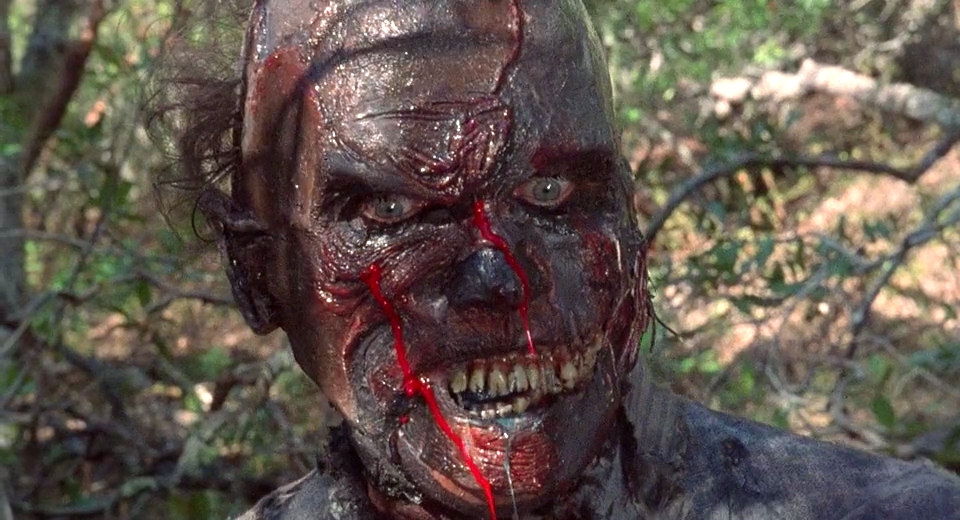
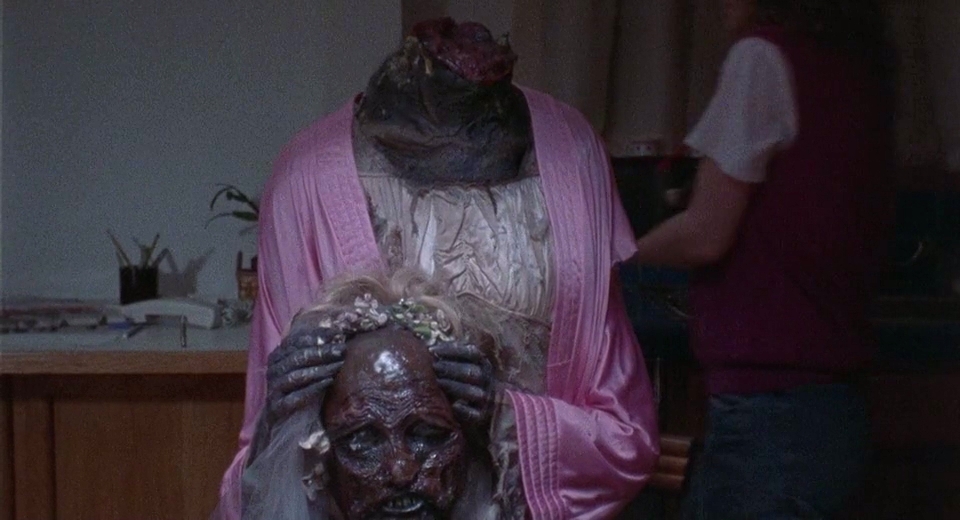
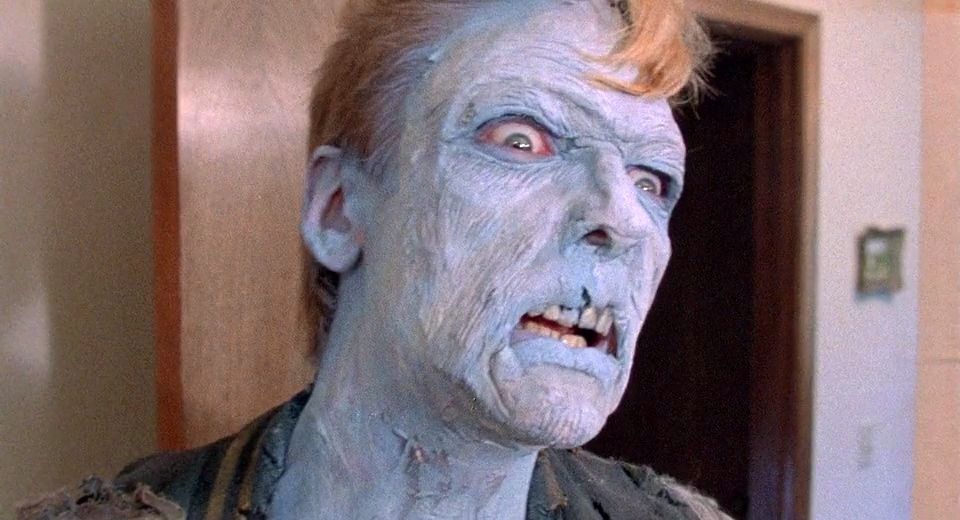
For me, the appeal of The Video Dead is its savvy. Scott is evidently a horror fan. He cites the leafy, autumnal unease fostered by John Carpenter’s Halloween (1978) as a major inspiration and the whole film harbours an awareness of genre history; an awareness that somehow straddles both celebrating the past and prefiguring what would come. George A. Romero’s Night of the Living Dead (1968) clearly informs ‘Zombie Blood Nightmare”, and the amazing make-ups of the eponymous brain-munchers exhibit a Fulci-esque elan. Contrary to their collective name, the fiends have bugger all to do with VHS. In any case, their individual personalities and gimmicks – they’re Christened ‘The Bride’, ‘Ironhead’, ‘Jimmy D’ and ‘Half-Creeper’ and are depicted accordingly – call to mind the monsters in another kooky, comic book-style zombie romp of the same period, Neon Maniacs (1986) (which, incidentally, was likewise partially shot in San Francisco). Elsewhere, their screen-bending shenanigans position The Video Dead in line with the other cathode ray creepers of its decade: Poltergeist (1982), Videodrome (1983), Demons (1985), Demons 2 (1986), TerrorVision (1986), and fellow cheapies Night Vision (1989) and Video Violence 1 & 2 (1987 & 1988). Combined, the films poke and ponder how home media impacts our lives to varying degrees. Despite The Video Dead sitting at the slighter end of the thematic scale, Scott’s musings on isolation, boredom, the latchkey generation, and mindless content consumption intriguing but hollow, the film is charismatic, chilly and memorable.
And that art.
Oh that art…
[1] That said, the film did bag two theatrical dates ahead of its VHS bow, unspooling at The Strand in San Francisco on 15th and 16th October 1987. As an aside, Embassy unleashed The Video Dead the same day they released Slumber Party Massacre II (1987).
 The Schlock Pit
One of my guilty pleasures from childhood. The Australian VHS for this had an awesome holographic cover.
LikeLike
Holographic! That sounds awesome. Do you still have a copy?!
LikeLike
Never owned it myself unfortunately. Remember it vividly from the video store shelf though.
Not sure if this will work, but a static picture of the front cover can be found at this link https://www.google.com/imgres?imgurl=https://lookaside.fbsbx.com/lookaside/crawler/media/?media_id%3D1435625521542346&tbnid=XRmvBKybkEjPzM&vet=1&imgrefurl=https://www.facebook.com/RetroHorror/&docid=soQ1h4ysHB8WsM&w=1224&h=1632&hl=en-au&source=sh/x/im/m5/3&kgs=dc3a444a91841fa5&shem=epsdc,rimspwouoe&utm_source=epsdc,rimspwouoe,sh/x/im/m5/3
LikeLike