

Matty gets weird with Albert Pyun’s kooky sci-fi chamber piece.
A heavily stylised, avant-garde quickie about impending Armageddon and an alien sex fiend trying to get his end away isn’t the typical basis for a laugh riot. DECEIT (1990), however, isn’t your run-of-the-mill comedy — and nor is writer/director Albert Pyun your usual filmmaker.
Hard to describe as truly funny, the humour Pyun mines — which, per the parameters of his minimal cast, near single location framework, is almost totally dialogue driven — is rough in terms of content. It’s designed to provoke and eke uneasy chuckles, and it circles around shock for shock’s sake. That said, Deceit’s deliberately stagey presentation is intoxicating if you’re in the right mood, and Pyun’s mischievous theatre kid posturing — all brash and antagonistic — is as snotty as you’d expect from someone powered by spite.
The clues to Deceit’s venomous genesis are nestled in its opening and closing credits. The former features a title card that says crucial plot information is coming up, only for the damned thing to go by so fast in relation to the amount of text scrawled across it that it’s borderline unreadable. The latter, meanwhile, wryly lists Jean-Claude Van Damme among its thanks.
Delicious fuck yous.
As Pyun recounted years later, amidst his 2008 to 2010 period as a spiller of B-movie secrets on Facebook, Deceit was assembled during the post production of Cyborg (1989). Confused by Pyun’s weirdo first cut, Cyborg’s producers, iconic ‘80s outfit Cannon, ordered reshoots and gave star Van Damme carte blanche to recut the picture, to render it a more conventional and cohesive narrative experience. Incensed but contractually handcuffed, Pyun reluctantly agreed and cushioned the blow by hatching a plan to use Cannon’s time n’ dime to fashion one from the heart in order to realign his creative chakras and flick the Vs at a shingle he’d worked tirelessly for with little reciprocation (on Dangerously Close (1986), Down Twisted (1987), Alien From L.A. (1988), and various patch-up jobs and false starts including Journey to the Center of the Earth (1988), Cannon’s legendary attempt to adapt Spiderman, and the project that birthed Cyborg, an aborted sequel to Masters of the Universe (1987)).
Written to fit a couple of locations picked for the Cyborg reshoots, Deceit was shot on the sly over a long three day weekend sneakily tacked to the schedule, on equipment and stock paid for by Cannon. In a final twist, when Deceit was finished, it wound up acquired by the 21st Century Film Corporation: the company ex-Cannon bigwig Menahem Golan was gifted as part of his severance package from the studio, meaning that the Israeli firebrand essentially paid again for a film he’d already unwittingly part bankrolled. [1]
Check. Mate.
Inspired, Pyun repeated the process twice in the ensuing decade, re-energising his mojo — and lining his pockets — with Bloodmatch (1991) and Nemesis 4: Death Angel (1996): two equally edgy and experimental cheapies mounted to piggyback on the tumultuous productions of Kickboxer 2: The Road Back (1991) and Adrenalin: Fear the Rush (1996) respectively, and sold for great profit to HBO and Imperial. [2]
Unfolding like a half remembered dream, Deceit’s most appealing attribute is the way in which Pyun flits between minimalistic footing and surreal and convoluted flights of pomp and fancy. Though brusqueness is a key component to the script’s (occasionally tin-eared) patter — an ironic joke at the expense of the film’s eponymous central idea — Pyun infuses Deceit with a hazy, elliptic quality where details somehow feel at once overdone and finely sketched. A curious blend of vagary, vulgarity, suggestion, and dramatic bludgeon; a film completely lacking subtlety but simultaneously so delicate and open to interpretation that even Pyun himself had a hard time extrapolating any kind of specific message or statement — if, indeed, there are any at all.
Still, despite the actual thrust of the ‘plot’ — Pyun regulars Norbert Weisser and Scott Paulin [3] attempting to hump Samantha Phillips, the fate of the world apparently depending on it — becoming a little wearying, and the whole ‘I’m alien/LOL not really’ shtick never quite balancing, watching Deceit with modern eyes does reveal surprisingly weighty themes of gaslighting and toxic masculinity. As noted, whether there was intent to such concepts is up for debate. But within a body of work bursting with strong females (see: Dollman (1990), Knights (1993), Brain Smasher… A Love Story (1993), Spitfire (1995), Ravenhawk (1996), Adrenalin, Left For Dead (2007), Bulletface (2010), and the Nemesis sequels), Jordache jeans model Phillips’ feisty, existentially frustrated Eve might be the toughest of the lot.
An extraordinary performance in an extraordinary Marmite movie.
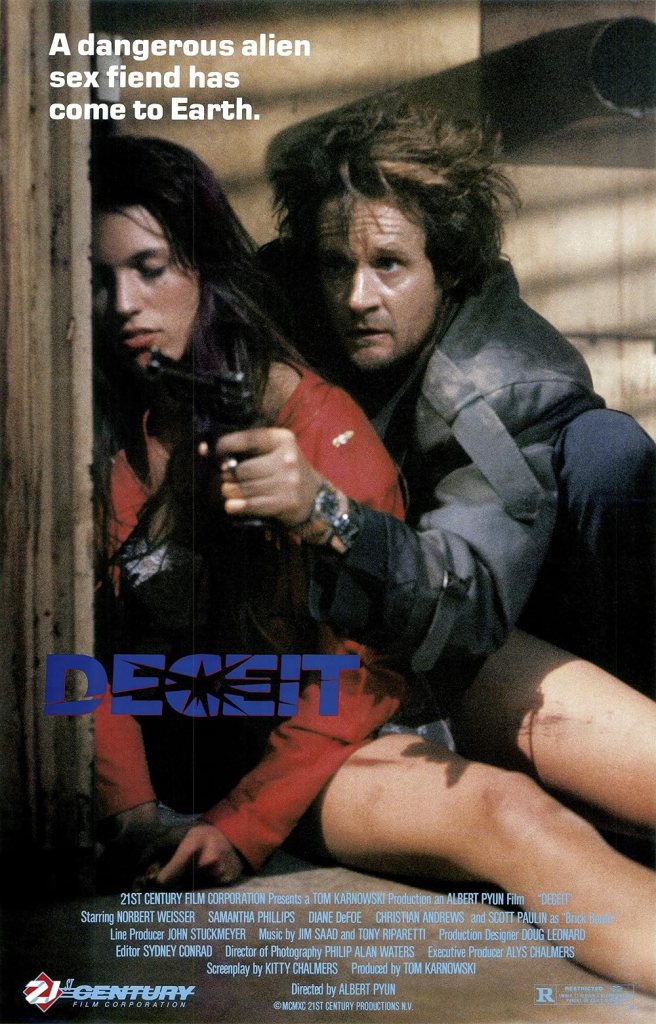
[1] Unreleased here in the U.K., Deceit surfaced on U.S. cassette in August 1993 via 21st Century’s distribution deal with Columbia-TriStar.
[2] An additional wrinkle: Bloodmatch was also co-produced by the 21st Century Film Corporation.
[3] Deceit marks Paulin’s first Pyun flick and is one of three teamings where the actor sports the auteur’s oft-used Brick Bardo moniker, the others the similarly kooky — if, sadly, wholly shoddier — Infection (2005) and Road to Hell (2008). Incidentally, Weisser’s character, Bailey, is identified by another frequent Pyunism, Farnsworth.
 The Schlock Pit
Have a look at this: https://www.bbfc.co.uk/release/deceit-q29sbgvjdglvbjpwwc0yotm3mdq
LikeLike
Thank you, Ryan. However, since you’re such a stickler for detail, you might want to know that, despite it being classified, Castle never actually released the tape due to their deal with Golan coming to an end (lest we forget the outfit released a few other 21st Century titles: Phantom of the Opera, House of Usher, Masque of the Red Death…).
Now, in regards to you constantly blasting over here and seemingly doing this whole weird ‘gotcha!’ type thing, let me be clear:
Stop acting like Comic Book Guy in The Simpsons.
If you’re genuinely trying to be helpful, fair enough; I can appreciate that, and applaud your devotion to the wonderful world of B-movies. However, the brusque, “I KNOW MORE THAN ANYONE” manner in which you swoop in just makes you come across as an obnoxious, socially inert arsehole. Your territorial attitude to what we write about is deranged. And though it’s hard to say without sounding arrogant (I assure you I have no ego whatsoever, especially about movies — an art form which is meant for everyone), if you think you can do a better job than Dave and I, please, sod off and start your own site.
LikeLike
Well fuck you too then.
LikeLike