
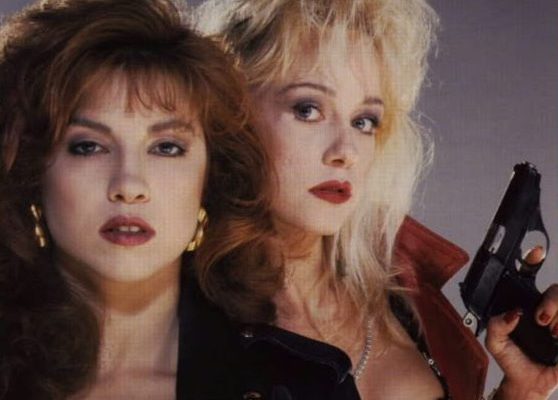
Hunks, trunks, blood n’ guts – Matty dissects David DeCoteau’s succulently splattery carve-’em-up.
On the surface, David DeCoteau’s MURDER WEAPON (1989) is no more than a tawdry, late-in-the-day slasher flick. The script – in which a mysterious psycho terrorises a house party – is rote and riddled with inane prattle. The film is also impoverished, and technically slipshod on occasion. Lensed for $50,000 across six days in February 1989 with two further days of shooting occurring a few months later, Murder Weapon sports a poor sound mix (mercifully, some might say) and the remastered widescreen copies of the movie that have surfaced – all sourced from Vinegar Syndrome’s 2016 HD spruce-up – reveal a plethora of gaffes. Lights are left in shot, stands poke into frame – and in the most egregious botch, a bearded crew member can be seen at the sixty-two minute mark, lurking at the edge of the scene, clutching a can of Diet Coke.
And yet Murder Weapon possesses a glorious seductive power; a bulging, throbbing compulsivity exemplified by its slithers of dramatic brilliance, potent T&A, and extreme violence. Moreover, a la DeCoteau’s similarly footed Dreamaniac (1986), the film works as another early example of director’s artistry virtually being fully formed from the outset.
Encouraged by the financial success of proto erotic thriller Deadly Embrace (1989), Murder Weapon was conceived as a sex-driven carve-’em-up wherein handsome, barely dressed men rather than beautiful, scantily clad women would be the victims. Like Dreamaniac, the film’s core elements have been recycled for many a DeCoteau joint since: studly fellas (DeCoteau’s Lady Avenger (1988) and American Rampage (1989) stars Rodger Burt and Mike Jacobs Jr., and Silent Night, Deadly Night Part 2 (1987) icon Eric Freeman among them [1]) under siege from a seemingly unstoppable threat in a single location, the bulk of the action unfolding over a truncated period. However, there’s a darkness to Murder Weapon. Its grittiness prefigures harder-edged DeCoteau fare – the human horrors of Prey of the Jaguar (1996) and Skeletons (1997), for instance – and it’s closest in theme and tone to the aforementioned Lady Avenger. As with the eponymous vigilante, leads Amy and Dawn (Karen Russell and DeCoteau mainstay Linnea Quigley [2]) are plagued with assorted traumas, the tragic and inevitable result of being exposed to their parents’ nefarious activities. Daughters of mobsters, they’re as haunted by violence as they are guilty of it; an idea that, when coupled with the film’s Beverly Hills setting, eerily mirrors the real-life Lyle and Erik Menendez murder case, which occurred six months after Murder Weapon wrapped.
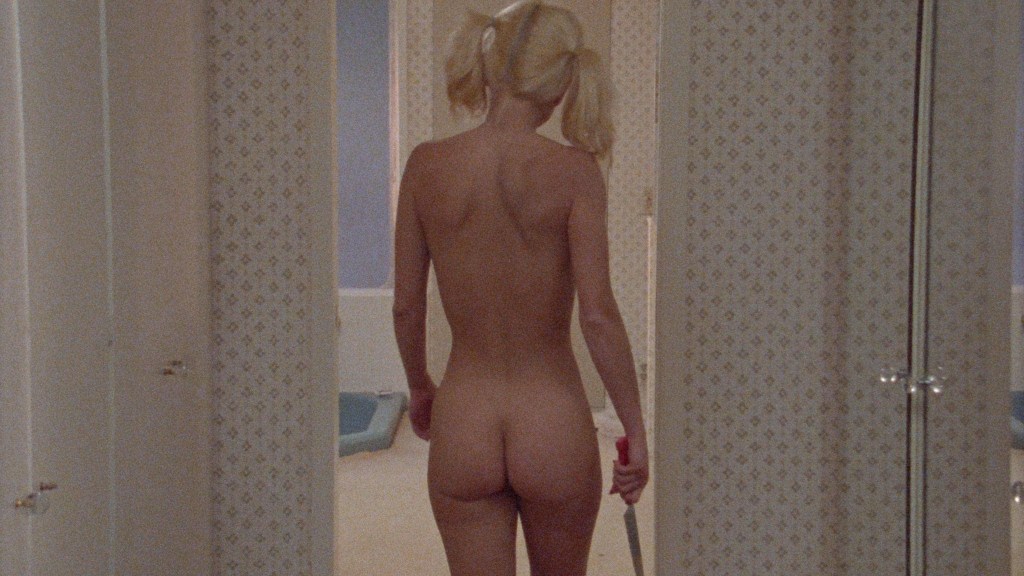
Done as part of the additional shooting when the film came up short in post, Murder Weapon’s attention-grabbing hot start – a floaty, wordless flashback, sex and death colliding as Dawn’s adolescence comes screeching to a halt – is essentially a dry run for DeCoteau’s moody and experimental masterpiece, Beastly Boyz (2006). And given how dreadful the rest of the dialogue is at the soirée Amy and Dawn throw to celebrate their releases from sanitariums, a pair of incredible scenes – whereupon the girls offload their anguish onto their therapists (‘80s/’90s DeCoteau bit-parter Lenny Rose and ‘star’ Lyle Waggoner) – pack a surprisingly weighty punch. To be clear, in terms of performance, Russell and Quigley are astounding and elevate the lamer aspects of the material.
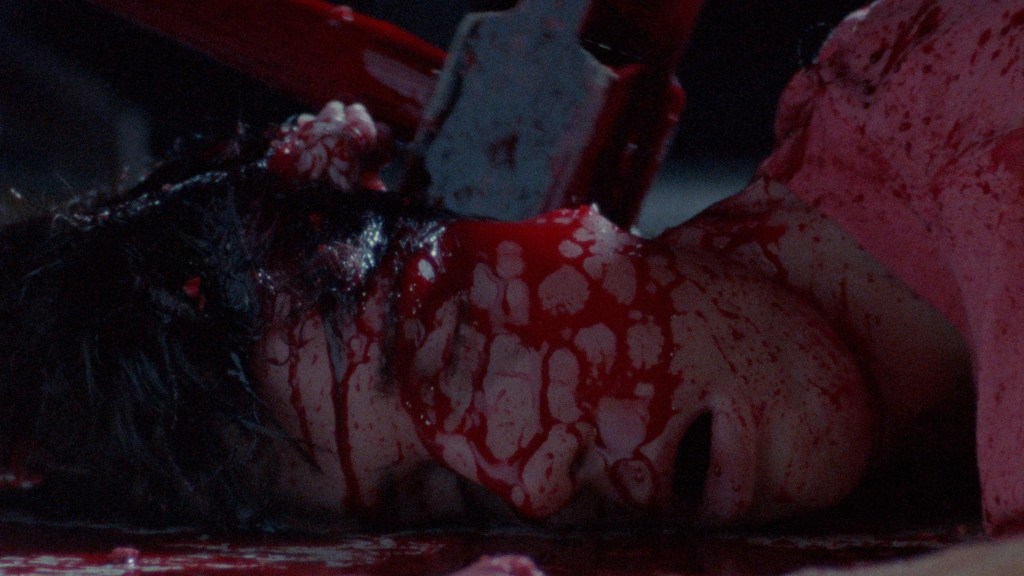
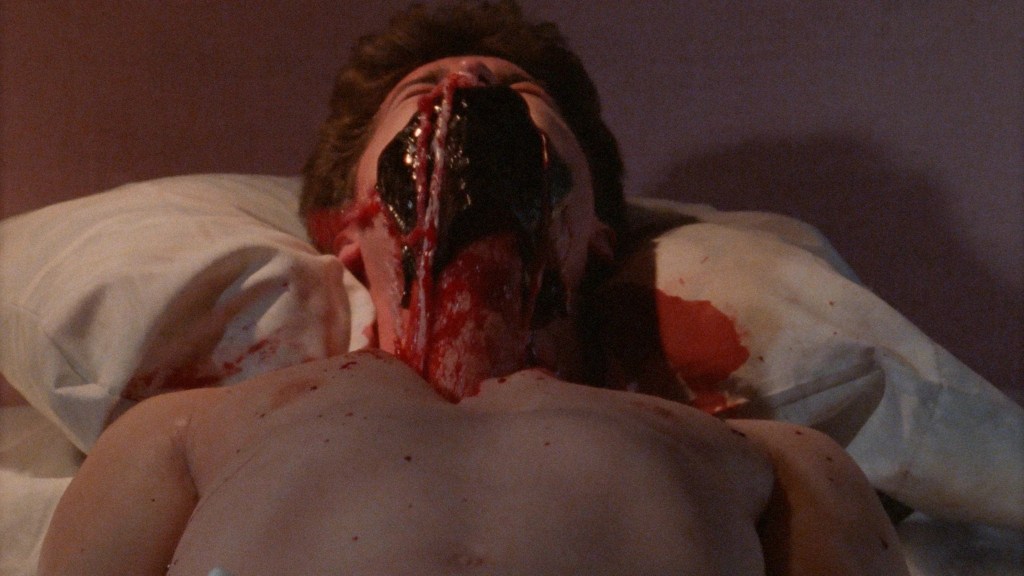
Murder Weapon contains flashes of DeCoteau’s naughty sense of humour. The sack-headed killer is decked out like a leather daddy, accentuating the homoeroticism and bringing the film in line with the mischievous, kinky imagery of Dr. Alien (1988) and Leeches! (2003), and the moment when Freeman and co. sit down to watch Brinke Stevens and Michelle Bauer frolicking in Nightmare Sisters (1988) exudes the same sort of self-reflexivity present throughout Sorority Babes in the Slimeball Bowl-O-Rama (1988) and the 1313 series and its offshoots (specifically the Quigley, Stevens and Bauer-topping 3 Scream Queens (2014)). Uneasy chuckles are conjured by the film’s yuck factor. Dreamaniac and Creepozoids (1987) are gory, and DeCoteau’s crowning horror achievement, Puppet Master III: Toulon’s Revenge (1991), isn’t without claret. Murder Weapon, though, is the most gratuitous and splattery film on his resume. David Barton’s effects are stunningly sick and nasty. A head is sledgehammered into mush. A black-gloved hand bursts through someone’s chest and force feeds them their still-beating heart. A glass bottle is smashed into a throat and accompanied by a fountain of bubbles. A bullet blasts into a face. And the killer’s unmasking – following an impressive full body burn stunt by the brilliant Bob Ivy (Sorority Babes, Lady Avenger) – is capped by suitably crispy-looking makeup. They’re deliberately outlandish, and their baulk-inducing ickiness is matched only by their purposefully absurd violation of physics and logic.
Having established Cinema Home Video as a production service company, largely for his and co-founder John Schouweiler’s partnership with Charles Band’s Empire International Pictures (Creepozoids, Sorority Babes), Murder Weapon was the shingle’s first production for their own video label (despite the ‘Gerardfilm Ltd’ citation). Incredibly, DeCoteau was able to hype the film when the Associated Press dropped by the Murder Weapon set. Journalist John Horn observed:
“Shots were hurriedly lighted and captured in only one or two takes, [but] DeCoteau’s genius rests on an aptitude to make really cheap films look only semi-cheap, delivering them on time and on budget.” [3]
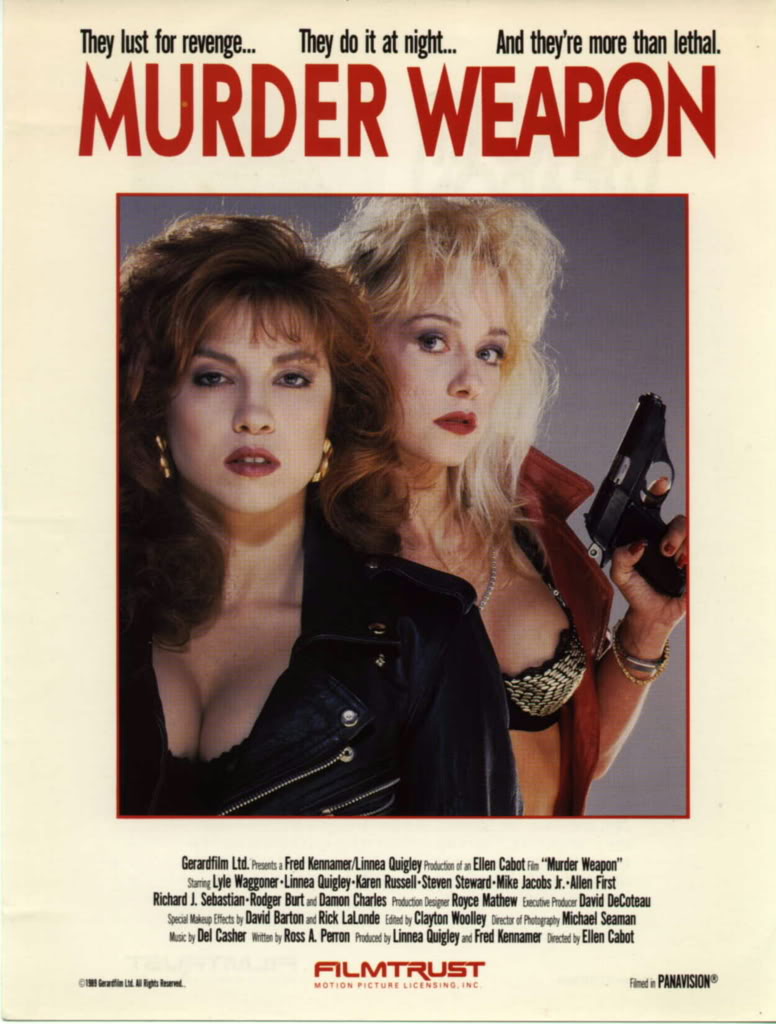
Credited to DeCoteau’s ‘Ellen Cabot’ pseudonym [4], Murder Weapon landed on U.S. cassette on 7th November 1989. Funnily, CHV’s marketing campaign — by sales agents/co-producers Filmtrust Motion Picture Licensing, who vetoed the project’s original title, ‘Beverly Hills Corpse’, in favour of Murder Weapon — pitched it as a kind of all-girl Lethal Weapon (1989), which, incidentally, was DeCoteau’s vision for American Rampage.
[1] Freeman is billed as ‘Damon Charles’. Freeman was in the Screen Actors’ Guild; Murder Weapon was a non-union production.
[2] Russell popped up in American Rampage and Dr. Alien, and reunited with DeCoteau and Quigley for The Girl I Want (1990). Quigley also co-produces Murder Weapon and The Girl I Want.
[3] Slashing Movie Costs by John Horn, The Associated Press, Waco-Tribune Herald, 18th February 1989.
[4] On the subject of pseudonyms, ‘Janice Breen’ is listed as ‘Cabot’s’ intern. Likely done to pad the end titles (a common practice to make low-budgeters seem bigger and thus more legit), one can assume ‘Janice’ is related to ‘Julian Breen’; the alias DeCoteau employs on Prehysteria! 3 (1995), Frankenstein Reborn (1998), and Alien Arsenal (1999).
 The Schlock Pit