

Matty charts the troubled making of an infamous Charles Band production, and tracks the impact it had on its key creatives.
The making of ASSAULT OF THE KILLER BIMBOS (1988) is legendary among fans of Empire Pictures, resulting in two movies and, in a roundabout way, the end of one company and the start of another. Nestled among it are the careers of David DeCoteau and Ted Nicolaou: a pair of Empire up-and-comers whose work on the film retrospectively seems to be what cemented their status as two of studio boss Charles Band’s most trusted collaborators.
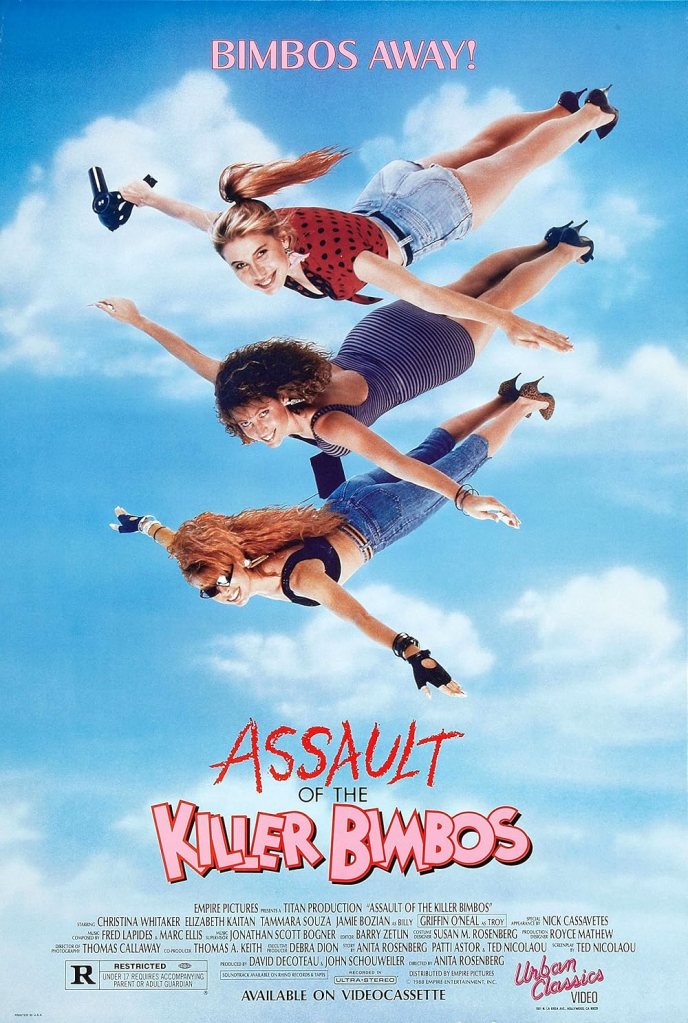
Shopped around the 1986 American Film Market and 1987 Cannes Film Festival as a pre-sale item, Assault of the Killer Bimbos’ outrageous title and teaser poster – as well as the titles and posters of the fellow programmers touted by Empire’s low(er) budget subdivision, Beyond Infinity: Creepozoids (1987), Psychos in Love (1987), and Slave Girls From Beyond Infinity (1987) – caught the eye of many a critic and journo. Assigned to Psychos in Love helmer Gorman Bechard, the original iteration of Assault of the Killer Bimbos centred on the following scenario, per the sales sheet:
“Five alien beauties descend upon earth and become media darlings as they castrate and murder every man they can get their hands on!”
The film was shot but, two weeks after wrapping, Bechard received a call from Band. Band hadn’t actually read Bechard’s Bimbos script. Now he had, the mogul decided he hated it and informed his furious director that he was going to shelve the project until further notice. Bechard and Band’s union was already on shaky ground due to Band faffing with Bechard’s previous flick, Galactic Gigolo (1987). Eventually, with a bit of rescripting, re-shooting, re-editing, and re-titling, Bechard’s Assault of the Killer Bimbos became Cemetery High (1988).
Never one to squander a good title – and, crucially, not wanting to lose the press momentum (the Bimbos moniker was constantly being mentioned in ‘coming soon’ columns and notices the U.S. over) – Band drafted in David DeCoteau. At the time, DeCoteau was ascending the Empire ranks. He’d entered the Band fold with Dreamaniac (1986) and had just wrapped Creepozoids when he was tasked with Assault of the Killer Bimbos, causing him to junk another Empire/Beyond Infinity caper he was developing, the unmade ‘Space Sluts in the Slammer’. In turn, DeCoteau commissioned Anita Rosenberg – hot off writing and producing Empire contemporary Atlantic Releasing’s Modern Girls (1986) – and her writing partner, Patti Astor, to script the film. Rosenberg, however, had other ideas, as DeCoteau detailed in Cinefantastique:
“Rosenberg told Empire, ‘Sure, I’ll sell you the script… For $100,000.’ I said, ‘What do you mean one-hundred grand? We only pay five grand per script!’ And then she said, ‘I’ll sell it to you for five if I can direct it’.” [1]
Needing an Assault of the Killer Bimbos yesterday, Empire bigwig Debra Dion – the then-Mrs. Charles Band – watched a short Rosenberg made and deemed it passable enough to allow her to take the reins. To date, Assault of the Killer Bimbos remains Rosenberg’s sole feature as director. DeCoteau was annoyed. Fearing he’d walk, Dion and Band tripled his fee to keep him as producer. They also recruited Ted Nicolaou to polish Rosenberg and Astor’s script, sinking Nicolaou’s prospective follow-up to TerrorVision (1986), survival comedy ‘I Eat Cannibals’, in the process.
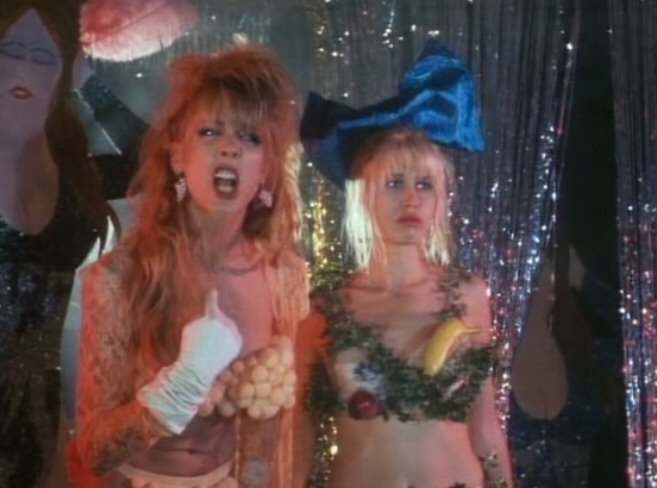
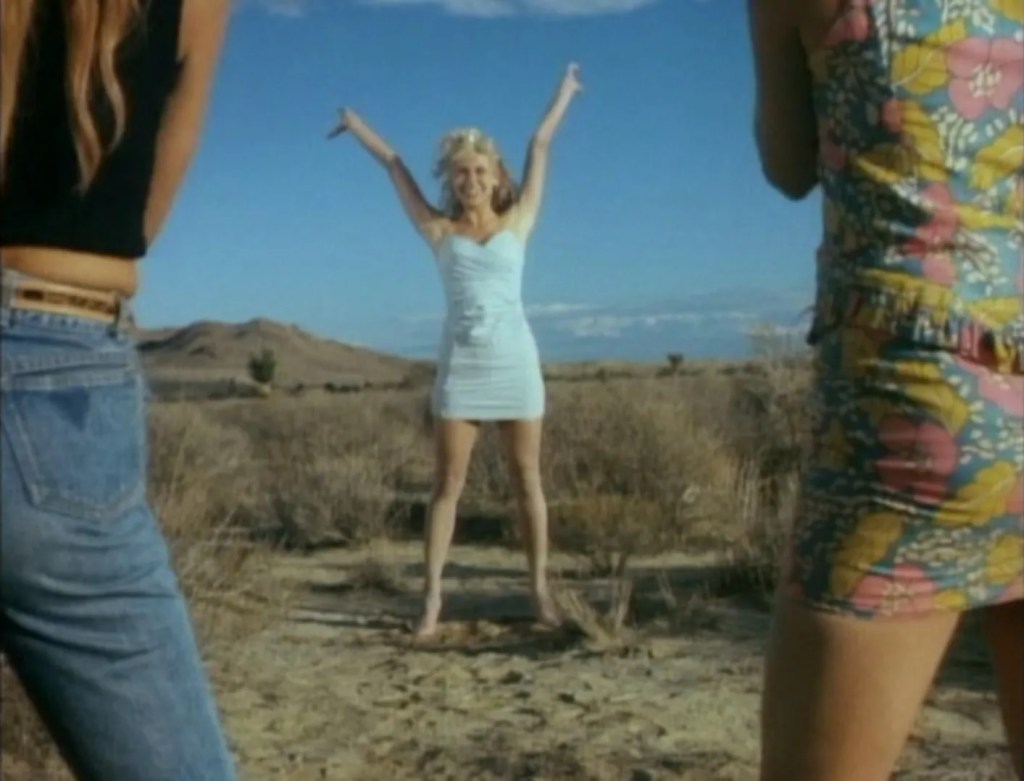
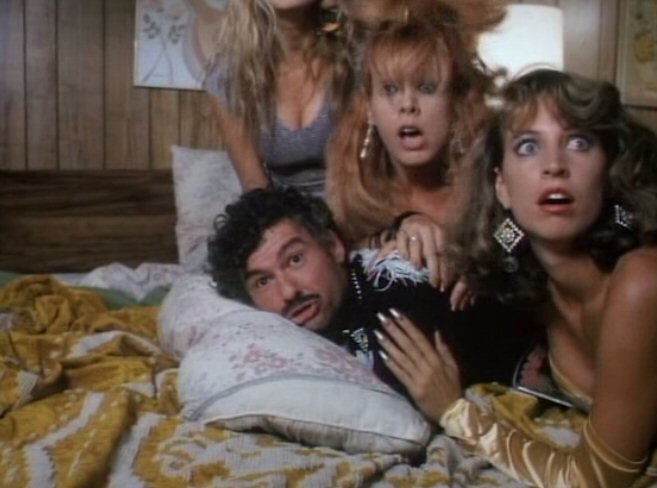
DeCoteau, Rosenberg, and Nicolaou’s Assault of the Killer Bimbos started shooting in mid-autumn ‘87, when Bechard’s original version was meant to hit video. According to Nicolaou, a few days into production, Band’s producer father, Albert, surveyed the dailies and ruled Rosenberg’s direction unacceptable. Thus, he wanted Nicolaou to step in. Nicolaou refused.
Nevertheless, Nicolaou’s fingerprints are all over the finished Assault of the Killer Bimbos. While far less gaudy in tone and delivery, the film possesses the same ‘manufactured cult’ vibe as TerrorVision: broad, cartoon-y characters; snappy, silly dialogue designed to be quoted (“Oh no, a bimbo with a gun!”); and a general air of kitschy abandon. It even shares TerrorVision’s lopsided approach to structure. Unlike TerrorVision, though, Bimbos never moves out of third gear. ‘Boring’ would be a stretch – but the film is certainly a leisurely amble, and a patience-tester.
The eponymous bimbos – go-go dancers Lulu (Elizabeth Kaitan, who’d go on to appear in DeCoteau romps Dr. Alien (1988), The Girl I Want (1990), and Petticoat Planet (1995)) and Peaches (Christina Whitaker), and their waitress charge Darlene (Tammara Souza, today an Emmy award-winning meteorologist) – are likable, and the message of female empowerment threaded into the story – in which the girls try to flee to Mexico, after being framed for a murder by a skeevy criminal (Mike Muscat) – largely succeeds. Despite Band, DeCoteau, and Nicolaou’s assertion that Rosenberg did a fine job with the film, her touch, for me at least, is listless. Assault of the Killer Bimbos is competent rather than anything noteworthy or exemplary. I agree with Albert Band.
“I hope everyone picks up on the fact the film was directed by a woman,” Rosenberg said in the pages of the San Francisco Examiner. “If it were by a man, it’d be a major exploitation picture; with me, it’s funny and cute.” [2]
Nicolaou was right to let Rosenberg finish Assault of the Killer Bimbos, and her mission to stop the whole thing descending into a lurid grindhouse exercise is commendable in a perverse, subversive sense. That said, one does wonder what Nicolaou or DeCoteau would have done with the material – particularly DeCoteau, what with his ‘girl power’ chops of the period extending to Lady Avenger (1988), Sorority Babes in the Slimeball Bowl-O-Rama (1988) (which, like Bimbos, was issued under Empire’s Urban Classics tag) and Nightmare Sisters (1988) (a number DeCoteau and Bimbos’ co-producer John Schouweiler self-funded and sold to Trans World Entertainment) [3].
Knee-jerkists will be aghast at the thought. Assault of the Killer Bimbos is a woman’s tale to tell – but so is Thelma & Louise (1991) on paper. Much has been made of the conceptual, thematic, and narrative overlap between Assault of the Killer Bimbos and Thelma & Louise in the decades since the era-defining latter’s release. Rosenberg herself was even invited onto an episode of Joe Bob’s Drive-In Theater on 29th August 1992 to talk about it [4]. Seldom discussed is how Thelma & Louise’s director, Ridley Scott, renders the film’s rousing feminist energy palatable to the average movie goer, delivering a movie that speaks as equally to men as it does to women, and fulfilling the non-negotiable entertainment factor. Assault of the Killer Bimbos isn’t a ranting polemic by any means; but Nicolaou and DeCoteau’s combined wares are packed with strong female characters as is, and their understanding of the B arena – their knowledge of the prerequisites key to cheap n’ cheerful genre fare – could have lent the film a bite befitting of its attention-grabbing appellation.
Nicolaou might have also stopped the excruciating Eddie Deezen cameoing.
DeCoteau reflected on his involvement with Assault of the Killer Bimbos in a sit-down with Femme Fatales in 2000, affirming his belief that Rosenberg was the right person:
“It was the first movie I didn’t have complete control over and I let my ego get in the way… I wanted to direct it and cast Linnea Quigley, Michelle Bauer, and Brinke Stevens as the leads. That was my original idea… I was suspicious of Anita’s abilities, and I didn’t approve of her on-set etiquette. I wanted complete control and she took advantage of the crew’s emotions, so they weren’t doing anything I requested. I do think she should have gone on to direct more. I look back now and think very highly of her talents. I think Assault of the Killer Bimbos is possibly the best film Empire made. It had a true vision; it was funny and it was clever.” [5]
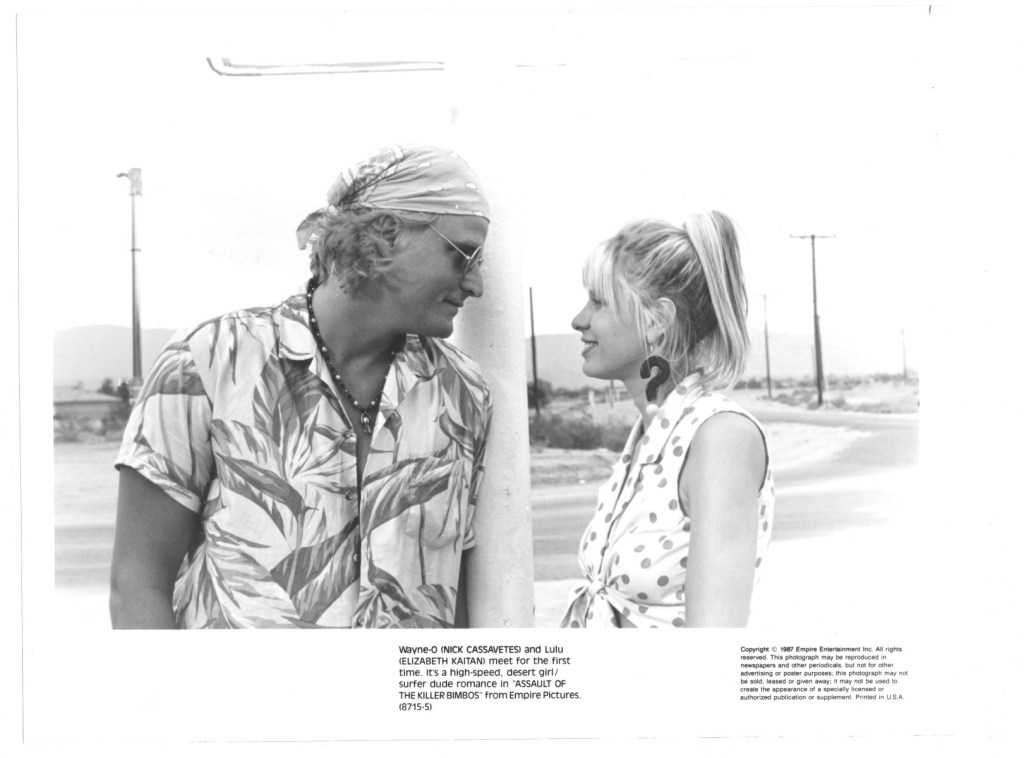
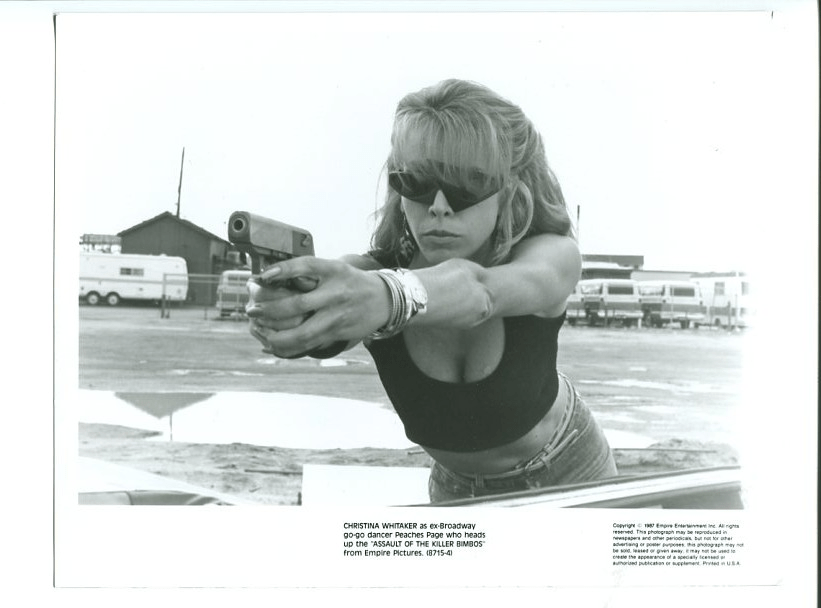
On 21st October 1987 – days into or days after Assault of the Killer Bimbos’ lensing depending on the source – Joe ‘The Phantom of the Movies’ Kane reported on Bechard’s Bimbos/Cemetery High switch. Two months later, on 20th December, news of Empire’s mounting financial woes broke in the Los Angeles Times.
As January ‘88 rolled around, Assault of the Killer Bimbos was still amassing inches in the press, alongside DeCoteau’s next Empire opus, Dr. Alien (then called ‘I Was a Teenage Sex Mutant’), and a grubby little comedy-thriller entitled ‘Hack ‘Em High’; another potential name for – yep – Bechard’s Cemetery High. Scheduled for a big screen run in April ‘88, Assault of the Killer Bimbos garnered more publicity when an advert was rejected by Playboy Magazine.
“We’re not in the business of exploiting women,” said Playboy’s Director of Advertising, Michael Carr. “We reject any ad that shows women as less than equal partners in life.” [6]
Finally, Assault of the Killer Bimbos landed in U.S. cinemas on 6th May 1988. It opened in California on screens in Sacramento, Santa Cruz, Roseville, San Pedro, San Bernardino, and Los Angeles. Surprisingly, Empire’s usually tight clutch on the purse strings slackened and the film was heavily promoted. Rosenberg and her stars made the rounds on The Late Show and TV spots unspooled on MTV. Despite failing to achieve the Ghoulies (1985), Re-Animator (1985) and Troll (1986) levels of box office Empire desired, Bimbos performed heartily, encouraging Band – who, admittedly, was thoroughly enamoured with Rosenberg’s confection – to give the go to the sequel jokingly teased in the film’s end credits, ‘Bimbo Barbeque’. Cheekily, Band sent the sequel’s script to Kathleen Turner and offered her a plum lead role, after the Academy Award nominee said she “wanted to play a bimbo” in a USA Today profile piece. Turner declined (obviously) and ‘Bimbo Barbeque’ failed to launch.
As far as Rosenberg was concerned, the sequel – her directing, Nicolaou scripting, DeCoteau conspicuous in his absence – was ready to roll in June ‘88 but fell victim to the 1988 Writer’s Guild strike.
The truth is that Empire crumbled.
The studio was taken over by international bank Crédit Lyonnais days after Assault of the Killer Bimbos trundled into cinemas.
It was the last film Empire released during Band’s tenure.
The company was acquired by Epic Productions – a newfangled offshoot of DeCoteau’s Nightmare Sisters distro, Trans World. When the takeover happened, DeCoteau was shooting Dr. Alien and heard from Band on set:
“The bank just shut down the entire company and seized everything. But they don’t know you’re shooting this, so just keep rolling and get it in the can before someone finds out!” [5]
Supposedly, DeCoteau was given Dr. Alien by way of an apology, for being nudged out of the director’s chair on Assault of the Killer Bimbos. When completed, Band used Dr. Alien and the two other films he managed to retain in Empire’s downfall – Intruder (1989) and Cannibal Women in the Avocado Jungle of Death (1989) – to ingratiate himself with Paramount, who bagged them for video. Ultimately, their success on tape coaxed the major into bankrolling Band’s next endeavour, Full Moon Entertainment. And as Full Moon grew, DeCoteau and Nicolaou were summarily brought on board as contracted talent. They’ve crafted more films a piece for Band than anyone else in the impresario’s Rolodex.
Of note are the typical circumstances of their employment.
They’re generally similar to the circumstances of Assault of the Killer Bimbos:
DeCoteau was often hired for his ruthless efficiency and deft ability to belt out content in trying scenarios (he effectively kept Full Moon afloat single-handedly in the late ‘90s — cf. Shrieker (1998), Curse of the Puppet Master (1998), Talisman (1998), The Killer Eye (1999)). And Nicolaou was often hired to kickstart languishing or floundering productions (Subspecies (1991), Bad Channels (1992), Ragdoll (1999)).
[1] The Rise and Fall of the Video Empire by Bill George, Cinefantastique Vol. 19, No. 3, March 1989.
[2] Bimbos, San Francisco Examiner, 6th May 1988.
[3] Lady Avenger shot August ‘87, and Sorority Babes and Nightmare Sisters shot September ‘87. A busy late summer/autumn!
[4] Another fun connective titbit: Nicolaou favourite Sonny Carl Davis (TerrorVision, Bad Channels) appears in Thelma & Louise.
[5] David DeCoteau: Rapid Heart’s Low Budget Auteur by Jason Paul Collum, Femme Fatales, Vol. 9, No. 7, November 2000.
[6] Outtakes, Los Angeles Times, 3rd April 1988.
 The Schlock Pit