

Matty dissects Charles Band’s 3D monster movie. It stars Demi Moore, don’t cha know.
B-movie titan Charles Band’s fourth stab at wielding the megaphone following Last Foxtrot in Burbank (1973), Crash! (1977), and The Alchemist (1983), PARASITE was conceived on the set of the latter but released in theatres before it, on either side of the Atlantic [1]. The film started its profitable U.K. and U.S. cinema run in spring 1982; eighteen months and three years ahead of The Alchemist, respectively.
Among Band’s better-known pre-Empire/Full Moon titles (think a step below Tourist Trap (1979), a step above Laserblast (1978)), Parasite’s credentials rest upon two pieces of oft-cited trivia. For British fans, Parasite is bolstered by its inclusion on the Section 3 video nasty list. For everyone else, it’s destined to appear on ‘before they were famous’ countdowns forevermore thanks to featuring a young Demi Moore. Of further note are the film’s special effects, which come courtesy of another up and coming talent: Band’s Mansion of the Doom (1976) collaborator, Stan Winston [2].
Fresh from an Academy Award nomination for his work on Allan Arkush’s Andy Kaufman vehicle Heartbeeps (1981), Winston supposedly passed on E.T.: The Extra-Terrestrial (1982) in favour of Parasite, wooed by Band’s promise of being able to direct the film’s second unit. While everything turned out O.K. in the end for the late, great FX maestro, Parasite seems a baffling career choice in retrospect. Though the grey/blue zombie-ish make-ups applied to the titular creature’s victims are suitably quease-inducing, and a brilliantly yuck-o head-splitting gag — executed on a dummy of Guys & Dolls (1955) star Vivian Blaine, no less — lends the film a pleasing squelchiness, the parasite itself — a toothy, phallic-looking fish-thing — is a poorly rendered chunk of rubbish. It lacks threat, menace, and any sort of attention-holding or imagination-firing physical presence; deficiencies unbecoming of any cinematic monster, let alone an eponymous one.
The problems with Parasite’s beastie(s) encapsulate the film:
It’s conceptually interesting but sloppily done.
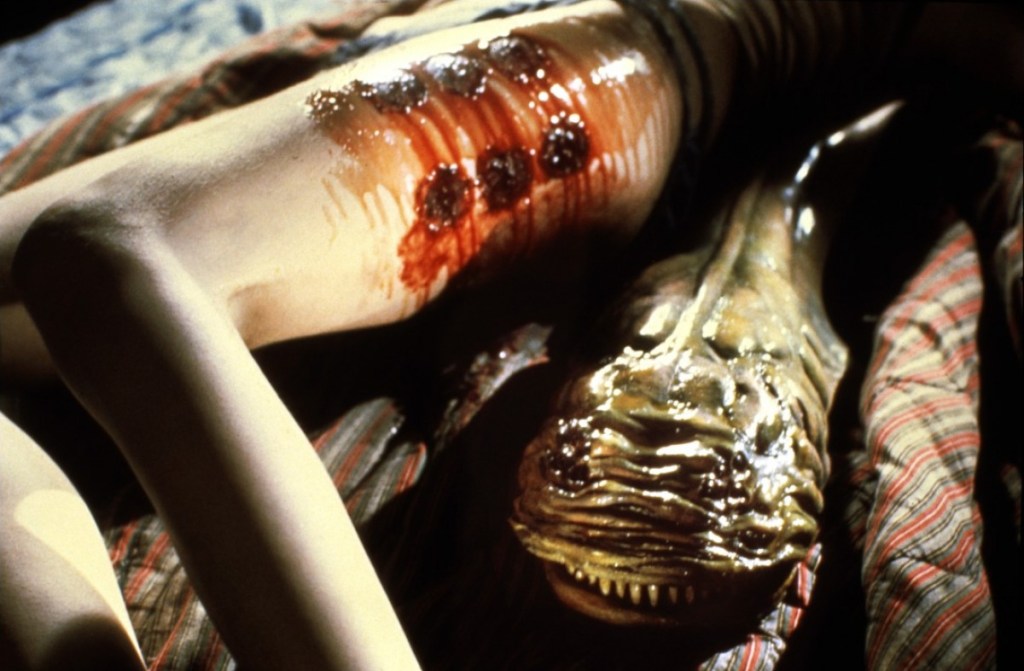

The plot — in which an infected, parasite-addled scientist (Robert Glaudini) and Moore’s teenage lemon farmer (!) stave off punks (Runaways singer Cherie Currie and Band’s Ghoulies (1985) helmer, Luca Bercovici, among them) and a sinister, Lamborghini driving G-Man (James Davidson) against a future-shock backdrop — offers an intriguing mix of Alien (1979), Star Wars (1977), The Warriors (1979) and A Fistful of Dollars (1964), and the script features plenty of neat ideas and touches. Alas, a la The Alchemist (which was also penned by co-scribe Alan J. Adler), Parasite is a glum and messy affair missing the focus, humour and heart indicative of Band’s finest directorial assignments (i.e. Trancers (1984), Head of the Family (1996), Blood Dolls (1999)).
Part of the early ‘80s 3D resurgence instigated by Comin’ at Ya! (1981), Parasite’s use of the extra dimension is mostly gimmicky. Like Band and Adler’s next pairing, the equally ‘meh’ Metalstorm: The Destruction of Jared-Syn (1983), Parasite’s 3D is more a case of random objects being flung at the camera for cheap thrills rather than any sustained attempts to create an immersive visual experience. A shame. Parasite’s strongest attributes are its ruinous, comic book production design; its potent realisation of a grubby, lived-in world – a post-apocalyptic western frontier town – fizzing with violence and danger; and several strikingly photographed moments that evoke authentic feelings of decay and hopelessness amidst the cheesier, in-yer-face silliness.
Despite the once teased ‘Parasite II’ failing to launch, Band returned to Parasite’s bleak, dystopian milieu nearly a decade later via the similarly minded — and equally middling — Robot Jox (1989) fake-quel, Crash and Burn (1990).

[1] The project began life as a quickie remake of William Castle’s The Tingler (1959).
[2] Additional titbits: lensed by Mac Ahlberg, Parasite marks the start of a harmonious, quarter-of-a-century collaboration between the genius cinematographer and Band. It’s also the film that brought Peter Manoogian (Eliminators (1986), Enemy Territory (1987), Demonic Toys (1992)) into the Band fold. Here he serves as an assistant director. Lastly, as detailed in his breezy 2021 memoir, Confessions of a Puppet Master, Band and Moore purportedly knocked boots during Parasite’s shooting, making Moore’s claim that it’s the worst film she’s ever done somewhat more eyebrow raising.
 The Schlock Pit