
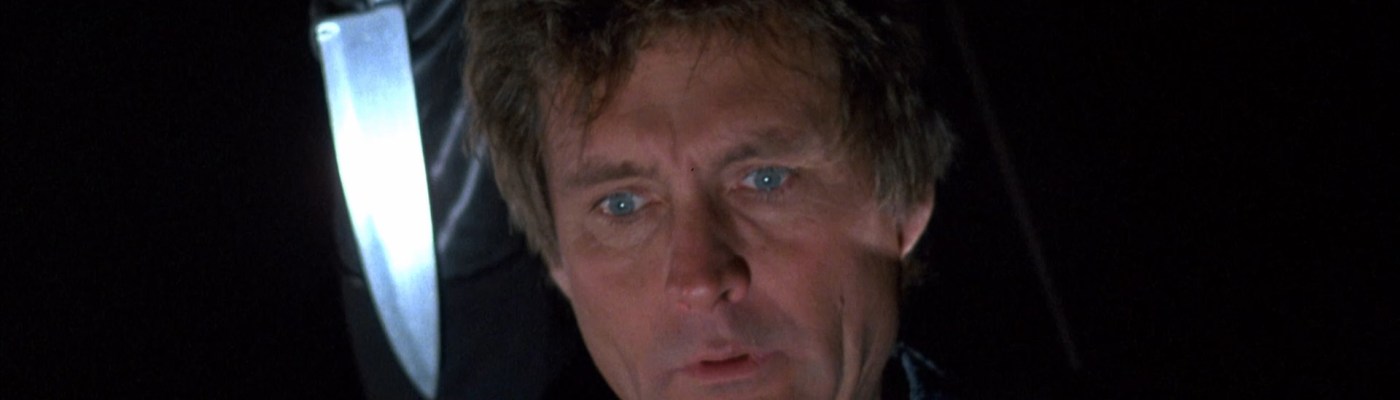
Matty looks back at Gary Graver’s much-maligned sea slasher and maps out a making that was far from plain sailing…
Among the biggest financial successes of Gary Graver’s legitimate (read: ‘non-porn’) directorial career, MOON IN SCORPIO (1987) did incredibly well according to the helmer, earning its backers, Trans World Entertainment, $1.5million in U.S. video sales alone. Co-producer Fred Olen Ray, meanwhile, prefers the plural and says “millions”, crediting the drawing power to its eye-catching poster [1].
But as Britt Ekland ponders in the film’s asylum opening:
“Moon in Scorpio… What does it mean?”
Once the name of an unrelated and aborted Canadian movie set to star Christopher Lee and Eli Wallach circa 1979, Moon in Scorpio’s charismatic title is an all-timer if you’re asking me, ranking alongside Larry Cohen’s God Told Me To (1976) and David Lynch’s Twin Peaks: Fire Walk With Me (1992) in terms of evocation and musicality. Repeated throughout the film’s duration, I’ve always interpreted the refrain in a Texas Chain Saw Massacre (1974) kind of way. Chain Saw’s line, “Saturn in retrograde” (or words to that effect), and the seemingly endless chanting of Moon in Scorpio — the result of Ray trying to rationalise the moniker — are presented in similar fashions, as if they’re omens or explanations for the craziness that drives the pictures they’re attached to.
It fits.
In astrology, Scorpio is a water sign and relates to the dimensions of life. However, those born under or influenced by a Scorpio Moon supposedly exhibit an affinity for disturbing behaviour. They revel in dark subjects and favour looking into matters with a deeper desire for meaning. Largely set on a boat, Graver’s fright flick — an attention-holding, giallo-esque carve-‘em-up spiked with a wealth of wonderfully weird flourishes — features a lot of water; anchors its most potent jolts in the emotional and psychological; and counters the narrative confusion caused by its garbled genesis with a hearty streak of soulful introspection. And for all its flaws, an appropriately deeper reading of Moon in Scorpio reveals it to be an essential Graver auteur text.
It teems with his trademarks:
Atonal pacing.
A clipped, scrapbook-y, shoot-shoot-shoot style.
Bursts of surreal, ‘are we meant to laugh?’ humour.
The film’s most alluring attribute, though, is how it reflects every facet of Graver as a filmmaker.
On one hand, Moon in Scorpio feels incredibly personal. On the other, the finished article is a shameless mercenary assignment; the doing of a professional acutely aware that, for the vast majority of talent — especially those in the blue collar ‘B’ arena — art is second to commerce.
Graver himself stated his involvement was due to Robert Aiken’s original script [2]. He summarised it as a strange and dark work that appealed to him for various reasons. Despite the specifics of Graver’s claim remaining a mystery, a solid hypothesis would be the story’s footing bearing a passing resemblance to Charles Williams’ 1963 novel, Dead Calm, which, of course, Graver’s sensei, Orson Welles, tried to bring to the screen as The Deep (unfinished). Another would be its Vietnam War backdrop. The crux of the plot positions male leads John Phillip Law, William Smith and Lewis Van Bergen as holidaying veterans haunted by an atrocity they committed during a tour of duty. Graver experienced Vietnam, serving as — what else? — a combat cinematographer, but never discussed his experiences. Perhaps, then, the opportunity to exorcise his demons via the medium dearest to him was enough to keep him invested in the material when Trans World started throwing their weight around.
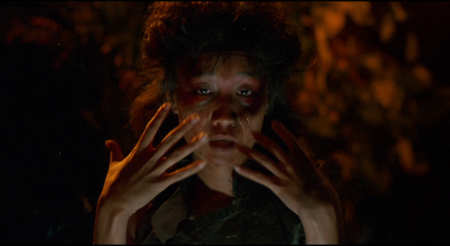
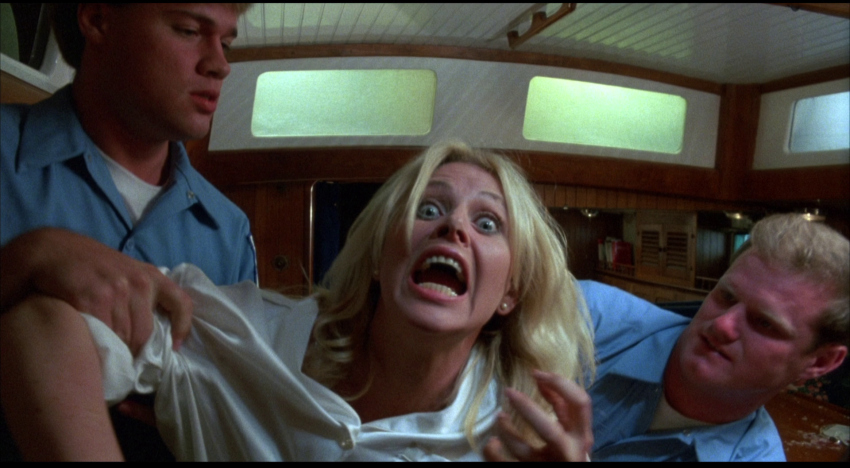
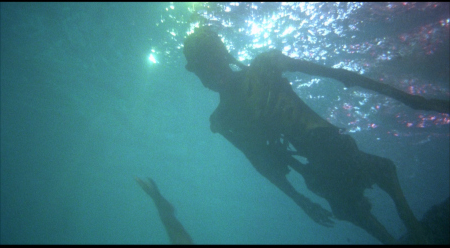
Described as “a European-type thriller” in the vein of Roman Polanski’s Knife in the Water (1962) upon its announcement in the trades, Moon in Scorpio began after Graver and Ray’s preceding Trans World opus, action romp Commando Squad (1987), came in under budget (by anything between $100,000 and $250,000 depending who you ask). Always on the grift — and, crucially, always hungry for his next picture — Graver told Trans World he could assemble a whole new movie for the surplus cash. Thus, the shingle greenlit Moon in Scorpio: a vaguely Lovecraftian tale concerning a snake goddess wreaking havoc on the high seas, in order to avenge the trashing of her temple by a trio of squaddies (a slight — slight — echo of Ray’s own CineTel/Trans World co-production, The Tomb (1986)).
Per Ray, the film’s producer, Alan Amiel, struggled with the premise. Wanting clarity, Amiel badgered Trans World’s boss, Moshe Diamant, into a meeting and pitched him the synopsis. Diamant poo-pooed it, and demanded Moon in Scorpio become a straight slasher instead (“No! You make Halloween (1978). Halloween on a boat,” goes the quote). Vexed, Graver rewrote the film to the mogul’s specifications and attempted to keep as many of Aiken’s ideas as possible. The rewritten script was shot, and Graver delivered his cut of the by-now already compromised picture.
Further strife followed.
Having left Los Angeles for a Welles-related speaking engagement, Graver fell victim to post-production politicking. Allegedly operating at the behest of the tinker-happy Amiel, editor Omar Tel informed Trans World brass that Moon in Scorpio contained only ten minutes of competent footage and that the film was a bust. Aghast, Diamant ordered more rewrites and three days of additional shooting, and tasked Ray with orchestrating them [4]. Given Graver’s blessing to noodle with the script, Ray came aboard and conceived the killer’s imaginative — if nonsensical — hook weapon; reconfigured the murder scenes; and bolstered the cast by plonking Robert Quarry, James Booth, and Don Scribner (replacing Blackie Dammett) into the mix.
At this point, Amiel wanted Ray to seize Moon in Scorpio and direct the reshoots; a plan he promptly kyboshed out of loyalty to Graver, who saw the project through to completion. Indeed, it speaks volumes about the connection Ray and Graver established that he’d do such a thing so early in their creative union.
The pair clearly struck a helluva friendship across their inaugural collaborations — the aforementioned Commando Squad; enterprising quickie The Phantom Empire (1988); and fellow Trans World epic, Deep Space (1988) [4] [5] — and it endured until Graver’s death in 2006.

[1] Moon in Scorpio was released straight-to-video on either side of the Atlantic. Stateside, the film was issued by Trans World on 14th October 1987; in Britain, it came courtesy of MGM/UA a year later.
[2] Aiken had written Sandra: The Making of a Woman (1970) and contributed to several other Graver offerings.
[3] As part of his payment, Ray was granted access to Moon in Scorpio’s camera equipment. The Moon in Scorpio reshoots took place Monday, Tuesday, and Wednesday. On the five and a half days either side of it — Friday evening, Saturday, Sunday, Thursday, and Friday — Ray used the equipment to shoot his signature piece, Hollywood Chainsaw Hookers (1988).
[4] Prior to Commando Squad, Ray courted Graver for Biohazard (1985) but couldn’t afford him.
[5] Incidentally, in the U.K., Commando Squad, The Phantom Empire, Deep Space, Moon in Scorpio, and Hollywood Chainsaw Hookers all landed on cassette within the same four month period, between September and December 1988. In order: September: The Phantom Empire; October: Moon in Scorpio; November: Deep Space; December: Commando Squad and Hollywood Chainsaw Hookers.
 The Schlock Pit
Thanks for sharing. Never heard of this before. I must go and look for it now👍. Kind regards…Jay😊
LikeLike