
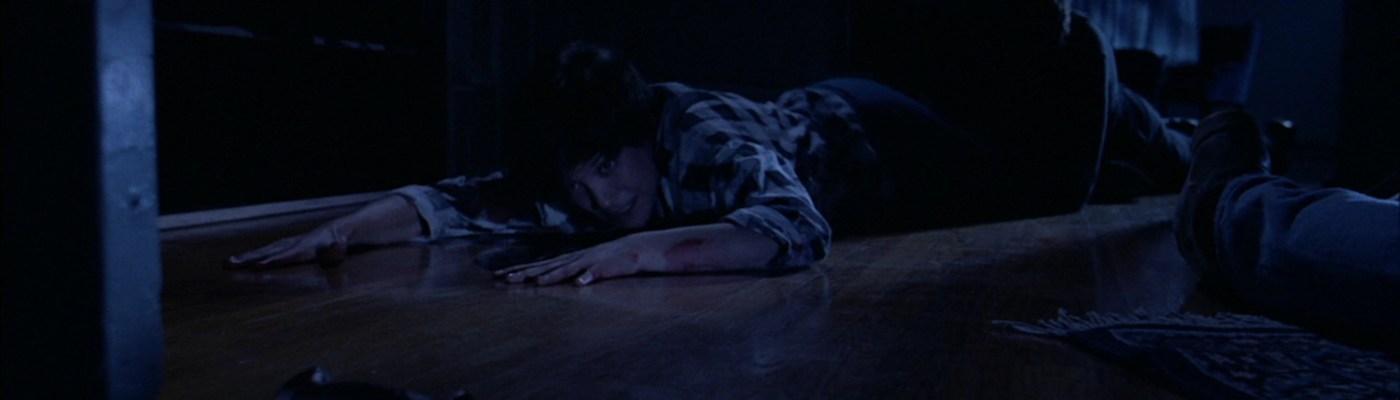
Matty probes a rote yet charismatic slasher flick from the Roger Corman stable.
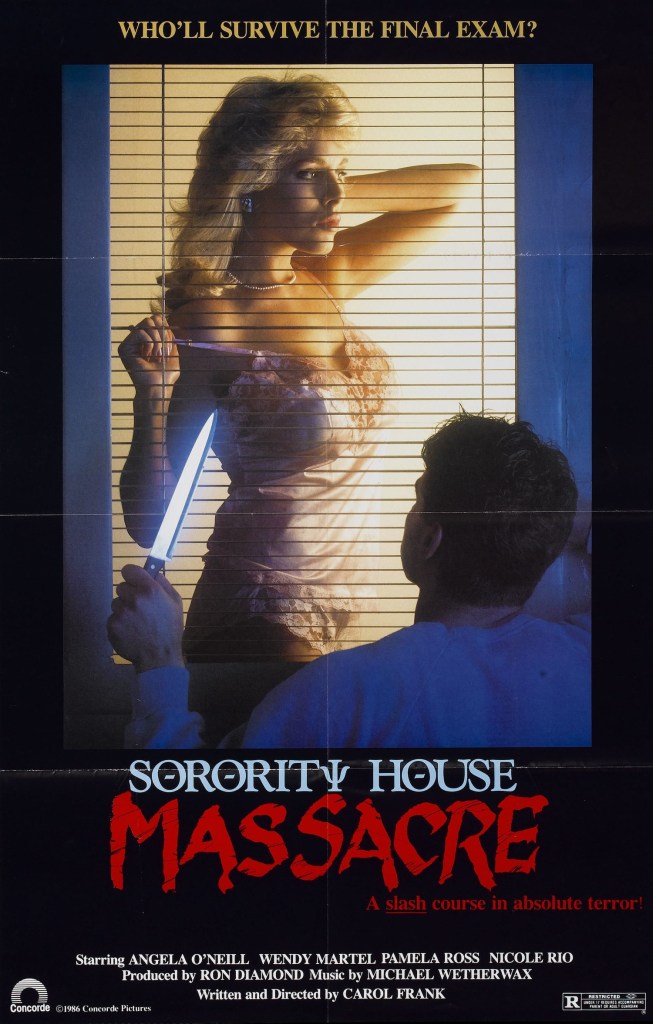
Though often overshadowed by Slumber Party Massacre (1982), SORORITY HOUSE MASSACRE isn’t without charm. Tired and cookie cutter in terms of set up — the plot is essentially Halloween (1978) transposed to the titular college dwelling — the film passes muster due to its mood and imagery.
Bankrolled by Roger Corman, the story goes that the wily mogul was happy with how Slumber Party Massacre was doing on tape and wanted another slasher flick in the same vein. Corman, of course, had a long history of cannibalising his own wares, ripping himself off, and reheating, retooling and reworking earlier premises, usually for a fraction of the cost (see: Death Race 2000 (1975)/Deathsport (1978), Eat My Dust (1976)/Grand Theft Auto (1977), Stripped to Kill (1987)/Dance With Death (1992)). To that end, the producer commissioned hungry young acolyte Carol Frank — who’d served as Amy Holden Jones’ assistant on Slumber Party Massacre — and co-producer Ron Diamond to sling together a cheaper do-over.
Mostly eschewing the sly, Freudian humour of Slumber Party Massacre and its ‘pneumatic drill as penis’ gimmickry in favour of the more conventional ‘knife as phallus’ shtick, Sorority House Massacre’s quirkier wrinkles — a bit of business involving a telepathic link between the killer (John C. Russell) and final girl (Angela O’Neill) — allows helmer Frank to get dreamy with the visuals. While disappointingly light in terms of blood n’ guts, Frank’s oneiric atmospherics and mannered approach to dialogue and staging lends the film a seductive, ethereal quality amplified by the slick photography of future music video specialist Marc Reshovsky (credits include promos for Bon Jovi, Ozzy Osbourne, Tom Petty, and Prince) [1]. As with Slumber Party Massacre (a picture I’ve always thought is held in higher regard than it should be), Sorority House Massacre’s so-called ‘feminist’ attributes are largely incidental. They’re by virtue of the film being written and directed by a woman, rather than any sustained or meaningful design. Nevertheless, Corman knew talent when he saw it, and it’s a shame the clearly very skilled Frank didn’t reach the heights of the B-movie impresario’s other female filmmakers: Katt Shea, Kristine Peterson, Gale Ann Hurd, Penelope Spheeris, and the aforementioned Amy Holden Jones. Sorority House Massacre remains Frank’s sole feature.
Opening at the Stewart Theatre in Dunn, North Carolina on 12th September 1986, Sorority House Massacre’s U.S. theatrical run went on to encompass Pennsylvania, Alabama, Tennessee, Georgia, and, by spring ‘87, California and New York. It debuted on cassette in the U.K., landing on shelves in summer ‘87 via Medusa in a version at once ten minutes longer than the U.S. cut but pruned of half a second of (minor) pickaxe violence. A solid renter on either side of the Atlantic, Corman followed the film with Sorority House Massacre II (1990); span it off with Hard to Die (1990) and Cheerleader Massacre (2003); and subsequently banded it alongside Slumber Party Massacre, Slumber Party Massacre II (1987) and Slumber Party Massacre III (1990) as part of the ‘Massacre Franchise’ — a loose, sprawling saga which also finds the unreleased ‘The Legacy’ and Cheerleader Massacre 2 (2011), and the Corman-less 2021 remake of Slumber Party Massacre as part of its make-up.
USA ● 1986 ● Horror ● 74mins (U.S. theatrical cut) / 89mins (U.K. VHS cut)
Angela O’Neill, John C. Russell ● Wri./Dir. Carol Frank
[1] For those wanting the perfect carve-’em-up chaser, Sorority House Massacre plays well alongside the equally peculiar Silent Night, Deadly Night 3: Better Watch Out! (1989). Despite their flaws, both exude a strange and chilly compulsivity characterised by off-centre vibes, atonal rhythms, and chaste attitudes to gore. Silent Night, Deadly Night 3 sports a Corman connection too: it was spearheaded by the maven’s ‘60s and ‘70s collaborator, Monte Hellman (Beast From Haunted Cave (1959), Ride the Whirlwind (1966), The Shooting (1966), Cockfighter (1974)).
 The Schlock Pit