

Matty chugs a Guinness in honour of Ted Nicolaou’s whimsical Moonbeam twofer.
Part of the same Charles Band/Ted Nicolaou/Ed Naha family film continuum as Dragonworld (1994) — where, in essence, Nicolaou was recruited to retool some ancient Empire-era Naha material into Moonbeam Entertainment programmers — LEAPIN’ LEPRECHAUNS! (1995) and its sequel were shot back-to-back in Romania, at Band and Vlad Păunescu’s Castel Film Studios. Nicolaou did something similar with Bloodstone: Subspecies II (1993) and Bloodlust: Subspecies III (1994), and he’d do the same again with his next Band-backed, Naha-rooted kiddie double whammy, Magic in the Mirror (1996) and Magic in the Mirror: Fowl Play (1997).
Watched in order, all six movies provide quite the snapshot of producer Band’s career. At one end of the spectrum are Bloodstone and Bloodlust, the peak of the Full Moon mogul’s fructiferous — and oft-rhapsodized — union with Paramount. At the other are Magic in the Mirror and Fowl Play which, despite their excellence, nearly fell victim to the usual behind the scenes shenanigans that plagued Full Moon’s pair-up with The Kushner-Locke Company, when their output increased but quality and care frequently took a beating. Fittingly, Leapin’ Leprechauns! and LEAPIN’ LEPRECHAUNS 2 (1996) sit somewhere in the middle. Having to be finished through the completion bond company due to Full Moon’s financial woes, they’re a bridge or a tipping point depending on your proclivity for Band’s post 1994 work, when the bulk of his ‘fans’ (you know, the fair weatherers) threw in the towel…
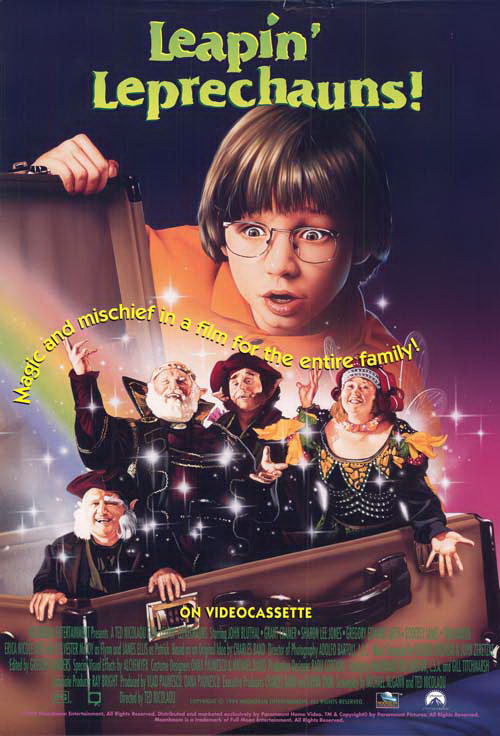
With most of the leprechaun effects rendered by Nicolaou’s Bad Channels (1992) technique — forced perspective shots and oversized props (which, amusingly, was a technique Band and Nicolaou scrapped on the original Subspecies (1991)) — Leapin’ Leprechauns! 1 and 2 are noticeably cheaper-looking than preceding Moonbeam romps (Prehysteria! (1993) and Nicolaou’s Remote (1993) et al). Nevertheless, they’re likable and diverting. While pretty much remixing key elements of the superior Dragonworld — another bit of theme park business (the wonderfully daft-sounding ‘IrelandLand’), Scotland switched for the Emerald Isle, the eponymous little folk (and a few fairies) instead of a fire-breathing dragon — the first film possesses a pleasing British lilt. There’s a surreal, Reeves & Mortimer inflection to its humour, and at the story’s core is a lovely message about the importance of keeping your inner child and its sense of magic and wonder alive.
Scholars of Nicolaou will get a kick out of the conceptual overlap Leapin’ Leprechauns! shares with the Band stalwart’s inaugural feature length assignment, TerrorVision (1986). The family units at the centre of each are identical: here, a grandpa (John Bluthal), a father (Grant Cramer), a mother (Sharon Lee Jones), and two kids (Gregory Smith and Erica Hess). They’re just far less grotesque in Leapin’ Leprechauns!.
Bluthal’s whimsical patriarch, Smith’s grandbairn, and the core leprechaun/fairy cast (Godfrey James, Tina Martin, James Ellis, Sylvester McCoy, and Nicolaou fav Ion Haiduc) return for chapter two. Scrubbing the fish out of water angle of the previous instalment, whereupon Bluthal travels to America to reconnect with his estranged son and neglected kin — accompanied, of course, by his diminutive, wish-granting pals — Leapin’ Leprechauns 2 keeps its action in Ireland which, in turn, lends the film a more sweeping, classically-minded fairy tale feel. The vibe is bolstered by the increase in horror imagery. The strongest visual aspect of Leapin’ Leprechauns! is its macabre closing stretch, when Bluthal and Smith save Killer Klowns From Outer Space (1988) star Cramer from a banshee and, ultimately, Finvara, the God of the Dead. In Leapin’ Leprechauns 2, Nicolaou unleashes a darker experience; The Return to Oz (1985) of the Moonbeam universe if you will. Though the nods to Arthurian lore seem tacked on rather than well thought out, the inclusion of slinky sorceress Morgan le Fay — who, it transpires, is actually Nula, the Queen of the Underworld — results in some stupendous vamping from Madeleine Potter. She’s a brilliant and waggishly creepy antagonist, delivering the kind of menacing performance that’d wage war on a younger viewer’s psyche. The sequence towards the end of the film – Potter leading Smith into the fiery depths of hell for a final confrontation – is among the grandest and scariest passages in Nicolaou’s filmography.
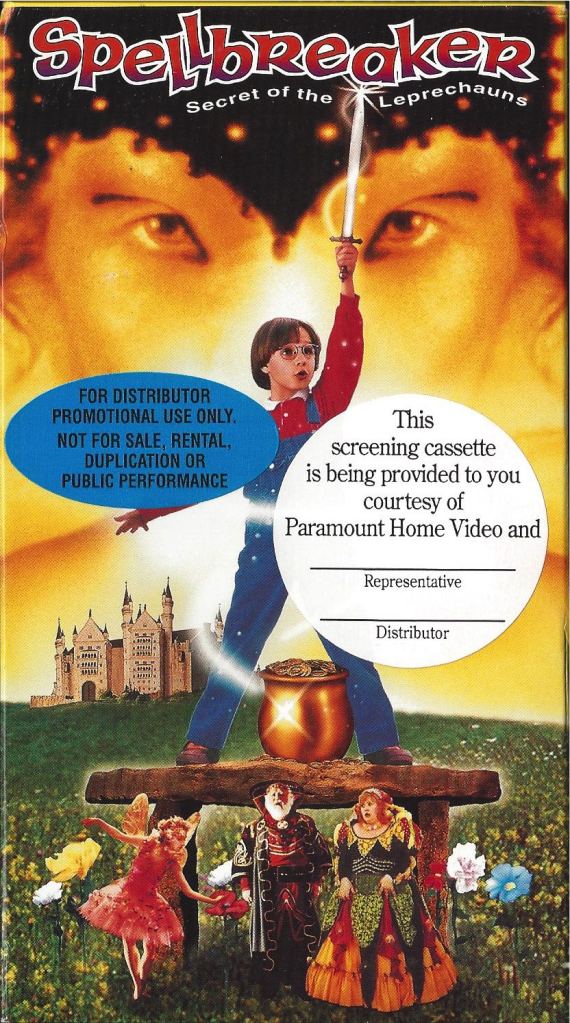
Leapin’ Leprechauns! hit U.S. and U.K. video via Paramount in July/August 1995 and April 1996 respectively. Presumably wanting to distance themselves from their acrimonious split with Band, Paramount rechristened Leapin’ Leprechauns 2 ‘Spellbreaker: Secret of the Leprechauns’ for its U.S. cassette release in October ‘96. By the time Leapin’ Leprechauns 2 landed on British shores in February ‘97 it’d reverted to its proper title.
 The Schlock Pit