

Matty mulls over Ted Nicolaou’s Charles Band-backed sci-fi horror caper.
Reviled upon its U.S. theatrical release in February 1986, TERRORVISION has twisted into a fan favourite in the decades since, powered by – what else? – the nostalgia-baiting magic of video [1]. It’s become one of the most beloved films in Charles Band’s Empire Pictures catalogue; a second-tier title a la Ghoulies (1985) and production mate Troll (1986), a step below canonised classics Trancers (1984), Re-Animator (1985), and From Beyond (1986).
A self-fulfilling prophecy in a way. TerrorVision flirts with an attribute I usually find excruciating:
A ready-made cult vibe.
Everything about the film is knowingly kitsch and designed to pander to the midnight crowd – from the first shot lingering on an upturned model of the Starship Enterprise as part of its space station set dressing, to the cast (Gerrit Graham, Mary Woronov, Diane Franklin, John Gries, Bert Remsen); the quotably crass script (“what the hell did that homo do to the jacooz?!”); the meta-referential flourishes (such as Band’s The Dungeonmaster (1984) and a wealth of other infamously chintzy B-flicks playing on TV); and the general air of high camp that permeates its comedy/horror/sci-fi mash-up plot (which is basically Poltergeist (1982), Videodrome (1982), The Thing (1982), and Bob & Carol & Ted & Alice (1969) flung into a blender).
Typically these kind of movies – say, Attack of the Killer Tomatoes (1978) or Quentin Tarantino’s Death Proof (2007) – irk me no end. They’re annoyingly smug at worst or a pale imitation of more authentic fare at best. TerrorVision is a rare exception. And that’s because writer/director Ted Nicolaou’s creative vision is genuine. As his subsequent work has affirmed, Nicolaou is an idiosyncratic filmmaker with a penchant for strange incidental details, zany humour, expansive world building, mood mastery, and fascinating characters. TerrorVision is real. It’s an acquired taste, admittedly, but its outrageousness isn’t a put-on. After all, cult — true cult — can’t be manufactured.
Referring to the film as “his baby”, Nicolaou has repeatedly said he poured his heart and soul into TerrorVision and that he was massively hurt by its dire critical reception. He even worried the project – his feature-length directorial debut – killed future chances to wield the megaphone. Happily, that wasn’t the case. Post TerrorVision, Nicolaou has joined Empire alumni David DeCoteau, David Schmoeller, Peter Manoogian, and Stuart Gordon among Band’s most trusted lieutenants. In fact, given Nicolaou is the only one of the four to continue his union with Band to this day, it’s fair to say he is the most trusted lieutenant [2].


A graduate of the University of Texas’ film programme, Nicolaou entered the Band contingent as an editor, cutting pre-Empire offerings Tourist Trap (1979) (for classmate Schmoeller) and The Day Time Ended (1979). Following a successful patch-up job on Band’s ill-fated for-hire gig The Alchemist (1983), Nicolaou was approached by its producers, Lawrence Appelbaum and Billy Fine, to helm The Concrete Jungle (1982). Sadly, he was quickly dismissed in favour of Tom De Simone, leaving his actual first stab at calling ‘action’ to come in the form of a segment of Band’s aforementioned fantasy portmanteau, The Dungeonmaster. As Nicolaou tells it, during editing The Dungeonmaster ran short; thus, he persuaded Band to let him add a section to it, resulting in him piecing together an effective and exciting Mad Max (1979) riff entitled ‘Desert Pursuit’. Like fellow Dungeonmaster contributors David Allen, John Carl Buechler, and Peter Manoogian, Nicolaou’s vignette was a proving ground; a test Band employed in order to nudge him towards a full-length assignment. Between ‘Desert Pursuit’ and TerrorVision, Nicolaou spliced Empire’s Ghoulies, Trancers and Zone Troopers (1985), and was tasked with assembling a new film out of two women in prison cheapies Band bagged the rights to, Escape From Hell (1980) and Hotel Paradise (1980). Cloaked by the pseudonym ‘Nicholas Beardsley’, Nicolaou shot a day’s worth of linking material with Linda Blair and the finished stew was released as Savage Island (1985) [3].
Despite dropping a clanger with the wonky structure, TerrorVision is a largely well-rounded maiden voyage. Assembled from Band’s patented title/poster combo (here, an alien and a satellite dish) and shot at Empire’s legendary studio in Rome, ol’ Dinocitta, Nicolaou’s madcap story sees a grotesque, sitcom-style family, The Puttermans, falling afoul of a ravenous, extraterrestrial monster who invades their tackily decorated homestead through their television. The satirical jabs hit more than they miss. The entire clan and their associates embody and spoof various then ‘of the moment’ obsessions and excesses (swinging, survivalism, new wave and heavy metal music) which, in turn, adds another layer of self-reflection and parody due to the film’s quintessentially ‘80s aesthetic. Watched with modern eyes, TerrorVision is as much a time capsule as it is an exploration of contemporaneous ideals and values. And though Nicolaou’s commentary on how TV and junk culture can both soothe and manipulate is very on the nose, his sentiment remains relevant in the age of social media and disposable content.
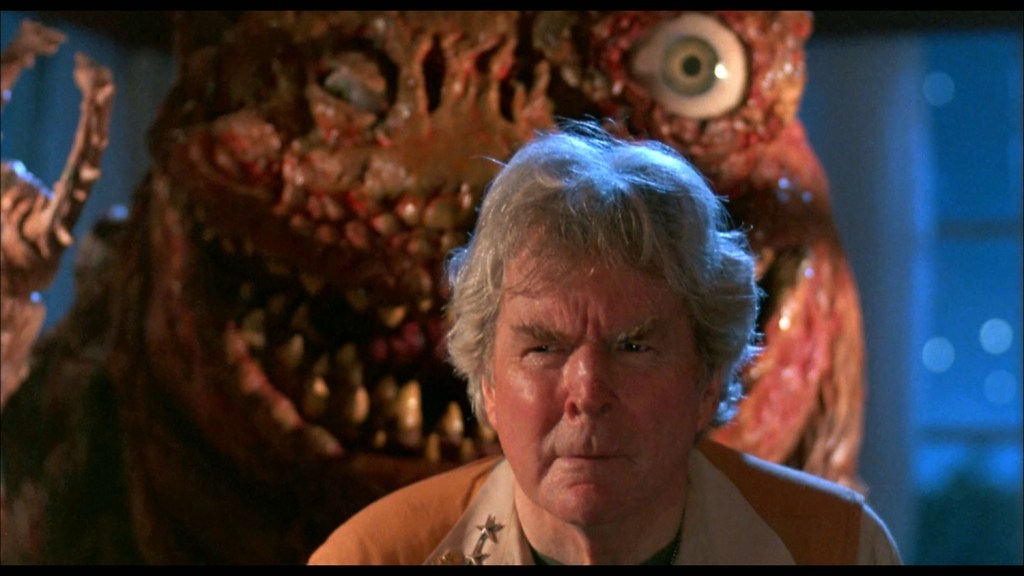
Baser, more conventional genre fancies are tickled by TerrorVision’s hearty technical credentials. It’s gorgeously — garishly — lit and shot, and Empire mainstay Giovanni Natalucci’s operatic production design is chunky and colourful. Visually speaking, the film is an impressively immersive experience. However, the ‘star’, so to speak, is TerrorVision’s toothy blob-creature, the bong-eyed, tentacle-flailing Hungry Beast. A rubbery, goo-slathered joy, it’s a masterpiece of cartoonish physicality and arguably the definitive artistic statement of FX wiz/Band perennial John Carl Buechler — who, incidentally, was supervising the edit of his own directorial debut, Troll, while TerrorVision was shooting (Troll wrapped the week prior to TerrorVision rolling).
Nicolaou, Band, and supporting players Sonny Carl Davis and Ian Patrick Williams reconvened for the lesser-known Bad Channels (1992); a radio-focused successor of sorts that’s nearly as good [4].

[1] TerrorVision landed on tape in the states through Empire’s output deal with Vestron in June ‘86, and arrived on U.K. shores via Band’s dependable British distro Entertainment [in Video]. Incredibly, in August ‘86, Entertainment bundled together TerrorVision and its Band brethren Parasite (1982), Metalstorm: The Destruction of Jared-Syn (1983), The Dungeonmaster, Trancers, Swordkill (1984), Ghoulies, Re-Animator, Troll, Eliminators (1986) and Breeders (1986) for a month-long season of big screen showings at the ICA in London, who humorously embellished Band’s unashamed B-movie posturing and branded the run “Empire of the Senseless”.
[2] Friendly with Band until his death in 2020, the late Gordon last toiled with his Re-Animator, From Beyond, and Castle Freak (1995) compadre almost twenty years earlier, as an executive producer on 2002’s DeathBed. Schmoeller and Manoogian, meanwhile, last paired with Band circa Full Moon’s Kushner-Locke era on family capers Mysterious Museum (1999) and The Midas Touch (1997) respectively. Manoogian’s debut proper, Eliminators, played alongside TerrorVision as a double feature at El Paso, Texas drive-in the Lomaland 3 for two nights on 2nd and 3rd April 1986. Another Empire double feature, TerrorVision and Zone Troopers, opened just over a week later, on 11th April, in Los Angeles. By May, TerrorVision was coupled with The Alchemist, scuttling onto select screens in Spokane, Washington.
[3] As Nicolaou told author and Schlock Pit pal Dave Jay in Empire of the Bs: The Mad Movie World of Charles Band, “Beardsley was the name of my cat! The challenge was trying to cut together the two source films. The shoot itself was a gruelling all-nighter at a Century City office tower. Linda was a pleasure to work with… [but the film] is not one of my proudest moments”.
[4] Band also recycled TerrorVision’s moniker (ish) for 2001’s HorrorVision.
 The Schlock Pit