
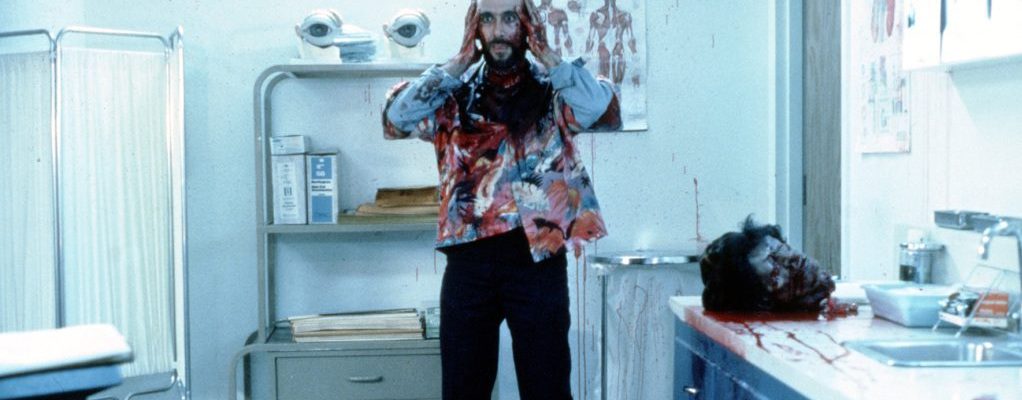
Matty ponders on John McNaughton’s lively sci-shocker and its satirical sense of place.
Veteran indie peddlers Atlantic Releasing Corporation (The Attic (1980), Valley Girl (1983), Teen Wolf (1985)) expressed interest in distributing Henry: Portrait of a Serial Killer (1986) but passed on doing so when the film received an X rating from the MPAA. Nevertheless, they were still taken enough with Henry to hire its helmer, John McNaughton, to tackle their sci-shocker, THE BORROWER (1991).
Atlantic’s contribution to the ‘alien on the rampage’ cycle instigated by Predator (1987) and The Hidden (1987) (cf. Dark Angel (aka ‘I Come in Peace’) (1990), Peacemaker (1990), and The Arrival (1991)), The Borrower began as a spec script by Sam Egan (credited as ‘Mason Nage’ on the finished film — basically his name backwards). When McNaughton came aboard, he brought in Henry’s co-scribe, theatre legend Richard Fire, to downsize it. Reportedly, Egan’s intended set pieces — several shootouts, a finale at an observatory, and the eponymous, head-swapping extraterrestrial unleashing twice the amount of decapitations — majorly exceeded The Borrower’s $2million budget. McNaughton and Fire set their draft in their native Chicago. Atlantic ordered them to change it to Los Angeles, much to McNaughton’s chagrin. Begrudgingly accepting it, McNaughton, Fire, and producer Steven A. Jones – another Henry alum – reasoned that the film was now set in Big City, Anywheresville, USA even though The Borrower’s Angeleno twang is unmistakable and at the heart of the movie.


Essentially a gory fish out of water comedy, The Borrower starts with a sardonic laugh when it’s revealed that, in space, the harshest punishment in the galaxy is being sent to earth to live as a human (“de-evolved”). Such a fate is bestowed to the titular alien; an intergalactic murderer whose de-evolution unfurls like a Charles Bukowski poem. The film’s hook is that its namesake antagonist has to constantly snatch and switch heads in order to survive earth’s atmosphere (or something along those lines – the mythos isn’t wholly clear by any stretch of the imagination). However, the dramatic and comedic meat comes in the form of The Borrower’s bizarre citywide odyssey.
Despite McNaughton deliberately trying to avoid overly obvious L.A. locations, The Borrower offers a fascinating snapshot of the city as it moved towards the 1990s. The Borrower himself wanders into a wealth of skid row settings, and is repeatedly left bemused by the people, situations, and social customs he encounters. Many appear representative of the darker aspects of human existence, and all are seemingly built around various Los Angeles stereotypes: work-dodging inner-city ‘rednecks’; bums; those chasing fame and fortune etc. The bulk of The Borrower’s victims are shitty people: a poacher (McNaughton regular Tom Towles); a philandering doctor (Tony Amendola); and, in a wonderful bit of plotting, a fellow violent criminal (Neil Giuntoli, future star of Henry: Portrait of a Serial Killer, Part 2 (1996)) which, in turn, invokes McNaughton and Fire’s Henry idea of sickos silently attracting their own. The exceptions – a dog and a kindly down n’ out (Antonio Fargas) – have their grisly demises played as ghoulish punchlines. In The Borrower’s most authentically unnerving scene, McNaughton codifies his inadvertent focus – really, the horror of L.A. life – as the bonce-nabbing beastie strolls through a hospital where everyone is either suffering, dying, or dead. Those not in sync with Los Angeles’ unique aura might say that’s the City of Angels in a nutshell.
While McNaughton has since stated it was the metaphorical connotations of the alien being able to become someone else that drew him to The Borrower (well, that and the fact Egan’s script was substantially better than a lot of the dreck offered to him post-Henry), his fixation on the passages that take place among the homeless – another Los Angeles tell – suggest a logical extension of another concept he’d circled with his feature debut:
How those on the fringe are frequently swept aside and left to fend for themselves, in the hope they’ll go away.

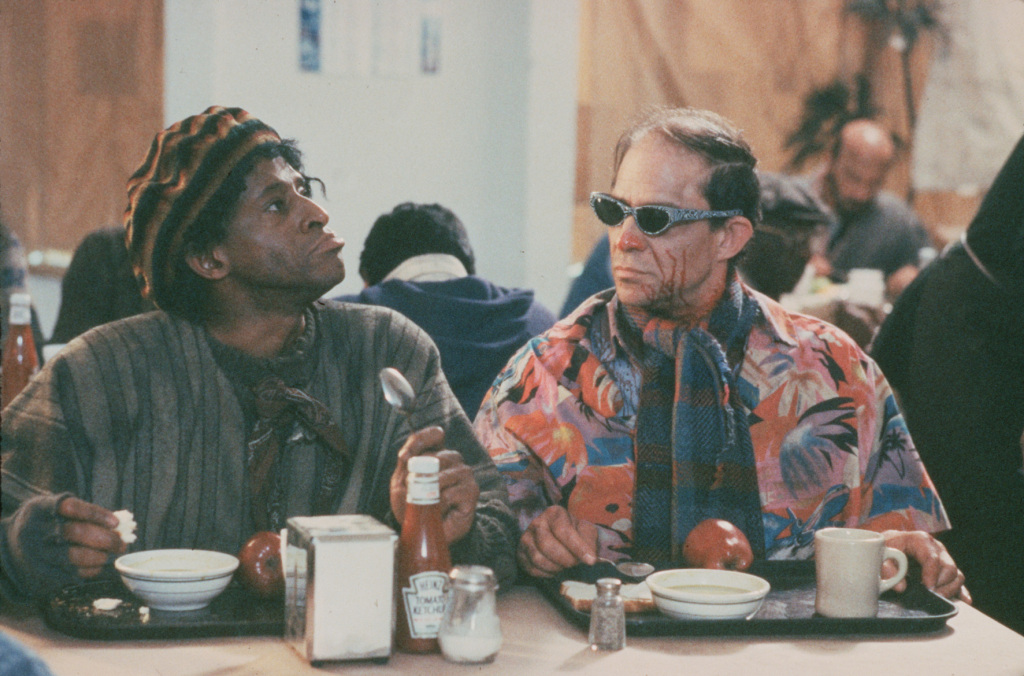

From a technical perspective, The Borrower is a far slicker opus than Henry. Visually it has a pulpy, comic book sheen indicative of its humorous tone, the amount of storyboarding McNaughton and Jones did (they boarded the film twice), and McNaughton’s desire to make it a homage to the science fiction B-movies of the ‘50s.
Lensed in eight weeks – five of which were fourteen hour night shifts – McNaughton clashed with star Rae Dawn Chong during the first leg of The Borrower’s shoot, and the production was plagued by several acts of God. There was an earthquake; a forest fire; ferocious winds; and multiple days of rain. Worst of all, Atlantic went out of business two weeks before the film was finished, leaving it to be taken over by the completion bond company and stranded in limbo as the rights to its distribution were contested in bankruptcy hearings.
Nearly two years after it was completed — half the time Henry was shelved for, admittedly — The Borrower was acquired by The Cannon Group. The outfit originally declined when one of the project’s backers, Lou Horowitz, inquired about them saving the film at the start of 1990. Come ‘91, Cannon acquiesced. They bought The Borrower and, following a warm response at its premiere at the Seattle International Film Festival in May ‘91, and an equally favourable run at the Music Box in Chicago (a venue that had previously shown Henry for a whopping eighteen months), dropped it into select cinemas in New York and – of course – Los Angeles.
During its brief autumn theatrical stint, The Borrower occasionally overlapped with McNaughton and Jones’ third feature, sex, drugs, rock & roll (1991) – a filmed version of Eric Bogosian’s acclaimed one-man show – and Ken Russell’s much-maligned Whore (1991), which also starred Fargas as a hobo. It was released on British VHS via Cannon’s output deal with Warner Home Video on Friday 27th September 1991. By that time, McNaughton and Jones were already prepping their fourth feature, the Martin Scorsese produced dramedy Mad Dog and Glory (1993) [1].

[1] September 1991 also saw The Borrower screen at the Toronto International Film Festival as part of their Midnight Madness line-up. The other films screened were: Children of the Night (1991), The Sect (1991), Motorama (1991), Guilty as Charged (1991), Blood & Concrete (1991), The Raid (1991), A Chinese Ghost Story III (1991), and, suitably, David Schmoeller’s aforementioned ‘alien on the rampage’ flick, The Arrival.
 The Schlock Pit