
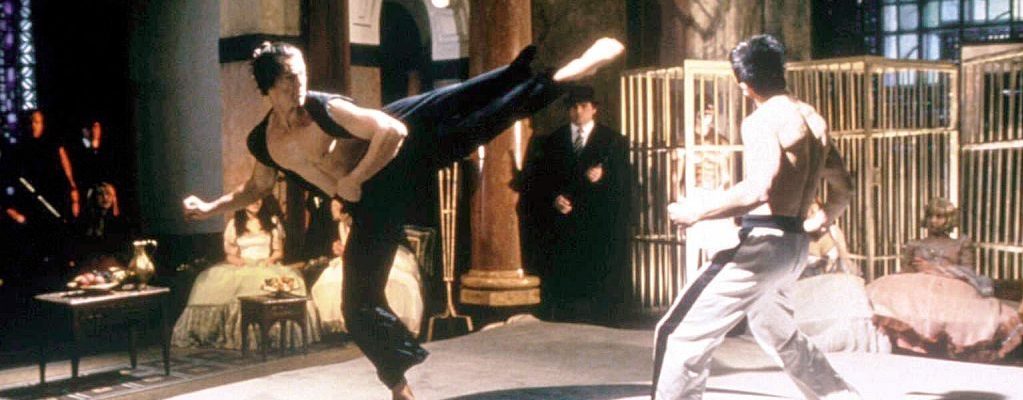
Matty explains why he can’t get enough of helmer Elvis Restaino’s crazy and charismatic sequel.
Having merrily plundered Jean-Claude Van Damme’s filmography conceptually and stylistically with Cyborg 3: The Recycler (1994) and their previous Daniel Bernhardt-starring action capers, Bloodsport II (1996), Bloodsport III (1997) and True Vengeance (1997), FM Entertainment really did a number in the pilfering/homaging/riffing stakes with their fourth and final Bernhardt biff-’em-up, BLOODSPORT 4: THE DARK KUMITE (1998).
Written by George Saunders — a journeyman, jack-of-all-trades who’d penned the Bernhardt-topping Perfect Target (1997) (directed by Sheldon Lettich, a close friend of JCVD and scripter of the original Bloodsport (1988), no less [1]) — Bloodsport 4 is ostensibly FM’s take on The Muscles From Brussels’ classic, prison-set thumper, Death Warrant (1990). However, this weird and wonderful offering, shot on the cheap in Bulgaria, quickly differentiates itself by diving headfirst into truly bonkers intertextual territory.
It’s coincidence more than anything, but the grim and disturbing Bloodsport 4 somehow manages to prefigure Van Damme’s later jail-based masterpiece, the ultra-bleak In Hell (2003) – which, as it happens, was also partially lensed at Nu Boyana Studios in Sofia – and call to mind another oddball, DTV fourth-quel to a vintage Van Damme vehicle: Albert Pyun’s Kickboxer 4: The Aggressor (1994).
Indeed, during its best moments, Bloodsport 4 exhibits a distinct Pyun-y charm.
An offbeat, mannered and highly stylised sensibility, anchored by a desire to experiment, unsettle, seduce, and overwhelm.
The air of Pyun-ness is enhanced by the presence of genius cinematographer George Mooradian. Though the ragged, handheld camerawork becomes an endurance test in a few places, Mooradian’s colourful lighting schemes and expressionist use of shadows add a pulpy, comic book edge, and his eye-popping compositions, outrageous movements, and general visual flourishes emphasise how much influence he had on Pyun, his greatest and most frequent collaborator.
That said, Bloodsport 4 isn’t a facsimile.
Helmer Elvis Restaino entered the FM fold amidst the tumultuous making of sword n’ sorcery flick, Sinbad: The Battle of the Dark Knights (1998). There, Restaino upped the kitsch when he was tasked with slapping together additional scenes for company boss Alan Mehrez after the project relocated from Jordan to the Balkans. Here, in Bloodsport 4, Restaino proves quite the surrealist. Ratcheting the procedural hook — a deep cover investigation into the strange goings on inside a Kafka-esque penitentiary — to fever pitch, the predictability of the mystery plot (hint: the film’s title is what the lags are being forced into) is countered by the eerie, often upsetting mood Restaino fosters. The threat of violence is ever present; but Restaino’s flair for disquieting images, his kink for peculiar and evocative spaces (no surprise given his parallel careers as a production designer and architect), and penchant for unusual details and freakish characters (including his own, self-played Dr. Rosenblum) teases a kind of relentless cosmic doom that’s infinitely creepier and nastier.
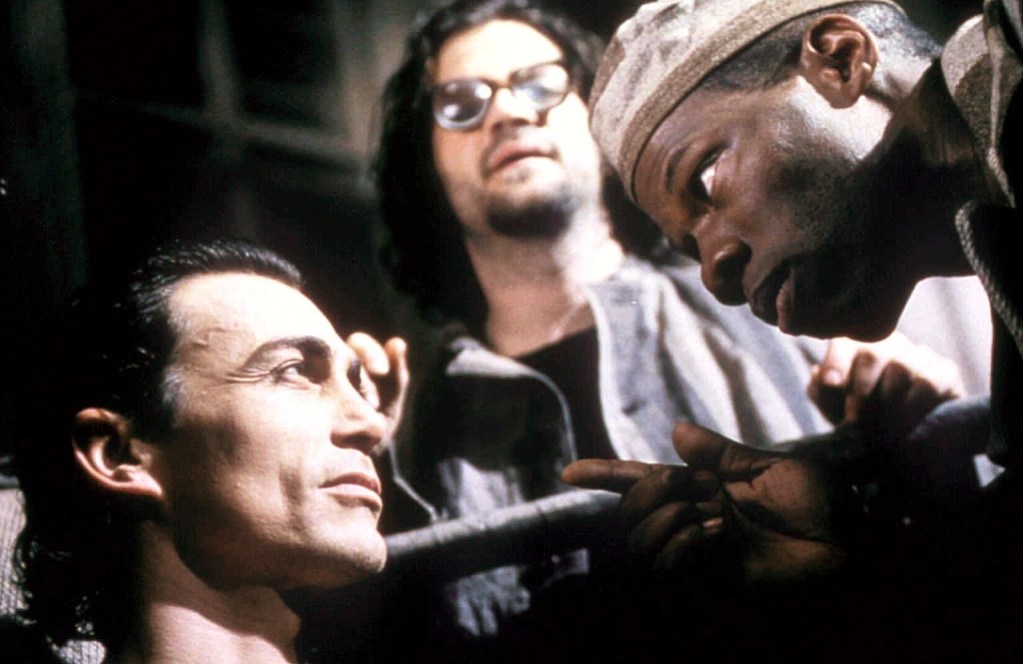

At the centre of the storm is Bernhardt. Bloodsport II and III hero Alex Cardo is long gone. A la the evolving personas of Don ‘The Dragon’ Wilson in Roger Corman’s sprawling Bloodfist saga, this time Bernhardt is a brand new character: jaded detective John Keller. It’s a compelling turn. Strong-armed into the eponymous knock-out contest by a catty warden (Derek McGrath) and his sinister, white-suited benefactor (Ivan Ivanov), Bernhardt’s martial arts skills are as impressive as always. His bruising scrap with a villainous henchman Schreck (Stefanos Miltsakakis) towards the back end is magnificent. And yet the meat of his performance lies in the subtler touches: a stare, a cock of the head, the way he enters a room, the dirty tactics he employs to – dammit – Get Shit Done™. It’s an effective, all-encompassing portrayal of a broken sideways thinker desperate to do the right thing, by any means necessary.
Incidentally, Bernhardt didn’t want to do Bloodsport 4:
“They changed the character and I didn’t like the story,” he told Movie Mavericks in 2010. “They came up with a script that was very strange and the whole project was sort of bizarre. I was contractually obligated to do the film. I do have to say what the one positive out of it was: I met my wife, [co-star] Lisa Stothard, on it. Everything happens for a reason. I was forced to do the movie and I tell people Bloodsport 4 is a little different, there is no other way to say it.” [2]
Bloodsport 4 was issued on video in the U.K. by Third Millennium in November 1998, around five months after the outfit released Bloodsport III and True Vengeance. They retitled it ‘The Final Chapter: Bloodsport 4’. It landed on cassette in the U.S. via Lionsgate subdivision Avalanche Home Entertainment on 30th March 1999. The film’s producers, FM Entertainment, never made another movie. They closed shop in the wake of an out of court settlement with Sylvester Stallone, who sued them for a whopping $20million following their misuse of his cameo in their ill-fated, Tarantino-tinged dramedy, The Good Life (1997), which starred Sly’s brother, Frank.

[1] Saunders, Lettich and Van Damme subsequently teamed on The Hard Corps (2006).
[2] Interview: Daniel Bernhardt by Jason Rugaard, Movie Mavericks, 16th November 2010.
 The Schlock Pit