
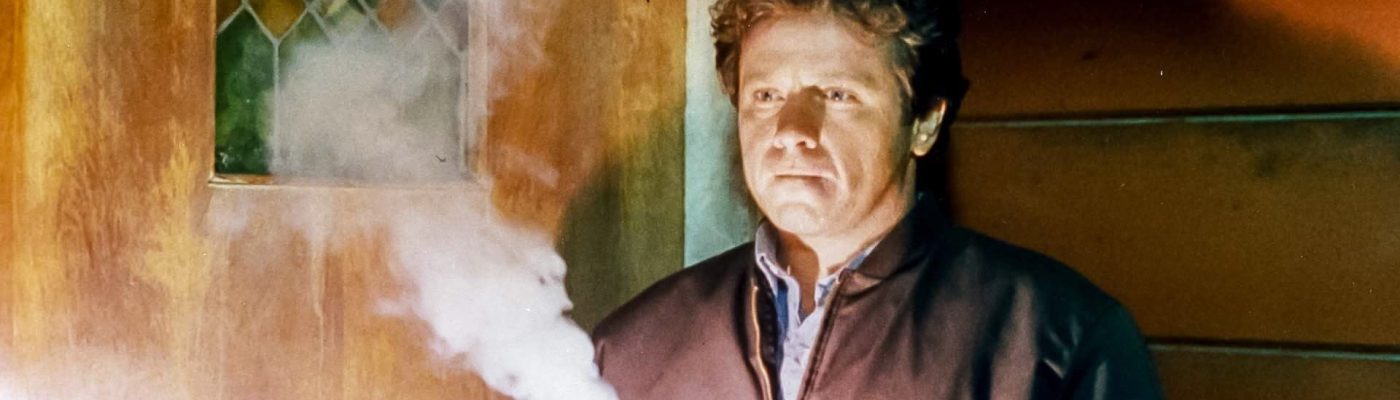
Matty examines an underappreciated sequel, and highlights its place within its maker’s resume and a wider subgenre.
John McNaughton’s Henry: Portrait of a Serial Killer (1986) was conceived by producers MPI as a cheap horror item they could dump on tape in the hope of a fast buck. Fitting, then, that the man MPI tasked with directing Henry’s sequel would go on to become the great auteur of one of DTV horror’s strangest subgenres: the serial killer biopic, which McNaughton’s grim classic – alongside In Cold Blood (1967), The Boston Strangler (1968), 10 Rillington Place (1971), Deranged (1974), and The Town That Dreaded Sundown (1976) – helped shape.
Chuck Parello was working at Screen Magazine, a film trade publication in Chicago, when McNaughton, a fellow denizen of The Windy City, gave him a cassette of Henry. Parello was impressed, and upon telling McNaughton so, was hired as Henry’s publicist.
At the time, Henry was in limbo. MPI wanted an easily saleable slasher flick a la Friday the 13th (1980); McNaughton delivered a disturbing, kitchen sink mood piece rooted in the crimes — and claims — of real-life murderers Henry Lee Lucas and Ottis Toole. Famously, MPI shelved the film for four years while they tried to figure out what to do with it. To their mind, such an unflinching and uncompromising plummet into the depths of human darkness was commercially ruinous.
Parello proved instrumental in getting Henry out there, first into film festivals, then theatrically. Critical and modest financial success ensued. As Henry started amassing money on video and in foreign territories, MPI asked McNaughton for a follow-up. By this point, Parello was on McNaughton and Henry producer Steven A. Jones’ payroll, toiling for their production company. Initially, Parello was only going to write HENRY: PORTRAIT OF A SERIAL KILLER, PART 2 (1996) [1]. After McNaughton left the project Parello took the reins as well.


Generally prefaced by a description along the lines of ‘a sequel no one needed’ and begrudgingly summarised as being better than it has right to be – or, rather, less worse than expected – Henry 2 seems so beholden to its predecessor it occasionally feels like an emulation. However, as Parello demonstrates with his subsequent films, Ed Gein (2000) and The Hillside Strangler (2004), the style and tone McNaughton employs in Henry: Portrait of a Serial Killer is clearly identical to his preferred method of chronicling the real monsters at the heart of his own fact-based material.
As conventional entertainment, Parello’s approach can be wearying. Henry 2, Ed Gein, and The Hillside Strangler are endurance tests if you’re not ready to watch miserable, fucked-up people potter around. Save for a handful of grizzly effects – a decapitated head in Henry 2, for example, which further supports the beholden argument – Parello’s true(ish) crime opuses aren’t especially graphic; the films are just bleak and upsetting. But why should they be anything else? Though bending certain aspects for dramatic purposes – and, in the case of Henry 2, fashioning an entirely fictional tale that bears merely a passing resemblance to its inspirations – Parello is keen to avoid exploitation. His wares exhibit a sincerity in keeping with the graveness of their subjects’ nefarious activities; an honesty and an integrity that positions them at the top end of the DTV serial killer biopic cycle (a wave Ed Gein initiated proper). Compare the largely serious-minded Henry 2, Ed Gein, and The Hillside Strangler to the form’s biggie, Matthew Bright’s Ted Bundy (2002) – which, despite sharing Ed Gein and The Hillside Strangler’s writer and producers, presents its eponymous murderer as a lovable scamp and unspools like a knockabout comedy – and the difference is night and day.
That said, Henry 2 does veer towards dark parody. Several narrative developments – male rape, domestic violence, suicide – appear unpleasant for unpleasant’s sake. In these moments, it’s as if Parello is trying to beat McNaughton in the harrowing stakes, unloading the yucks in the manner of an Aristocrats joke. Thankfully, for much of the film, Parello adheres to McNaughton’s epochal ‘portrait’ mandate. McNaughton’s idea for a sequel was ‘Henry: Superstar of Murder’. It would have concerned the media’s response to, their wallowing in, and, ultimately, their tacit celebration of Henry’s antics [2]. Parello isn’t interested in Henry’s actions in a wider, societal sense, and Henry 2 is at its most compelling when the helmer is probing the inner conflicts and toxic dynamic of four damaged individuals.
While McNaughton and Richard Fire’s script for Henry: Portrait of a Serial Killer featured pockets of dud dialogue (Henry’s whole “modus operandi” bit always comes across as awkward), Parello’s script for Henry 2 sports more of it. Nevertheless, as with its forebearer, Henry 2 is anchored by fascinating central characters, expanding the original’s trio into a quartet.
Having previously stole the show as the secondary antagonist of McNaughton’s satirical sci-shocker The Borrower (1991), Chicago theatre darling Neil Giuntoli replaces Michael Rooker as Henry and tackles the role nicely, offering a take that’s the apples to Rooker’s oranges. Both iterations of Henry are similar yet wildly different. Neither would be out of place in either movie, but Giuntoli’s interpretation juxtaposes Henry’s insatiable lust for blood with a tiredness indicative of someone as exhausted by his impulses as he is powerless to them. Kate Walsh and Rich Komenich jointly fill the Tom Towles/Otis slot — sidekick, foil etc. — in a sort of/not quite capacity as Cricket and Kai: a white trash couple whose fraught relationship is pushed to the limit by Henry’s arrival. Among Walsh’s earliest screen work, her achingly stoic portrayal of the down but never out Cricket is potent if stagey, and Komenich imbues gruff arsonist Kai (shades of the real-life Ottis Toole, a pyromaniac) with a quiet vulnerability that makes Henry’s eventual puppeteering of him all the more chilling [3]. Lastly, Carri Levinson submits a solid — albeit cartoon-y — performance as Henry’s Becky-esque love interest, Cricket’s fragile niece, Louisa.
Lensed in November 1995, Henry: Portrait of a Serial Killer, Part 2 debuted at the Chicago International Film Festival in October 1996; a month after Ottis Toole died in jail, and a full decade after the original Henry played the fest. A brief cinema run commenced nearly two years later, beginning in Los Angeles in August ‘98, and rolling out to New York, Michigan, and, of course, Chicago.
The film was released straight-to-video in the U.K., uncut and unexpurgated, by Mosaic Entertainment in July ‘99.
Incidentally, six months earlier, chief censor James Ferman — who’d long considered McNaughton’s Henry a thorn in his side — had departed the BBFC.
And when the British cassette landed, Parello was prepping Ed Gein, which producer Hamish McAlpine recruited him for at McNaughton’s recommendation.
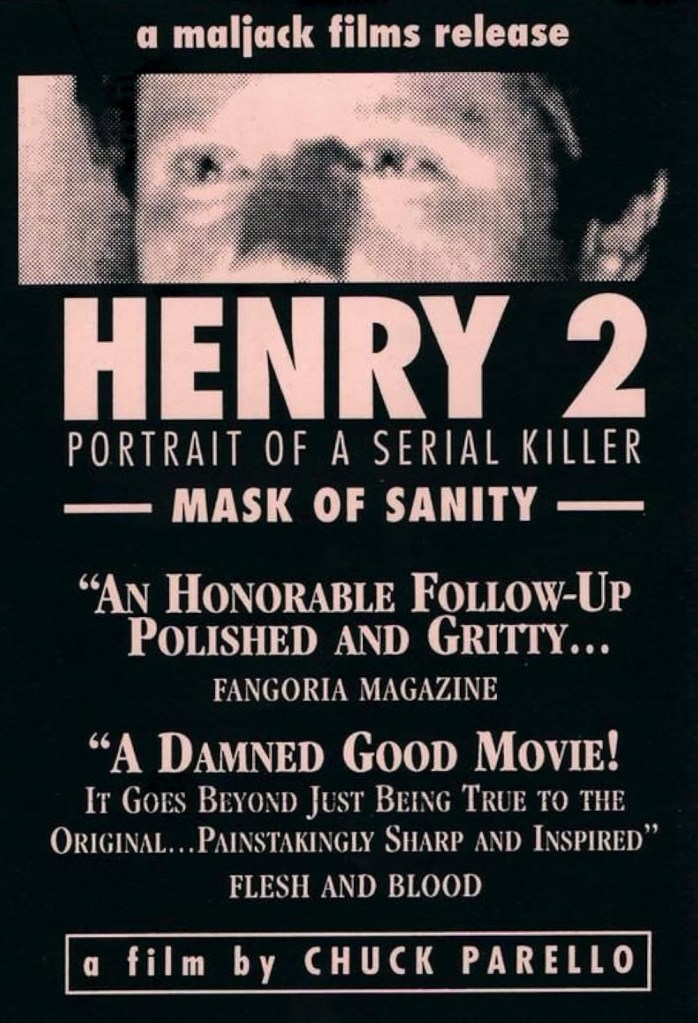
[1] A strong contender for the most messily titled movie in existence, Henry 2’s monikers extend to: ‘Henry: Portrait of a Serial Killer 2 – Mask of Sanity’; ‘Henry 2: Portrait of a Serial Killer’; and variations thereof with Roman numerals. The film’s title on screen is the comma-less ‘Henry: Portrait of a Serial Killer Part 2’.
[2] MPI nixed the concept for budgetary reasons, despite its topicality post Jeffrey Dahmer, and in the wake of the Menendez Brothers and O.J. Simpson trials.
[3] Komenich was deservedly nominated for the Best Support Actor trophy at Fangoria’s 1999 edition of the Golden Chainsaw Awards. Alas, he was beaten by Udo Kier/Blade (1998) in a field that also included: Richard O’Brien/Dark City (1998), Robert Patrick/The Faculty (1998), and Liev Schreiber/Phantoms (1998). In a peculiar twist of fate, three of the films nominated in the same year’s Best Limited Release/DTV Film category bear a Henry connection: Aussie creeper The Ugly (1997) and Austrian meta-thriller Funny Games (1997) are cut from the same lineage, and Bram Stoker’s Shadowbuilder (1998) stars Michael Rooker.
 The Schlock Pit