
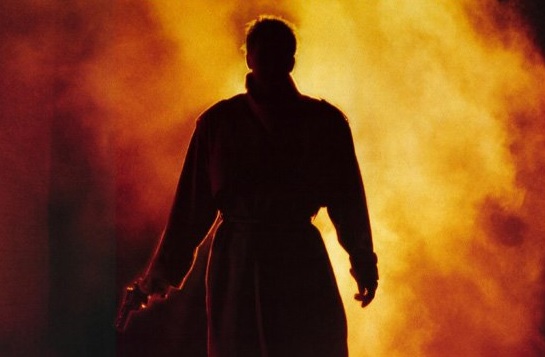
Dave chats to Schlock Pit hall-of-famer Louis Morneau about making buddy cop gold in deepest Peru.
Legend has it that a plane carrying Roger Corman was headed for Argentina, where the legendary mogul was making the likes of Deathstalker II (1987), when it had to stop in Peru due to bad weather. Killing time in the country’s capital, Corman grabbed a telephone directory and started calling people associated with film production to gauge who the best local filmmaker was.
Luis Llosa was the name most mentioned.
Alas, the reality of the situation is a little more unexceptional.
Llosa’s television work in Peru had come to the attention of Livia Antola, a member of Corman’s acquisitions department with experience in South America. She’d shown the late producer an episode of the TV show Gamboa, and that was enough for him to hire Llosa to put Hour of the Assassin (1987) together.
What ensued between Corman and Llosa over the next seven years – with Llosa now assuming producer duties over directing – was just shy of a dozen films that were inconsistent (see: Eight-Hundred Leagues Down the Amazon (1993)) with the odd jewel in-between.
CRACKDOWN (1991) [1], for instance, is a Pink Star diamond.
“It wasn’t even meant to be my film!” recalls director Louis Morneau. “A director had dropped off the project a couple of weeks before he was to leave for Peru. Rodman Flender, who was Roger’s Head of Production at the time, called me to ask if I’d be interested. I asked if I could read the script, but he assured me to trust him and that it was very good. I agreed to do it and he was right! A couple of weeks later, after some casting, I was off to Lima.”
Cliff De Young plays maverick DEA agent Shaun Broderick who’s begrudgingly teamed with Juan Delgado (Robert Beltran), a by the book Peruvian cop, in order to bring international drug lord Don Castillo (Orlando Sacha) to justice. Despite their mutual disdain for each other, an attack by Castillo on Delgado’s wife means that the two quarrelling cops are left with no choice but to put their differences aside and nail the vicious kingpin.
The casting is the winner in Crackdown. Corman’s desire to trade on the success of Lethal Weapon (1987) is obvious, so getting two leads who could replicate the Gibson/Glover buddy cop chemistry was vital. De Young and Beltran are a match made in heaven. They possess the kind of natural spark that thousands of casting directors have tried to engineer with little success.
It could have turned out so differently, though.
“George Clooney had come in to meet for the lead,” says Morneau. “I remember going into Roger’s office with the handful of possibilities that we had, but Roger said to just go with ‘the name’. And at the time, Cliff De Young was a bigger name!”
Ross Grayson Bell and Daryl Haney’s script is as tight as a drum. Haney, of course, was on the cusp of direct-to-video infamy. He’d boxed off Friday the 13th Part VII: The New Blood (1988) and Crime Zone (1988) prior to Crackdown, and he’d fly the Concorde-New Horizons nest in the early ‘90s, whereupon he’d pen a handful of erotic thrillers for Axis International, including Mirror Images II (1993) and Animal Instincts II (1994).
One other aspect that’s beneficial to the picture is the Lima exteriors. Despite the number of films that Llosa and co. shot there during this era, the Peruvian capital is conspicuously absent in many of them. Crackdown flexes its surroundings and cultural flavours to the max, with cinematographer Pili Flores-Guerra clearly having a ball in his hometown.
However, the location didn’t always serve Morneau well from a physical perspective, as the future Carnosaur 2 (1995) helmer painfully recounts:
“It nearly killed me. We shot the gas station sequence first, and I drank a coffee that had been made from water at the location. We later learned that the area had previously been the landfill destination for the entire city! I was sick for most of the production, and in the last week I was directing from a cot. It was my first film, though, and I wasn’t going to quit, even if I did lose fifty pounds in the process.”
“It was a low budget – roughly $250K for production – but I was able to shoot for twice the number of days that filming elsewhere would have allowed. I did only have a hundred-thousand feet of film to shoot on, which was tight for an action movie, and that ultimately meant I finished shooting the film on short ends. Ironically, though, I never saw any of my footage until we’d wrapped, as the negative was sent back to Los Angeles every other day or so.”
“I did a few pick-ups in Los Angeles, then edited for six months or so – which was highly unusual – although I think Roger trusted me as an editor.”
“In the end it was a great ride; and most importantly, I believe Roger liked the picture quite a bit.”


[1] Crackdown is the film’s most commonly used title, particularly here in the U.K., but it was released on VHS and laserdisc in the U.S. as ‘To Die Standing’.
 The Schlock Pit