
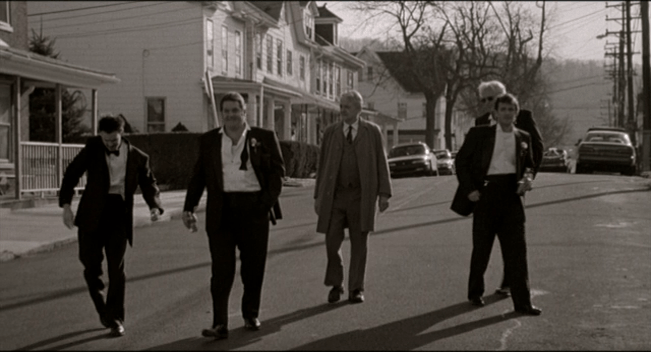
Dave spotlights a compelling ensemble drama that was kneecapped by a sniffy trade review.
“THE FLORENTINE can’t break away from its verbose theatrical origins,” wrote Robert Koehler in Variety, soon after a screening at the LA Independent Film Festival in April 1999 [1].
And just like that, any hope that director Nick Stagliano had for a run on the cinema circuit quickly disappeared. Admittedly, Koehler’s criticism of The Florentine‘s “distracting spread of novelistic story strands” and its “repetitive series of two-character dialogue scenes” didn’t help either, but it was that lead summary that killed the film, much to Stagliano’s chagrin.
“It didn’t help because it was an industry review,” remarked the filmmaker to The Morning Call, a Philadelphia newspaper that had devoted several column inches to The Florentine‘s six week shoot in November ’97 [2]. Nearly two years had passed, but there was still no sign of the star-studded drama debuting to the masses. Cannes had come and gone, as well as a handful of well-received festival appearances (“six-hundred people gave it a standing ovation in LA”).
“It’s not a phenomenon,” sighed Stagliano when asked about his film’s lack of saleability. “And it’s not a high school teenage sex romp.”
Nevertheless, Initial Entertainment Group, the production company handling The Florentine‘s sales, had no such trouble signing distribution deals in close to fifty foreign territories. It was America that was proving to be the stumbling block, and you have to feel a pang of regret that proud Philly native Stagliano didn’t manage to showcase his debut on the big screen. Interestingly, offers had come in to snag the film’s domestic distribution – including one from Miramax that included a small advance – but all were turned down flat by IEG. It was a time of transition for the company, who were beginning to turn their focus away from economical indies to the bright lights of budgets in excess of $30million.
Predictably, The Florentine got lost in their ambition, and Monarch Home Video eventually released the movie – direct-to-video, no less – in March 2000. One does wonder if the trajectory and legacy of the picture would have been elevated somewhat if it been grabbed by the Weinsteins.

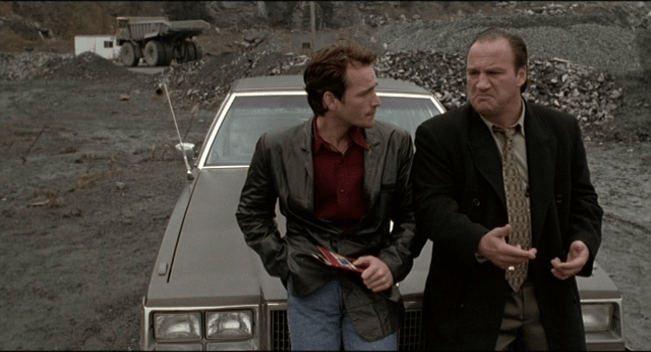

The Florentine had spent the best part of a decade edging towards production. Once Francis Ford Coppola’s American Zoetrope became attached, the cast fell into place – as Jim Ridley wrote in Nashville Scene – “like a set of dominos” [3]. Tom Sizemore – who played a key role in the development of the picture – enthusiastically fired the script to his friend Chris Penn, who subsequently gave it to Michael Madsen whose sister, Virgina, happened to be staying with him in the wake of her recent divorce. After reading it she too was immediately interested.
The storyline is sprawling – so, for the sake of brevity, the titular Florentine is a neighbourhood bar that serves as a touchstone for a circle of friends living in the shadow of a deteriorated mill town. A wedding is on the horizon, and it’s quickly evolving into an event that won’t just signal a new start for the happy couple, but also a new phase of life for each of the pals.
Keohler was correct in some regard. There is a degree of verbosity to Tom Benson and Damien Gray’s script, which was adapted from Gray’s Off-Broadway play (penned with Amy McCarty-Baker). There is, though, joy to be had in watching the crème de la crème of ‘90s character actors chew their dialogue. We’re yet to fully appreciate the quality the likes of Madsen, Penn and Sizemore brought to a litany of indie features during that decade and the early ’00s. At the minute, we’re too caught up on the deaths of the latter pair, and too preoccupied with mocking the conveyor belt of Z-grade material that now features the former. But in their heyday, this power trio unleashed the same kind of scene stealing performances that defined icons like Bo Hopkins, Charles Napier and Henry Silva in the ‘70s and ‘80s.
“To me, the area is emblematic of an America that doesn’t get a lot of attention these days,” Sizemore told Dennis Zehner. “The American of poor, white, blue collar workers. [The Lehigh Valley] is a real symbol of the American dream, but with the closing of the steel mill here, it’s also symbolic of that dream’s failure.” [2]
And essentially that’s where Stagliano’s film succeeds.
The Florentine is a stark portrayal of a dying community.
One where hope is a commodity that’s in short supply, and where desperation leads to corruption. The stunning turns of the uniformly excellent ensemble are central to conveying this, and special mention must go to Hal Holbrook who’s at the heart of the most genuinely affecting moment in the movie [4].
With the right backing, The Florentine would have been part of the same conversation that circled the other great working class dramas of the era, a la Ed Burns’ The Brothers McMullen (1995) or Ted Demme’s Beautiful Girls (1996).
There’s still time, of course…

[1] The Florentine Review by Robert Koehler, Variety, 3rd May 1999.
[2] Movie Shot in Valley Might Never Hit a Theater Near You by Dennis Zehner, The Morning Call, 9th August 1999.
[3] Where Everybody Knows Your Name: Review of The Florentine by Jim Ridley, Nashville Scene, 19th October 2000.
[4] Typically, it’s a scene IEG wanted to cut to reduce the running time of the movie. What was it that William Goldman said again?
 The Schlock Pit