

Moved for Marty? Who knows – but Dave’s convinced that Scott Ziehl’s intense drama is one of the finest and most neglected films of its decade.
“Miramax just didn’t respond to it. They thought it was great filmmaking, but they weren’t sure about marketing it. We’ve heard a couple of theories about Bringing Out the Dead (1999) having something to do with us not getting distribution. I don’t know if I believe that conspiracy theory.” [1]
Director Scott Ziehl might have been skeptical about the impact that Martin Scorsese’s equally underrated thriller had on BROKEN VESSELS (1998), but, a quarter of a century on, it’s clear that the Paramount-backed picture had to have played some part in Ziehl’s film being virtually blackballed. The fact that Broken Vessels came first is seemingly moot. Scorsese’s source material, Joe Connelly’s eponymous novel, didn’t surface until a year after Ziehl wrapped. Irrespective of timeline semantics though, the bottom line is that Broken Vessels’ anonymity is an absolute travesty.
Although marking Ziehl’s directorial debut, the filmmaker had been involved in the business for close to a decade, producing a series of direct-to-video action flicks for his friend, John Sjogren. It was the success of the likes of Red Line (1995) with Michael Madsen that provided Ziehl with enough money to fund a good chunk of the budget for Broken Vessels.
The story introduces us to a college graduate, Tom (Jason London), who’s left the tranquillity of Pennsylvania behind for a job with the Los Angeles ambulance service. Once there he’s paired up with veteran medic Jimmy (Todd Field), who, it transpires, has had more partners than hot dinners. Initially, Tom is in awe of Jimmy’s ability to deal with the pressures and traumas of the situations they find themselves in. However, it soon becomes clear that Jimmy is not what he seems, and the stresses of the job lead Tom into a downward spiral of drugs, girls, and booze…

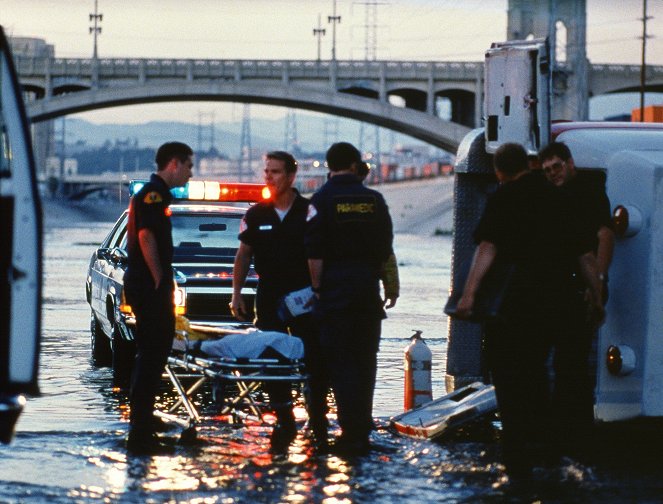

“We’re the difference between life and death,” emphasises Jimmy to Tom. “And some guy flipping burgers makes more than you do.”
The promotional material for Broken Vessels nailed it: “A raw look at the paramedic subculture, and its gradual movement to the outer edges of sanity and the law.” It’s a film with an attitude, and it grabs you by the throat from the get-go.
An impeccable piece of casting, Field wholly embodies the unshakable coolness of Jimmy. Boasting a magnetic arrogance and hypnotic swagger, it’s almost a shame that Field turned his back on acting for the director’s chair (In the Bedroom (2001), Little Children (2006)), because he’s a force of nature here. London is a fine foil too.
In terms of behind the scenes, Ziehl has to take the bulk of the credit. Broken Vessels is his baby. The manner and pace in which he captures the underbelly of downtown L.A. is excellent, especially when one considers the meagre resources he was working with. Think of your generic fly-on-the-wall ambulance chaser on the small screen, then mainline class A narcotics into its system, and dose it with a heady cocktail of adrenaline and endorphins. There’s a bleakness to Broken Vessels that festers in your brain for days after watching it, but the film’s funny in parts as well. Hysterically so.
Inevitably there’s the inclination to labour it with comparisons to Bringing Out the Dead. Given Broken Vessels cost one percent of Scorsese’s budget, I’d urge you to judge it on its own merits.
Ziehl told Indiewire that he has no regrets:
“As for getting your career going, I don’t think you want to play it safe. I think people and studios really respond to someone who’s done something unique. But at the same time, it can be a little hectic trying to sell these movies. I feel that it’s wrong to tell people to play it safe. They should do what they believe and what’s in their heart.” [1]
Eventually Broken Vessels was picked up for U.S. release by Unapix. And with a handful of theatrical releases in Europe, Ziehl got his money back. In a comical twist of irony, despite Miramax turning their noses up at this, they were more forthcoming with writing Ziehl a weighty cheque for ‘Airtime’, a pitch about California joyriders. According to Variety, the Weinsteins tapped up both Stephen Susco (The Grudge (2004)) and John Weidner (Maximum Force (1992)) to convert it into a script for Ziehl to direct [2]. Alas, the project failed to launch [3], and Ziehl went on to carve himself a solid helming career in the world of DTV, tackling several thoroughly recommendable programmers. Three Way (2004) is an impressive crime-thriller, while Proximity (2001), Earth vs. the Spider (2001), and Cruel Intentions 3 (2004) are all worth investigating.

[1] Scott Ziehl’s Broken Vessels: Struggling to Distribute in Today’s Market, Indiewire, 1st July 1999.
[2] Scribe Duo Gets Airtime by Benedict Carver, Variety, 1st June 1999.
[3] The newly formed writing partnership of Susco and Weidner could never escape the depths of development hell. A New Line script called ‘Bone in the Throat’ never materialised as a movie, and neither did ‘Dumbstruck’ (which had John Leguizamo attached to star and Mike Nichols pencilled in to direct) and ‘Johnny Nitrate’ (a thriller Weidner hoped to call ‘action’ on).
 The Schlock Pit