
Dave charts the tragic demise of a talented director, and gives fulsome praise to his final feature.
The Laguna Canyon Fire of 1993 was unrelenting in its destruction. Engulfing more than sixteen-thousand acres of land and burning hundreds of homes to the ground, it was a miracle that no one was killed. TV crews captured the inferno. One clip showed a man waving people away from their properties who were desperate to rescue their pets: “A cat’s just not worth it,” he shouted.
As Laguna was extinguished, a similar blaze began further up the coast in Malibu.
Filmmaker Duncan Gibbins would have been wise to take heed of the warning broadcast the previous week. On 3rd November, the Brit arrived at the plush Southern California cottage he’d been renting from friend Peter Alexander and discovered it engulfed in flames. His first thought was to rescue his precious Siamese cat, Elsa. With little regard for his own safety, Gibbins entered the burning building.
He made it out with 95% burns, but later died at Sherman Oaks Hospital.
His cat survived.
The story made it into several newspapers over the course of the next few days. The Los Angeles Times ran a piece titled Would You Risk Your Life to Save Your Pet? and debated whether Gibbins’ actions were brave or foolhardy. What seemed to be overlooked, though, was the premature demise of a genuinely talented director.
Gibbins started out in the business as a music video director of enviable ability. With some of the most iconic pop promos of the ‘80s under his belt (Club Tropicana for Wham!, Careless Whisper for George Michael), he made his way to Hollywood. Gibbins experienced moderate success with his debut feature, the prophetically titled – and impressively cast – Fire with Fire (1986), which saw middling box office success and mediocre reviews. A screenwriting job came with – seriously – Third Degree Burn (1989), which had Tomorrow Never Dies (1997) helmer Roger Spottiswoode in the chair, and then it was back to wielding a megaphone for the excellent sci-fi thriller, Eve of Destruction (1991). Despite favourable opinion surrounding it today, Eve of Destruction theatrical run was ruled a bust and Gibbins found himself in the world of television.
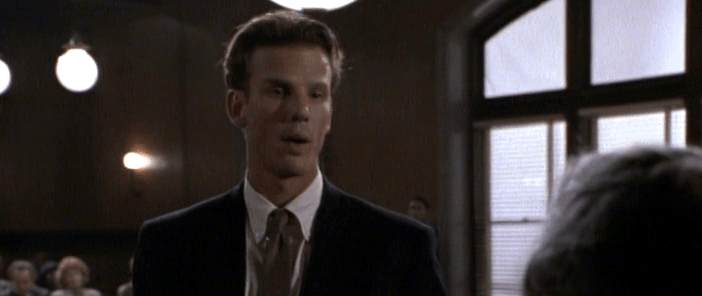
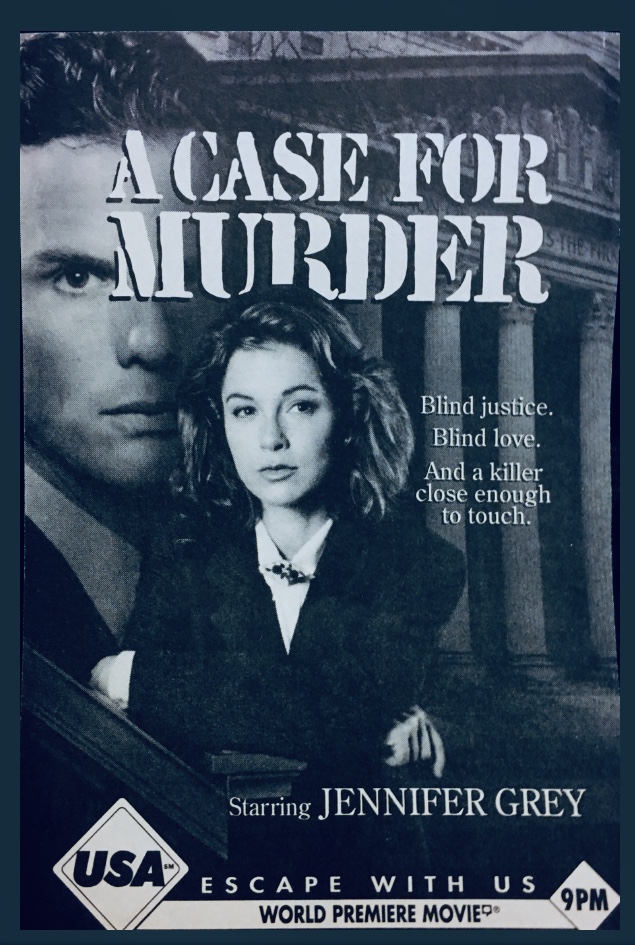
Airing on the USA Network just over five months before Gibbins’ death, A CASE FOR MURDER casts Jennifer Grey as Kate Weldon: an ambitious lawyer who joins a prestigious legal firm in Los Angeles. It’s here she meets Jack Hammet (Peter Berg): a rising star in the company who’s also very easy on the eye. Kate is thrilled to be taken on as Jack’s assistant in the murder case of one of the firm’s senior partners – until, that is, she uncovers evidence that brings into question Jack’s connection to the case.
Legal thrillers were the go-to for network TV and cable stations during the ‘90s as they mined every avenue in order to hit their lofty quotas of original movies. A Case For Murder sits comfortably in the upper echelons thanks to a couple of contributing factors. The script – by Gibbins and Pablo F. Fenjves – is a well-written attention holder that grips with its tight structure and rich characterisation. Incidentally, it was Fenjves’ feature debut. The ghostwriter might have achieved infamy penning If I Did It – O.J. Simpson’s hugely controversial take on his own murder case – but Fenjves’ screenwriting career – which peaked with Man on a Ledge (2012) – is noteworthy for its consistency.
A Case For Murder looks better than most of its peers. A visually skilled craftsman, Gibbins had made the leap from music to movies with aplomb in terms of form; and with a cinematographer of the stature as Anthony Richmond (Don’t Look Now (1973), Candyman (1992)) alongside him, they add a cinematic brushstroke to the square, 4:3 rigidity of the small screen.
Both leads suit their roles, although it’s Berg who’s the most compelling. Criticised by press at the time as being the weak link, I think he brings a thrilling complexity to the picture. “This isn’t Off-Broadway, Mr. Hemmet”, remarks Judge Helen McCoy (Rosemary Forsyth) – but to Berg, that’s exactly where Hemmet belongs. Highly performative, the brash, shady, and at times purposefully obstructive behaviours and nuances he uses to bring Hemmet to life escalate as A Case For Murder edges towards its satisfying and stirring conclusion.
USA ● 1993 ● Thriller, TVM ● 93mins
Peter Berg, Jennifer Grey, Belinda Bauer, Eugene Roche, Samantha Eggar ● Dir. Duncan Gibbins ● Wri. Pablo F. Fenjves, Duncan Gibbins
 The Schlock Pit