

From the vault: a revised version of Matty and Dave’s look at a clucking wonderful regional horror flick, as originally published in the first pressing of 88 Films’ Blu-ray release. Featuring interviews with art director Lance Norris, set dresser Troy Peters, and FX wizard Mike Tristano!
“Carny barkers hawked and baited a curious public to come and see the sideshow freaks. Everything from the fat lady to the Wild Man of Borneo. But, of all the bizarre acts, the strangest was The Geek.”
Such poetically poised prose is better suited to Walt Whitman than the intro to a backwoods slasher – but then that strange contradiction epitomises the willingness of LUTHER THE GEEK (1990) to defy tropes at every opportunity.
Opening in 1938 in rural Illinois, we’re greeted by a torch-waving mob of dungaree-clad hicks chanting “Geek, Geek!” in unison, as they wait for a wild-eyed lummox in a cage to commit an act of savagery. Watching, as we do, is little Luther Watts – and the transfixed young lad has just discovered what he wants to be when he grows up…

Freaks & Geeks
On Troma’s old DVD release, writer-director Carlton J. Albright revealed that Luther the Geek‘s genesis was rooted in a dinner time discussion with his family over the changing definition of what ‘geek’ actually meant. His kids were only familiar with its nerd-like connotations, but Albright was au fait with its carny background.
During the early twentieth century, ‘geek’ was slang on the American circus and carnival scene, and was thought to have been derived as a variant of geck, “a fool, dupe or simpleton” from an imitative verb in Germany and Scandinavia. With the publication of William Lindsay Gresham’s novel, Nightmare Alley, in 1946, though, the word shifted to the application of sideshow wild men. Geek shows were often used as openers for the more commonly known freak shows – although circus and carnival professionals considered it a matter of pride to not have travelled with a troupe that included geeks, owing to their insalubrious lifestyle of drugs and depravity. Indeed, one of the earliest portrayals of the carny crazy was a year later in the film adaptation of Gresham’s book, where Tyrone Power ends up as an alcoholic geek, biting the heads off live chickens.
Considered one of the gems of film noir, Nightmare Alley (1947) is a stark piece of cinematic brilliance – albeit one that softens the bleak ending of its source material by edging towards ambiguity. But, as with so many features that have sought to accurately depict the grim reality of carnival life – either on the inside with Tod Browning’s Freaks (1932) or on the periphery a la Herk Harvey’s Carnival of Souls (1962) – there’s a tremendous voyeuristic appeal that goes hand in hand with observing carny folk.
After Tyrone Power’s stunning portrayal of Stan Carlisle, it took nearly four decades to see a geek such as Luther depicted so prominently; since Albright’s film, however, this sort of flesh-hungry freak has had greater publicity. In 1995, real-life sideshow performer The Enigma played a geek in Humbug, a 1995 episode of The X Files. Three years later, the world’s favourite animated family, The Simpsons, had Bart Carny, which saw Homer and Bart asked to perform in a geek show (“You just bite the heads off the chickens and take a bow!”). More recently, HBO series Carnivale nudged John Savage into alcoholism and chicken decapitation, and the late Ben Woolf was chilling as Meep in American Horror Story: Freakshow.
How much credit Luther the Geek can take for this spread of cock chomping – so to speak – is open to debate…
But it must’ve been an influence somewhere, right?

Cum On, Feel the Illinoize
“We started shooting in the summer of ‘87,” recalls art director Lance Norris. “I remember it was then because our cinematographer, David Knox, had done Steadicam work on Dirty Dancing (1987) and we all went to see it one night at the local theatre. I had been a theatre major in college, and Carl was an old friend of the family. Luther was my first feature film.”
Norris’ tale is a familiar one, and a story synonymous with the kind of regional horror filmmaking that took place post Blood Feast (1963), when ambitious wannabe auteurs and exploitation impresarios convinced friends, family and artistically-minded acquaintances to cover themselves in offal in pursuit of box office infamy. Brian Albright (no relation to Luther the Geek‘s Carlton) details this vibrant wave of creativity in his book, Regional Horror Films 1959-1990, noting that “they radiate with a unique energy that you just can’t find in most other films”. He also emphasises that the most iconic horror movies of this era – from Night of the Living Dead (1968) and The Last House on the Left (1972), to The Texas Chain Saw Massacre (1974) and Friday 13th (1980) – can all be considered regional as they were made outside the studio system by enterprising independent filmmakers who conceived their works in corners of the country that weren’t typically associated with the entertainment industry. This is certainly the case with Carlton Albright, Iowa, and Illinois.
Albright was a product of the University of Iowa’s fabled Writer’s Workshop – a hub that boasted the likes of John Irving and Raymond Carver among its alumni – and it was this swell of fresh talent from over Illinois’ state line that he would utilise to pick up some young and inexperienced crew members, as Troy Peters recalls:
“They came to the University film department and they were looking for slave labour! So naturally I thought that that’s something I want to be a part of! I interviewed with the producer on campus, but then didn’t hear back for a few weeks. After calling them back six or seven times, I finally got the producer on the line. He told me that my persistence had paid off and offered me a job as a production assistant – although when they found out I could use tools, they shuffled me over to the art department which launched a fifteen year career that saw me go on to L.A. Confidential (1997) and 8 Mile (2002).”
Meanwhile, over in Illinois, Albright’s mother-in-law had recently placed her home, a farm, on the market. Seizing the opportunity, Albright bought it and made some necessary improvements to both bring the place up to standard and to make it shoot friendly.
“That location was the major reason we shot in Illinois,” admits Norris. “We had free run to do whatever we wanted with the farm, and the proximity to Iowa meant the interns from the University didn’t have too far to travel. I remember that Kay Whipple and her stunt crew were from Illinois, but in general it was a cross-state blend.”


Let’s Go Clucking Mental
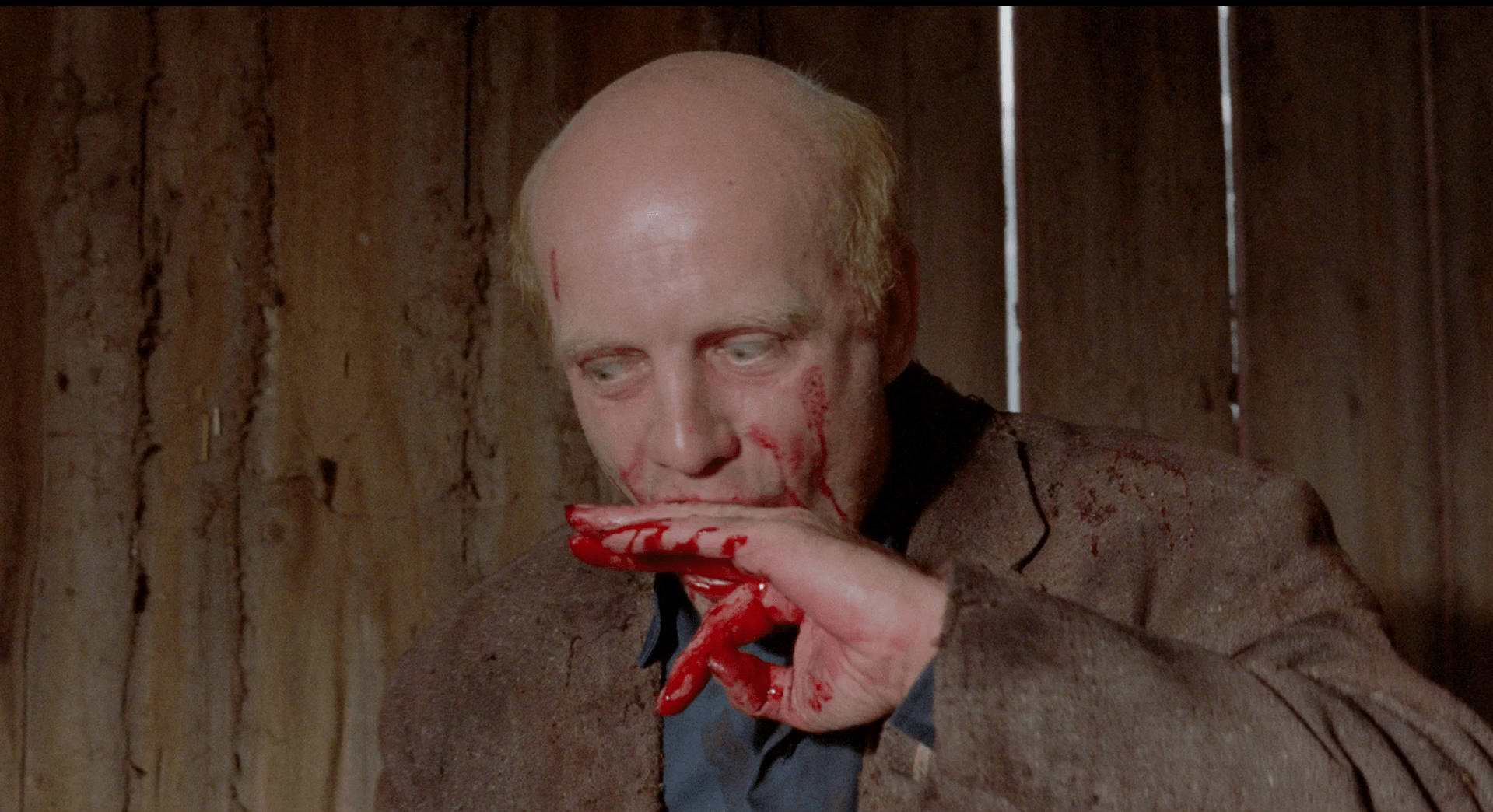
While the technical success of Luther the Geek is due its crew, dramatically it’s impossible to ignore the contribution of Edward Terry, who, as Luther Watts, is quite possibly the most unique horror villain of the last four decades. A socially backward character who we first encounter necking raw eggs in the middle of a supermarket, Luther captures your attention instantly – diminutive, pallid, balding – and Terry’s performance is ripped straight from Stanislavski’s system of The Method as he struts, clucks, and bawks without uttering a single word. He oozes a palpable sense of menace, enhanced by a pair of Richard Kiel/Jaws-esque metal dentures.
With just two acting credits to his name – the other being The Children (1980), which he co-wrote with Albright – Terry is as fascinating as the lunatic he plays. Throughout the ’70s and early ’80s he had an on/off friendship with Albright that waned in the wake of The Children, Terry irked at not having had the opportunity to direct. Thankfully, when Albright presented Terry with the script for Luther the Geek, saying that it was written with him in mind, any ill-feeling was swiftly healed.
Befitting of his Method approach, Terry wasn’t a mingler on set:
“I didn’t really get to know him all that well,” says Norris. “He didn’t socialise that much with the crew, or at least the part of the crew that I hung out with. I did, though, respect what he did as an actor. Luther could easily have been played as a hollow cartoon oddity, but Ed worked very hard trying to bring some truth to his character. I did feel bad for him at times, with those metal dentures in that tasted awful. He carried a bottle of mouthwash with him everywhere on set to help get rid of it.”
Albright similarly has little information to shed on Terry, aside from the fact that they met in New York, and that he regrets how Terry didn’t seem interested in continuing a career before the lens past Luther. Albright does allude to Terry having issues in his life, commenting in the build-up to filming that “he had really cleaned himself up and had stopped drinking” – and with the elfin star now apparently ensconced in a life of happy anonymity, hopefully he’s resting easy in the knowledge that he helped create a truly singular horror villain.
Make-Up and Break-Up
If Ed Terry is the glue that holds Luther the Geek together, then as far as Albright was concerned, the make-up and effects guy was the person threatening to derail the project. “He thought the whole film was about his special effects!” the director grumbled to Vinegar Syndrome in 2015.
Whether that was the case, it’s undeniable that the person hired by Albright to craft what can only be described as Luther the Geek‘s highly impressive practical effects was extremely dissatisfied with his work. “He wanted to leave halfway through, and asked me to take his name off the film,” recalled Albright. For the good of the picture, producer David Platt managed to convince him to see the film out. To this day, his name has never been credited, spoken or referred to on any of the home entertainment editions of Luther the Geek.
Until now…
“It was a guy called Bryant Tausek,” divulges the perennially busy Mike Tristano, whose own career began with him providing FX on Evil Dead 2 (1987). “Bryant was renting space and working out of my shop back in New York City. He was taking on some smaller film and commercial projects, and using my equipment and foam latex ovens. I think at that time he was having a lot of personal issues, and he asked if he could pay me to do most of the FX work for Luther, like the fabrication of the metal dentures, and to sculpt, mould and run most of the foam latex wound and gore prosthetics that would be used in the film.”
“I met Albright and Platt briefly when Bryant brought them by my shop, but he never really liked to introduce his clients to the other FX guys. All I know is that he was having problems dealing with both of them, but as far as I was concerned they seemed like nice guys, and I was just keen on ensuring that the FX pieces came out really well for their film.”
For Tausek, the issues with Luther the Geek were amplified once he left the security of NYC for Illinois.
“We discussed going out there together,” sighs Tristano, “But my schedule just got too busy. Also, there just wasn’t enough money left in the budget to pay for two FX artists on location. He called me during filming and told me he wanted to leave the set, and asked if I’d go out there to finish job. I was still working on a few projects so I told him I couldn’t go. He managed to resolve his issues with Albright and Platt and stayed on.”
“I don’t recall Bryant being a dick on set, and believe me, I have no problem calling out dicks,” adds Norris. “If Bryant was a prima-donna or wanted to go home, I wasn’t aware of it. I’ll admit that I was ‘below the line’ and not always privy to all the goings on, but I’d always thought that Bryant removed his name because the effects were gorier than he had planned. I do recall them rigging a chest wound on the hunter character and Carl asking for more and more blood and there was some push back on that. Of course, the more blood you add, the less the artistry of the latex wound can be seen, so perhaps that was a factor?”
The absence of a credit is still an issue that rankles Tristano to this day:
“We’d always planned to share the credit for the work that we did, that was our deal in addition to him paying me for the fabrication work. I never did understand why he told Albright to remove his credit from the picture, and I was pretty angry when he told me that not only did he take his name off the film, but that stopped me from getting a credit as well. I still don’t even know if he ever told Albright that I was doing a lot of the FX work for the film! At that time my resume was pretty thin so I was disappointed as our work really did look quite good. I must admit that Bryant’s personal issues and inner demons were struggling to be contained at the time, and he was a talented guy. I just think his ego had gotten the better of him.”
Was Albright right in thinking that Bryant considered the whole film to be about the FX?
“Well, a lot of FX guys do feel that way, and it’s often been our downfall with directors and producers. We all have to remember that filmmaking is a team effort.”

All Whitey Then
A relationship paramount to the success of any production is the bond between director and writer – and on Luther the Geek, Carlton Albright and screenwriter ‘Whitey Styles’ got along famously.
“During filming Carl was very careful to maintain that Whitey had written the script, which was of course his nom-de-plume!” laughs Lance Norris.
Even thirty years later, during his commentary for Vinegar Syndrome’s Blu-ray release, Albright maintained the charade.
“I don’t think it was because he was embarrassed about the script, or anything like that,” affirms Norris. “I just think it might have been a trick to give him time to think. One of the worst things a director can do is show signs of indecision, so Carl’s trick when a question about the script would come up was to reply with ‘Let me check with Whitey on that’, as if they were going to talk on the phone that night! Then, naturally, a little later on he would come back with an answer. It was a clever ploy to buy himself a little time.”
For what would be his only directorial outing of a frustratingly short career, there’s little to be critical over the way Albright shot Luther the Geek, even if some of the crew found some of his techniques a little unusual.
“He would have this strange thing where he would try to motivate an actor in a scare scene by using their real life fears,” recalls Peters. “I remember one actress had a fear of doctors, so right before a take Carl would whisper ‘The doctor is right behind you…’ Several of us heard it and from that point on, whenever we needed a member of the crew to do something quickly, we’d always use that line!”
A reason for Albright’s stifled career could be the fallout that followed Luther the Geek‘s release. Given to the Parks Brothers at Quest Entertainment, the movie bombed, bypassed cinemas and disappeared without a trace. A shady, fly-by-night operation, Quest’s antics went on to cost Albright $25,000 of his own money to buy the rights to the film back – and for a movie that only cost $400,000 it was perfectly reasonable that he then shelved it for a few years while he forensically examined the suitability of future distributors.
That Lloyd Kaufman and Troma would come sweeping in was a mixed blessing. With Kaufman himself opening his DVD intro with a bogus and sarcastic synopsis, he handicaps the gritty, nasty, and captivating Luther the Geek out the gate. Having said that, Kaufman at least afforded the film its maiden disc issue.
Winner, Winner, Chicken Dinner
There’s a moment during the on-camera interview with Albright included on 88 Film’s set when he’s asked by the interviewer what audiences will think of Luther the Geek today. It’s difficult not to be moved by the sadness in his eyes when he answers: “I think they’ll laugh”.
Thankfully, he couldn’t be more wrong – and with Luther the Geek receiving boutique Blu-ray treatment on both sides of the Atlantic, it’s heartening to think that the veteran filmmaker might finally see his sole directorial adventure treated with the exaltation it deserves.

 The Schlock Pit