

From the vault: a revised version of Matty and Dave’s mammoth look at the making of Empire Pictures’ spooky western, as originally published in 88 Films’ now out-of-print Blu-ray. Featuring interviews with C. Courtney Joyner, Duke Sandefur and Mike Deak, and an exclusive guest contribution from director Richard McCarthy!
When the words ‘Charles Band’ and ‘series’ are flung together, it’s generally in reference to the likes of Puppet Master (1989), Subspecies (1991), and Trancers (1985); the cornerstone franchises of the B-movie maven’s Full Moon Entertainment. However, in the dying days of the mogul’s ’80s outfit, Empire Pictures, Band assembled an unofficial trilogy of hair-raisers that have all enjoyed an increase in reputation over the intervening years. And rightly so, because parts one and two, Renny Harlin’s slammer-based scare-show Prison (1987), and David Schmoeller’s theological chiller Catacombs (1988), are both genuinely terrific. And although closing instalment GHOST TOWN (1988) is the weakest in this loose triptych of pulpy malevolence, it’s still an effective and irresistible horror western with a fascinating behind the scenes history.
The Good, The Bad & The Satanic
To call its making troubled would be a gross understatement, and if rumour is to be believed, Ghost Town‘s ‘finished’ version is little more than a workprint; a factoid supported by a couple of noticeably half-done effects, and a score that’s pieced together with cuts from the Empire library, chiefly the soundtracks to Ghoulies II (1987) and Crawlspace (1986). Curiously, though, no one from Ghost Town’s cast or crew has ever confirmed whether this is true or not, as the majority of those involved have kept suspiciously shtum about the film’s creation.
“Ghost Town is the eternal Empire question mark,” chuckles Empire and Full Moon alum, C. Courtney Joyner. “I wish I could be of some help, but the only thing I recall about it is the poster of the skeleton standing in the street, poised like a gunfighter. I’ve never seen it, and the script was never discussed with me when I was working for Charlie. But it would have been fun to have taken a stab at it!”
While Joyner – who scripted Prison – is quick to downplay suggestions of any thematic tethering to Ghost Town intentional or otherwise (“it was more likely the influence of Poltergeist (1982) and The Entity (1982). The demon spirit idea was definitely in the air and we all gravitated towards it. Well, I certainly did!”), the incestuous nature of it, Prison, and Catacombs‘ development rendered a synthesis of sorts unavoidable. For instance, after Prison, Joyner was tasked with penning the first draft of Catacombs. With the writer himself freely admitting that he never quite got a handle on the story, Band was ultimately displeased and Catacombs soon caught the eye of Schmoeller, who was then noodling away on Ghost Town with production partner Ron Underwood (the future helmer of beloved monster comedy Tremors (1990)).
The Director with No Name
Given the Texan terror auteur’s knack for crafting sturdy, mood-driven sleepers (witness: the aforementioned Crawlspace, the original Puppet Master, and the underrated, bayou-bound potboiler Netherworld (1992)), it’s tempting to rule David Schmoeller’s departure from Ghost Town as one of B-genredom’s biggest missed opportunities. It’s something that those familiar with his feature debut, Tourist Trap (1979), might agree with anyway, given how that nightmarish slasher exhibits a non-too-subtle western lilt; from the dusty hues of its desert-set opening, to the casting of the granite-jawed star of wild west TV show The Rifleman (1958-1963), Chuck Connors, as a mannequin-loving psycho. Assembled in typical Empire fashion, Schmoeller’s iteration of Ghost Town‘s screenplay was built around a title and poster concept from Band. But, like Joyner’s pass at Catacombs, Schmoeller’s take on Ghost Town left Band unhappy, as the film’s eventual scribe, Duke Sandefur, explains:
“I didn’t want to do Ghost Town. I was in the room with [Empire executive and Charles Band’s ex-wife] Debra Dion because she had read another script that I had written with my dad called ‘Nightcrawler’. ‘Nightcrawler’ has gotten me more jobs than any other single factor in my life, but to this day it has never been produced. Anyway, Debra Dion did not have a slot for ‘Nightcrawler’ – it was out of their comfort zone – but she did have Ghost Town on the schedule and a script that was not in good shape at all. Mind you, I don’t know what process led to it being that way, and far be it from me to judge. If I had to guess, I’d say that David Schmoeller was writing at a moving target and trying to serve too many masters. I kept what bones I could – the characters, premise, etc. – but set it aside for the most part. I just didn’t have enough time to completely rewrite someone else’s work.”
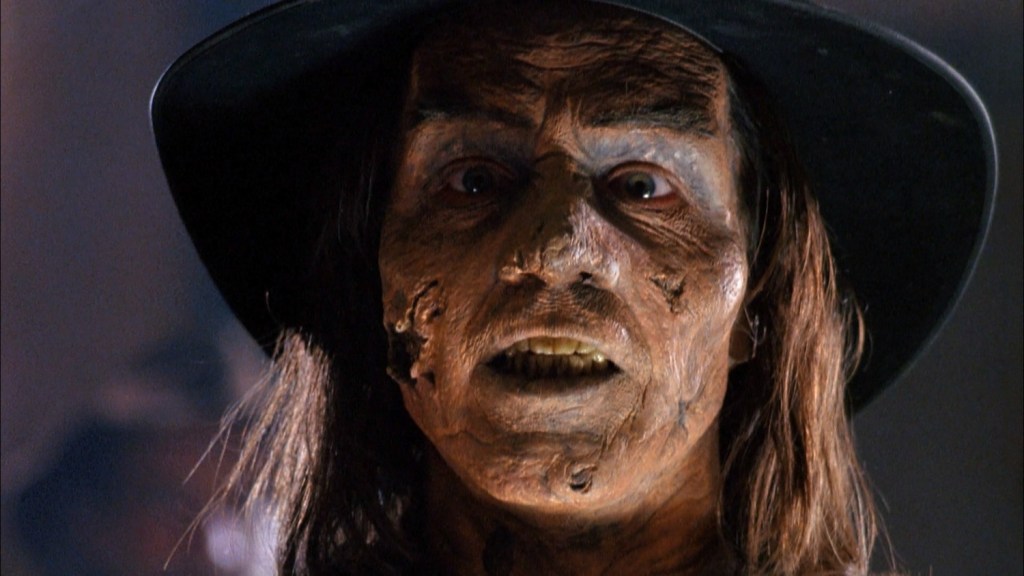
Sandefur – who’d go on to pen the lavish, Robert Englund-led Phantom of the Opera (1989) – certainly had the appropriate lineage to tackle Ghost Town. As well as the Tarantino-approved curio Poor Pretty Eddie (1975), Sandefur’s screenwriter father, B.W. Sandefur, has a litany of small screen Old West adventures to his credit, including episodes of Bonanza (1959-1973), The Virginian (1962-1971), and Little House on the Prairie (1975-1983) – the latter of which Duke even contributed to, writing the nineteenth episode of the show’s final season. Alas, Sandefur barely adds to Schmoeller’s woefully slight scenario. In it, a modern-day deputy (Franc Luz, The Nest (1988)) investigating the disappearance of a runaway bride (Catherine Hickland, Witchery (1988)) comes face-to-face with an undead evil lording over a long-abandoned frontier town: a cadaverous cowboy called Devlin (the late, great Jimmie F. Skaggs, a few months before his equally awesome turn as the big bad in Schmoeller’s Puppet Master), who’s trapped the spirits of this once thriving community in some kind of weird purgatory.
Heavily indebted to Prison and Catacombs‘ blend of mystery, spectacle and place, Ghost Town‘s simple narrative dovetails with them idea and beat-wise, but is completely bereft of the kind of intriguing subplots and compelling, nuanced characters that make Harlin and Schmoeller’s films so gripping. In fact, Ghost Town is often pretty tedious, and several scenes are so languidly paced that you can’t help but feel that they’ve been rendered that way to mask how thin the material is. Yet as Sandefur claims, that may be the result of him not having the time to rework Ghost Town from scratch; a point open to debate. After all, it’s clear that the scripter, the film’s crew, and the director eventually handed Ghost Town’s reins after Schmoeller left the project all have a wildly different opinion on the subject.
“To the best of my recollection, Ghost Town was scheduled for a four week shoot, all on a standing western set about an hour outside of Tucson, Arizona,” offers Mike Deak, the location supervisor of Ghost Town‘s plentiful and on the whole impressive special effects. “I was part of John Buechler’s Magical Media Industries and besides keeping the FX crew in line, I primarily rigged most of the blood and gore gags. Scott Coulter did the make-up on the Devlin character every day for the first three weeks and they rarely, if ever, photographed him. The reason I bring that up is because there wasn’t much of the actual script being shot during that time at all: the director was trying to shoot all this atmospheric stuff, and I can just remember panic setting in among the crew that there was very little of its story being shot.”
Long attributed to the mysterious ‘Richard Governor’, Ghost Town was actually the feature debut of Australian filmmaker Richard McCarthy; a prolific and award-winning director of commercials. Winning the industry’s prestigious International Commercial Directing Clio Award in 1982 (and beating Ridley Scott in the process), McCarthy was hired on the strength of his short-form work and was largely unproven on anything feature-length. With only a sixty minute, made-for-television special for comedian Benny Hill, Benny Hill Down Under (1977), coming anywhere close, McCarthy sharply addressed his own misgivings about Ghost Town in a rare interview with Italian film journalist Francesco Borseti:
“Ghost Town represents one of the worst choices I have ever made in my drive to make quality feature films. I was directing commercials in America at the time and in the final stages of getting my film ‘Copycat’ the go ahead by MGM… So the task of filming a feature [like Ghost Town], with stunts and cheap special effects – I still cringe at the sheriff who rises from the grave – in a few days over two weeks was daunting to say the least.”
Detailing a hasty and impoverished production at the mercy of Band’s penny pinching as Empire slid into financial ruin, McCarthy’s chat with Borseti (available in Borseti’s book, It Came From the ’80s! (2016, McFarland & Co.)) paints a tantalising picture of what he intended Ghost Town to be: a slow burn in which measured visuals and a dense soundscape were to supply the majority of the horror. Citing the looming threat of union interference as why he took the ‘Governor’ pseudonym (McCarthy was a member of the Directors Guild of America, Ghost Town was non-union), McCarthy now laments the decision, and calls it a “foolish and career-changing [choice that he’ll] always regret”. It’s hard not to agree with him either as, for all the gaping holes of the screenplay, Ghost Town is stylistically and ambiently excellent. Possessing a keen eye and demonstrating an affinity for the surreal that calls to mind Jean Rollin and David Lynch, it’s easy to believe that McCarthy could have graduated to the upper echelons of cult movie cool had he been more savvy to – for lack of a better term – ‘the Empire way of doing things’. By now, he should be sitting alongside those other filmmakers who have all flourished under Band’s canopy: Schmoeller, Stuart Gordon, David DeCoteau, and Ted Nicolaou; mavericks who have all reconciled their own artistic vision with the more gimmicky requirements of Band’s assembly line.
Of course, if you ask Mike Deak, he remains sceptical of McCarthy’s actual contribution:
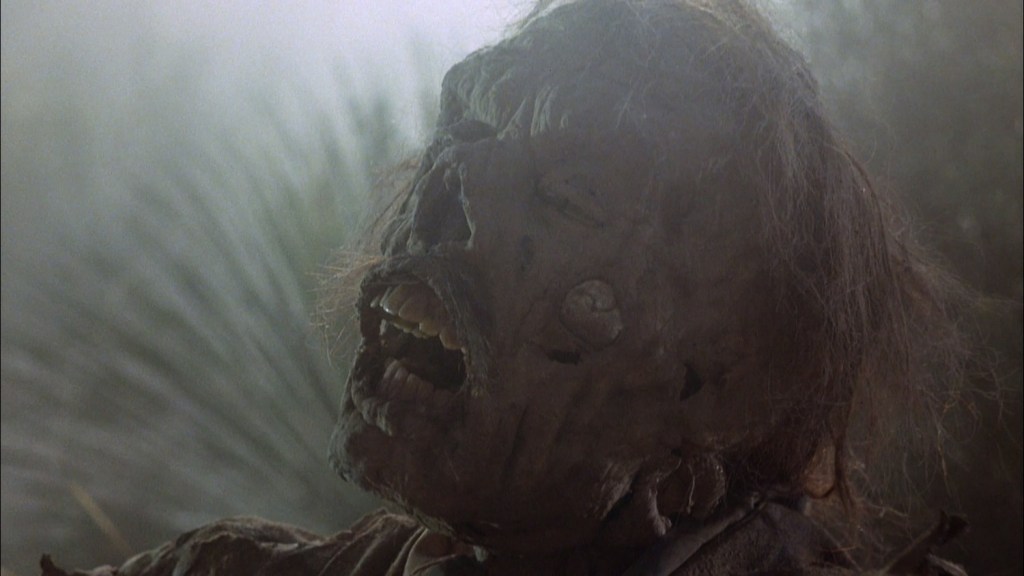
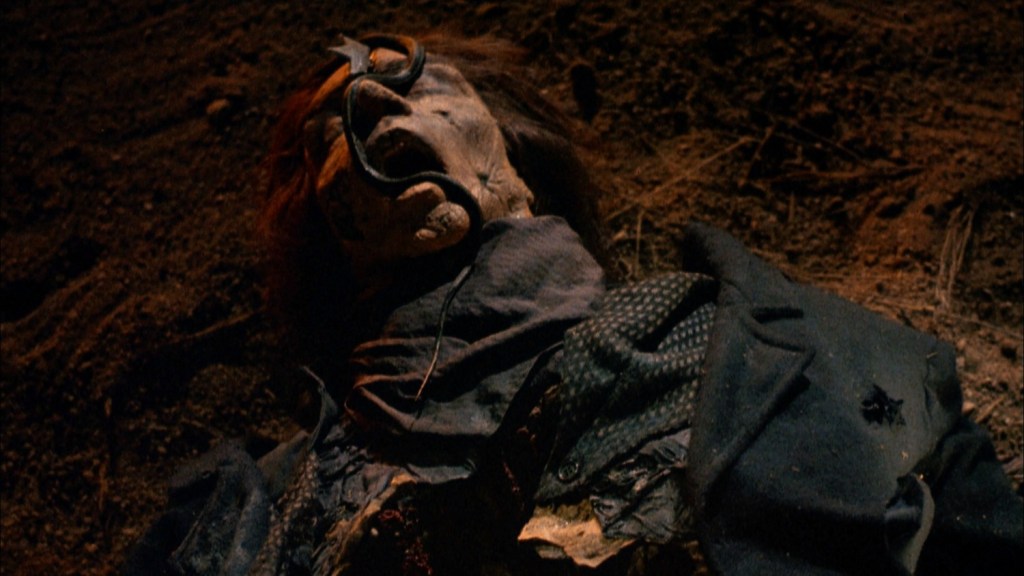
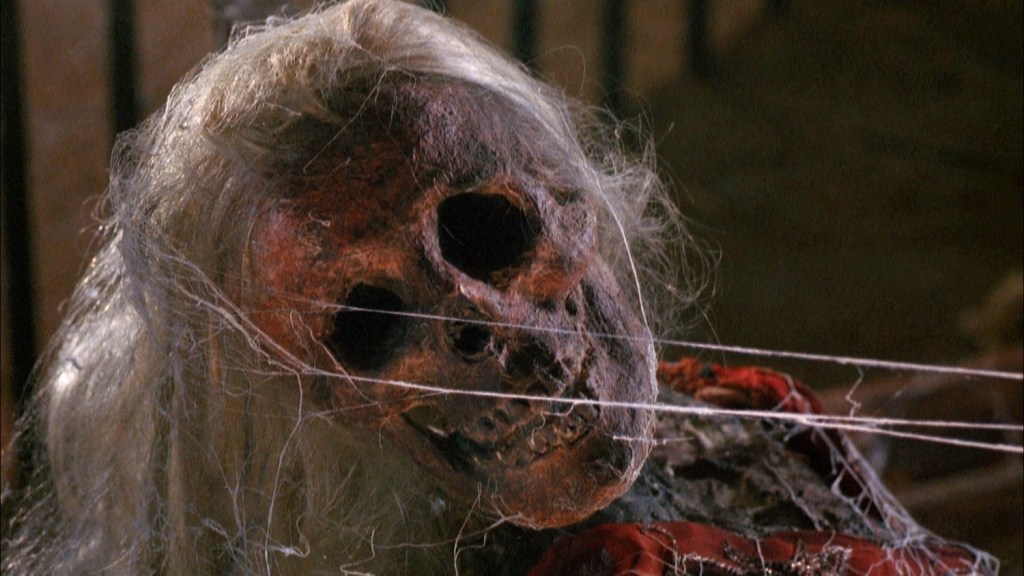
“I don’t exactly remember a lot of things about Ghost Town,” the FX wiz sighs. “And to be honest, I don’t think anyone remembers all that much about McCarthy. On one night of the shoot, there was a scene where Franc Luz and Catherine Hickland had to hide in a small wooden box next to the church and leap out on cue. The sound guy had them on wireless mics and just before ‘action’ was called, anyone near the sound cart could hear them trashing the director! An instant I remember with McCarthy was the moment where Franc finds a body in a chair and touches it. It was meant to be a little throwaway gag, but McCarthy wanted to basically recreate the scene in Psycho (1960) where the mummified Mrs. Bates turns in her chair. I spent an age trying to do it, and I just remember thinking ‘we’re spending a ridiculous amount of time on this’.”
Deak continues:
“The thing is, Ghost Town‘s core crew had been churning Empire movies out for the last few years, and a lot of the new directors who’d come in were sometimes rather ineffectual. They would say what they wanted or what the next shot was, but it was up to us or whichever department was primarily involved and we’d figure it out and do it. We knew each other’s strengths and weaknesses very well, and we’d work together to get it done.”
And behind the scenes of Ghost Town, there were few stronger than veteran cinematographer Mac Ahlberg…
The Shootist
In 1974, the release of cheeky comedy Around the World with Fanny Hill saw its director, Mac Ahlberg, described as “Ingmar Bergman’s right-hand man” by the China Mail. Revered status for sure, although it does beg the question how this Nordic powerhouse – a totem of European art cinema – came to lens over two-dozen features for Charles Band.
Ahlberg was born in 1931 in the small coastal municipality of Angelholm, Sweden. Beginning his film career in the ’50s as a camera assistant, Ahlberg garnered acclaim for his cinematography on 1963’s five-part documentary, Ingmar Bergman Makes a Movie. Settling into the director’s chair in 1965, Ahlberg unleashed I, A Woman: a slice of erotica that forever changed the landscape of adult moviemaking. A Swedish-Danish co-production, I, A Woman was incredibly successful and helped initiate a wave of sexploitation pictures into mainstream American cinemas during the ’60s, becoming so culturally significant that it even inspired pop art supremo Andy Warhol to co-direct his own experimental spoof of it, I, A Man, in 1967. As erotica auteur Radley Metzger – who picked up the film’s U.S. distribution rights – stated in a ‘67 issue of Filmmaker Magazine, “[I, A Woman] was the first feminist erotic film, and it pushed a button with every woman in America”.
While Ahlberg went on to helm a couple of sequels to this world cinema breakout hit, as well as a bunch of other sexy gems like The Second Coming of Eva (1974), the lure of Hollywood proved too strong – and in 1981 Ahlberg found himself photographing Tom DeSimone’s slasher favourite, Hell Night, in California. With his personable nature and professional dexterity, Ahlberg quickly forged a working relationship with Band after being introduced by Hell Night’s producer, Irwin Yablans, who was in the process of setting up the impresario’s 3D creature feature, Parasite (1982). The rest, as they say, is history; and over the course of the next two-and-a-half decades, Ahlberg’s robust style was a key component in cementing Empire and, later, Full Moon’s reputation as the sturdiest purveyors of contemporary B-flicks.
Ahlberg died on the 26th October 2012, and upon his passing his old Re-Animator (1985) and From Beyond (1986) compatriot, director Stuart Gordon, delivered a fitting eulogy over on Full Moon’s website:
“Mac put everyone at ease. His twinkling eyes and a subtle joke diffused any tense moment, while the actors loved him because he always made them look terrific. I loved him for the same reason: he made my movie look terrific, and he made me look like I knew what I was doing.”
But despite a fifty-year career that saw him rub shoulders with talent as diverse as Bergman, Gordon, John Landis, and Michael Jackson (Ahlberg shot Landis’ promo for the King of Pop’s 1991 smash, Black or White), it’s somewhat ironic that the Scandinavian maestro was only ever bestowed one award for his prestigious cinematographic skill. That award came at Portugal’s renowned festival of fantastic film, Fantasporto.
The film that brought this accolade?
Ghost Town.
As well as capturing Ghost Town’s Tucson vistas with stunning capacity, Ahlberg hones in on the textures of the film’s splendid location: a battle-scarred western set, built in 1939 for Wesley Ruggles’ Arizona (1940), and which had been used in over three-hundred other productions including Rio Bravo (1959) and The Outlaw Josey Wales (1976). Bringing McCarthy’s striking images to life with authority, there’s a beguiling alchemy to their often lyrical union; an unmistakable artistic harmony that makes the murmurs of Ahlberg allegedly usurping McCarthy as Ghost Town‘s director – after McCarthy was supposedly fired from its making – all the more strange. Stranger still is that such an erroneous bit of hearsay is Ghost Town‘s most frequently quoted nugget of trivia. Thankfully, there’s plenty of time to set the record straight.
And what better way to do that than by turning the rest of this over to Ghost Town‘s helmer…

Giving Up the Ghost: The Life and Career of Richard McCarthy, in His Own Words
by Richard McCarthy
‘A man who reached for the stars, only to be blocked by the Hollywood ceiling.’
That may seem a concise summation of my film career, but in a life that’s earned me the riches of a multitude of awards and a limited fame, the shame of removing my name from the one film I made in America has affected me greatly. I can only see now, after all of these years, that I clearly gave up on my dream and ran from Hollywood, leaving behind little more than an odd shoe stuck in some producer’s door as evidence of me ever being there in the first place.
I was born in Sydney in 1941. I graduated with a degree from the University of New England, having majored in English. After some time spent with the radio department of ABC in Australia, the early ’60s saw me hosting a TV program called Sydney This Week as part of the reporting team, before I took advantage of some family connections (my uncle was the Australian minister of the United Nations) to get a post over in ABC’s New York office.
I was completely enamoured with America; its great Constitution, its Bill of Rights, and the then growing Civil Rights movement – so much so that I was granted a rare radio interview with Martin Luther King. Though an honour for me, it did reveal an ugly, deep-set racism within my department at ABC, who, on receipt of the interview, admonished me for wasting my time “talking to n*gro troublemakers that the people of Australia have absolutely no interest in”. This was the time of the appalling White Australia Policy, and subsequently I decided to flee ABC and seek a Master’s Degree in Radio and Television Communications at Syracuse University in upstate New York. Upon my graduation, I headed for the studios of public television broadcaster WXXI. There I was involved in a whole host of exciting programs, the standout being King, A Tribute: a memorial that I put together and aired on that fateful day in 1968 when Dr. King was assassinated. Such was the delicate and measured tone of this broadcast, I was later told that it was only by a fraction of points that I missed out on receiving a Peabody Award.
Eventually, WXXI lost its funding and I began hunting for new employment. I ended up back in New York, where I was offered twice my public television pay to be a producer-cum-director for the Compton Advertising Agency – from public affairs to Madison Avenue! In turn, this led to me joining the Directors Guild of America, and after many commercials I returned to Sydney to set up Eureka Film Productions. In that first year I won my initial Commercial Director of the Year award at FACTS. I’d go on to win six in a row, which culminated in an International Commercial Directing Clio Award in 1982, where I pipped Ridley Scott and Alan Parker to the prize.
These years at the top of my craft were a dizzying plethora of moments to treasure. I spent two days with John Wayne in the wake of True Grit (1969), while I worked with Danny Kaye on a Save the Children campaign that was especially memorable. I travelled the world on so many occasions; seated in the camera chair of helicopters, filming the secret nooks and crannies of the Grand Canyon and Yosemite, then racing off to Europe to fly around the Châteaux of the Loire Valley. It was an incredible ride, and with such success in advertising the big bucks of Hollywood began calling. I ventured over the Pacific once more, and I sold my commercial wares to American agencies while I tried to raise the finance and interest in at least three films. All of them either lost their financing or their lead actor – both of which are so often symbiotic. As I waited for one of my pet projects to come to fruition, a friend of mine, Tim Tennant, proposed the idea of directing a film that he was producing called Ghost Town.
Now, from the outset there was a rush to begin filming Ghost Town, so initially it was a case of arduous hours in pre-production for a picture slated to be shot at Dinocitta Studios in Rome, the former home of so many great spaghetti westerns and then the base for Empire Pictures. I suspect it was financial problems, but at the last moment Charles Band changed his mind and decided we had to shoot the film in Tucson, Arizona, on an already standing western set that was a short drive from the main city.
I read recently that David Schmoeller said that there’s very little of his original story in Ghost Town. Well, if you excuse the chest thumping, it was primarily my contribution to Duke Sandefur’s relatively unfinished screenplay that added some weight to the film’s thin premise. Sandefur later clashed with Tennant and me in a production meeting, when I presented the style of film I intended to shoot. Sandefur seemed quite obsessed with guns, especially the new .454 Casull, which for the life of me I just couldn’t understand the importance of in relation to the story. In hindsight, our differences with him stemmed from his simple need to make a straight-forward western, albeit one with ghostly overtones. In contrast to that, my ideas were geared more towards removing the unnecessary scenes of gun worship that contributed nothing at all to the build-up of horror. I read with interest Francesco Borseti’s book, whereby Sandefur recalls an argument he supposedly had with me that ended with him hurling “blow me” in my direction as he stormed out of the room. It’s a slur I have no recollection of – although it’s ironic that he can recall such an exit, yet seems a little vague about the lack of energy in his own screenplay.
Anyway, with only twenty-three days scheduled for filming (after Tennant and I argued the impossibility of a proposed fourteen day shoot), and a budget of just over $1million (which had been cut down from a planned budget five times that), I quickly realised the importance of creating horror in the daytime. I chose to do what Jack Clayton had done with his fine film, The Innocents (1961). The Innocents relied heavily on the most wonderful daytime sequences, where a black-robed governess could be seen standing in the marshlands, simply staring at the children. Sound was key to Clayton’s film, and this was something I thought I could replicate with Ghost Town by way of some clever foley work. The first scene, for example, we don’t initially see Devlin. Instead, we hear the hoof beats of his approaching horse as our heroine, Kate, is swept screaming from her car. The call of the crow is another repeated sound in the film and common to many other things of Ghost Town‘s ilk – not least Edgar Allan Poe’s The Raven. To me, such images are common triggers to an audiences’ memory of past horror movies, and I’ll happily admit I used them in Ghost Town.
I admired Empire executive Debra Dion a great deal. She struck me as a person with fine cinematic vision. I just wish she’d stepped in to mix the film in my absence during my Christmas visit to Australia, instead of leaving it in the hands of her despotic husband, Charles Band. Realising I wasn’t going to be there to supervise the mix, Band rushed in and overruled my sound notes. To save money – and, perhaps, to satisfy his own lack of vision – he reduced Ghost Town‘s mix to the bare minimum. Band also managed to oversee the film being re-cut, much to its detriment, although when I returned in January I was mercifully able to restore it to the best of my ability. Some of the missing sound is still obvious. My intention was to fill the scenes where Langley is searching the town with whispers enhanced by musical discords. Naturally, Band removed all of this in his wrecking ball mix, and Ghost Town is littered with such glitches. Another is when Langley enters the old Sherriff’s office. As he searches the desk, he was meant to hear footsteps above him coming from the cells and the sound of a woman crying. In the finished film, Langley looks up and there’s no sound, so what he’s looking at remains a mystery. It’s a similar situation when he climbs the stairs shortly after, as I intended a creak to symbolise the sound of something evil. Sadly, Band cut it.
I must admit, though, one aspect of Ghost Town where I was blessed was with the supporting cast – although there were some minor issues with my two leads. Catherine Hickland was dropped in my lap by Band, unseen and without an audition. She was much older than the part required, and knowing that I hadn’t chosen her myself, she was antagonistic and difficult from the get-go. Franc Luz was fine, but perhaps a little wooden and hard to persuade to be more natural and less the chiseled hero. Jimmie Skaggs, however, was a real star. His malevolent turn as Devlin is a truly fine performance and the backbone of the film. Penelope Windust as Grace was beyond superb, displaying a subtlety that should be applauded, and the same goes for Bruce Glover. They were both absolute professionals who required very little direction and made my life a hell of a lot easier! Laura Schaefer as Etta was a real discovery. The camera loved her, although her agent’s insistence on using a body double for the love scene presented its own set of problems. We had to hold a body double casting session in Tucson, and to this day I’m amazed at just how many ladies turned up and casually took off their clothes for the camera. For me, it was an acutely embarrassing ordeal!
Mac Ahlberg was a wonderful DP to work with, and he supported me to the hilt. Annoyingly, Band played another of his careless, unthinking cards and pulled Mac off Ghost Town so he could work on something else. I had major scenes to shoot, including all those closing night scenes like the burning of the church and the final shoot out. They were all critical scenes, and unfortunately I can’t recall who it was who stepped in, but he was pretty good at matching Mac’s style. That’s probably where rumour came from about me being fired, and I’d like to take this opportunity to say that that was categorically not the case. In fact, the only moment of drama on the film was nowhere near as drastic as many have been led to believe. There was, though, a day where I needed to put my pride on the line and stand firm. Band had decided that I was not on schedule – whatever he thought that was – so during the filming of the blacksmith being confronted by Devlin – an entire sequence not in Sandefur’s screenplay, incidentally – a random guy turned up from Empire’s office, the intention being to stand over my shoulder and speed me up. I’d done the wide shot and was in the process of moving the camera for a medium shot, when this suit – this stooge – stepped in and ordered me to leave the camera where it was, and to be satisfied with tightening the framing with a zoom. I was aghast, so I sent the cast and crew to lunch and suggested to this bloke that he might want to direct the film from now on. He hesitated and looked a little shocked by my outburst, so I continued by standing my ground. I told him to tell Band that if he truly wanted to fuck up a film that was mostly in my head, and in my own shot by shot, hand-drawn storyboards he was welcome to do so. I yelled, “Go ahead and fire me, you useless prick!” Well, thank God he didn’t call my bluff! We completed the scene that afternoon and I stayed under the employment of Band and Ghost Town until its final fiery conclusion.
As for my alias, as I mentioned earlier, I was a fully paid up member of the Directors Guild of America. And since Arizona fell firmly within the Guild’s territory, the fact that Ghost Town was a non-union film meant that no Guild member could work on it without risking a huge fine, including the director’s fee. Call it greed, but I needed the money so I took a gamble. However, as the second week of shooting trundled on, there were whispers that the DGA were planning to visit the location. With a financial penalty looming, Empire Pictures persuaded me to assume a pseudonym; the incentive being that I’d be shooting another two films for them afterwards which would give me the opportunity to assert my real name. Needless to say, that never happened, and despite the enraged disgust of my agent, Bobby Littman, Band refused to change my masked credit on the film as it had apparently been set in concrete. Ghost Town would forever become ‘a Richard Governor film’.
So with my Empire adventure the stuff of nightmares and little interest in the scripts I tried to sell in Hollywood, I had no alternative but to head back to Australia. I found an incredible home on a cliff facing Sydney, and I was soon introduced to my wife-to-be, Amanda. She’s the best thing that’s ever happened to me and – if I had successfully promoted Richard McCarthy as Ghost Town’s director – I suspect our paths would never have crossed. Now that’s a Hollywood tale; a true love story.

 The Schlock Pit