

Matty celebrates Mark L. Lester’s bombastic buddy cop classic.
SHOWDOWN IN LITTLE TOKYO (1991) is adored in action circles.
Rightly so.
Like director Mark L. Lester’s previous, the magnificent Class of 1999 (1990), this dynamic caper is another solid gold classic of the VHS era; another masterpiece that came and went theatrically, but found an appreciative audience on tape.
A potpourri of fads and subgenres, Showdown rides the wave of East-meets-West exoticism instigated by The Golden Child (1986) and Black Rain (1989) (cf. Rising Sun (1993) and, at the DTV end of the trend, American Yakuza (1994) and Blue Tiger (1994)). It’s anchored by big time ‘action star’ footing in the manner of ‘Stallone/Rambo’, ‘Van Damme/Bloodsport (1988)’, and ‘Seagal/Above the Law (1988)’; and comfortably sits on the step below 48 Hrs. (1982), Lethal Weapon (1987) and Lethal Weapon 2 (1989) in the pantheon of buddy cop flicks.
Ostensibly a vehicle for Dolph Lundgren, Showdown in Little Tokyo finds the Swedish hunk as a maverick cop taking on the Yakuza, powered by revenge. Why? Cary-Hiroyuki Tagawa’s nasty oyabun killed his ma and pa, natch. In essence it’s the same terrain as Lundgren’s earlier romp, The Punisher (1989); a rollicking thrill ride whose cult status today rests on the fans it gathered during the halcyon days of video. However, while sharing an outlandish approach to violence — and, indeed, a helmer named Mark (The Punisher was shepherded by Mark Goldblatt [1]) — Showdown is far more jocular. Lundgren’s eponymous vigilante in the down n’ dirty Punisher had a foil, but the knockabout chemistry his character in Showdown, Detective Chris Kenner, has with the plucky, by-the-book upstart he’s paired with — Brandon Lee’s wisecracking yet just-as-handy Johnny Murata — is the film’s genial centre. It’s the key to its longevity too.
Action’s greatest shoulda been, Lee’s death on the set of his beautiful and devastating magnum opus, The Crow (1994), fostered an immediate must-see quality to his prior wares which lingers today. There are only a handful of Brandon Lee movies available; thus they ooze a James Dean-esque intrigue for the bangs n’ booms contingent. Pre Lee’s passing, Showdown in Little Tokyo and the gig he dove into afterwards, the awesome Rapid Fire (1992), were already solid renters. Post, their value skyrocketed. Rapid Fire proved Lee as skilled as his equally tragic father, Bruce, in the martial arts department. Showdown reveals him to be warmer and funnier than dear ol’ dad ever was [2].
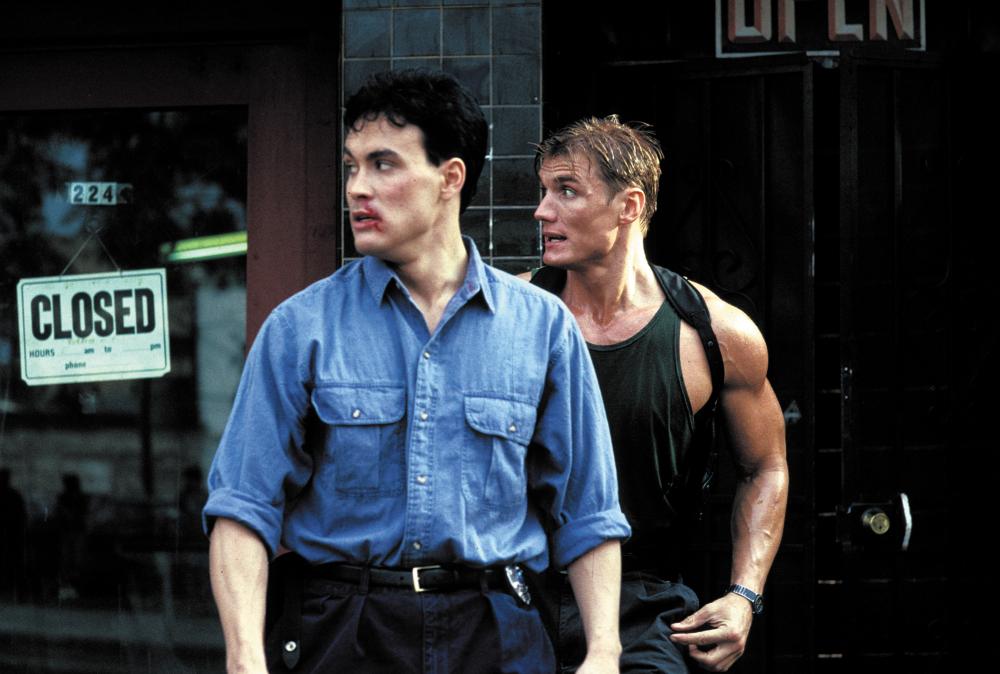
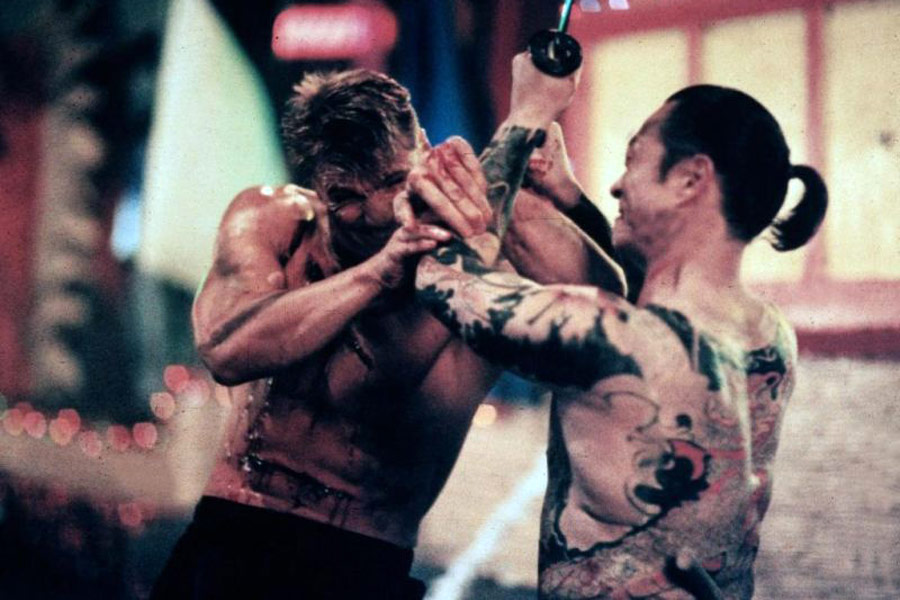
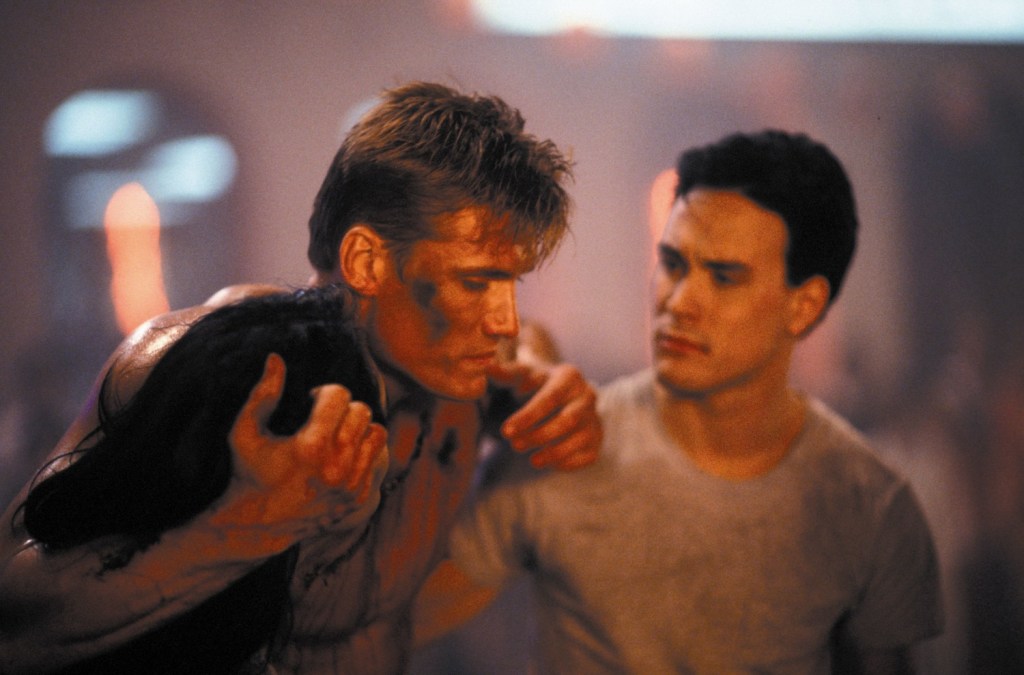
In the Riggs and Murtaugh stakes, Lundgren and Lee’s interplay is delightful. It strikes a nice balance between macho, tongue-in-cheek and, thanks to an infamous line about Kenner’s mammoth member, joyously homoerotic. The actual dialogue is cookie cutter, but Lundgren and Lee’s lively verbal and physical jousting — part warring cats, part twin flames — is an exercise in sheer charisma. Lester, of course, is au fait with double acts, allegiances and teams. His work is full of them. It’s a recurring flourish and arguably the quintessential Lester theme. Witness: Steel Arena (1973), Truck Stop Women (1974), Bobbie Jo and The Outlaw (1976), Stunts (1977), Roller Boogie (1979), Firestarter (1984), Commando (1985), Armed and Dangerous (1986), Classes of 1984 (1982) and 1999, and, well, everything really. That Showdown in Little Tokyo reconciles the notion with Lester’s other signatures nearly renders the film his definitive auteur text. It’s almost — almost — on par with Commando and Classes ‘84 and ‘99. The mayhem — which ranges from a club scrap and mansion siege, to car-based carnage, gunfire and an incredible bathhouse brawl (one of the finest sequences in Lester’s oeuvre, full stop) — is exciting and robustly staged. The humour — something present even in a lot of Lester’s most ‘serious’ offerings — lands. The technical credentials are excellent. Showdown is well shot, well scored, and delivered with punch. Lester loves a villain and Tagawa’s impotent crime-lord is suitably colourful, and the vibrant, carefully picked locations (which includes the third best use of the former Japanese Union Church in Los Angeles [3]) lend the film an immersive, lived-in swagger typical of its maker’s output.
Perverse, then, that Showdown in Little Tokyo is a compromised vision. Despite a harmonious shoot, producers Warner Bros. commandeered the project during editing. Depending who you ask, they pruned Lester’s original version of either ten or twenty minutes. The editing wiz Warner hired to do it, Michael Eliot, performed a similar job on their preceding Steven Seagal epic, Out For Justice (1991). Lester was understandably furious, to the point where he cites Showdown and the distribution issues that plagued Class of 1999 as the reasons why he opted to establish his own company, American World Pictures.
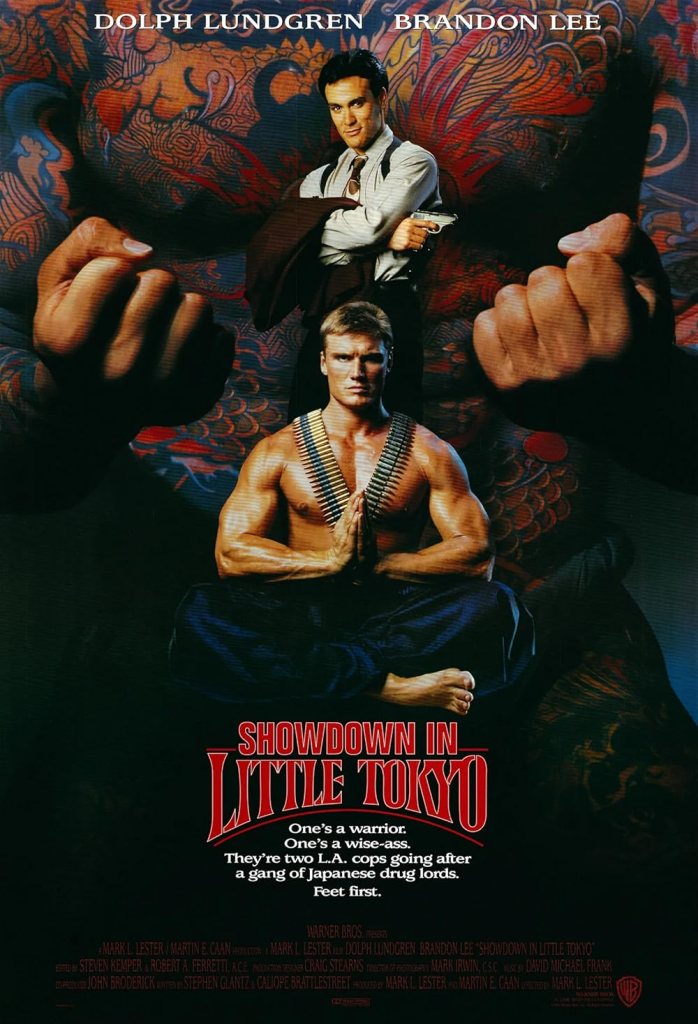
Showdown in Little Tokyo opened in L.A. on 23rd August 1991 and went on to screen throughout California, Arizona, Hawaii, and, by September and October, New York and Texas. Appropriately, it played alongside Out For Justice in several territories. The film hit U.S. video on 8th January 1992, and landed on U.K. cassette four months later, on 8th May ‘92. For Showdown’s British bow, Warner Home Video promoted it with a Spot the Difference contest ran in conjunction with newspaper The Sunday People, who were provided with fifty copies to dole out to lucky winners.
[1] An editor by trade, Goldblatt, incidentally, spliced Lester’s Commando.
[2] Showdown in Little Tokyo stands as Lee’s Hollywood debut, following Hong Kong production Legacy of Rage (1986) and West German production Laser Mission (1989) (aka ‘Soldier of Fortune’).
[3] Maniac Cop 3: Badge of Silence (1993) bags second place, and John Carpenter’s Prince of Darkness (1987) is the daddy. Because like that could be beaten.
 The Schlock Pit