
Dave dusts off a rare erotic thriller and discovers that there’s likely good reason for its scarcity.
“The people in Palm Beach are perverted,” remarked new resident and former Playboy Playmate, Pamela Bryant to a clearly bewildered Miami Herald reporter in 1978. “They are! Look, I just grew up in a small town in Indiana. I had never met a gay person or seen a Rolls-Royce. And then all of a sudden I was thrown into Rich City USA, where for all these people it’s fashionable to be rich and bisexual.” [1]
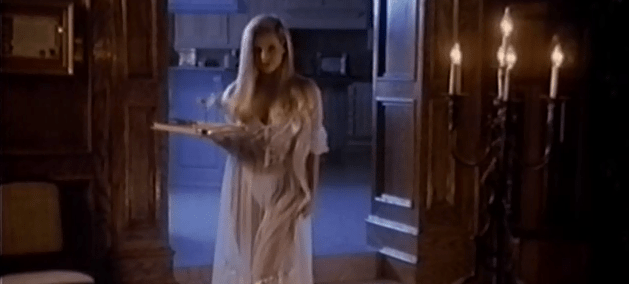
Thankfully, it seems that sadomasochistic straight sex was fine and dandy for the H.O.T.S (1979) actress, who died prematurely at the age of fifty-one in 2010 following a particularly severe (and non-sex related) asthma attack. S&M is the backbone of TRAPPED, a film which finds Bryant in the role of Lauren; a beautiful ex-Playmate who thinks she’s left her troubled life in the past after marrying a prominent criminal lawyer (Reid Smith). This level of wealthy wedded bliss seems to be everything she’s ever dreamed of – but behind her back, her scheming hubby has begun a torrid affair with her closest friend and murder is on their agenda.
Trapped was the brainchild of producer and writer Sheldon Silverstein, a curious character whose bio insists that he worked with Sergio Leone and Federico Fellini while living in Italy – yet on return to America, he could only muster this and forgettable no-budgeters The Pumpkin Karver (2006) and Hazard Jack (2014). Considering the company it kept, Trapped is certainly the best of Silverstein’s three. That is, though, the faintest praise I’d be willing to damn it with. Set entirely within the grounds of a generic Hollywood mansion, the film – the first and last feature of director David Blum – suffers from a degree of claustrophobia and a lead wholly devoid of any redeeming qualities. Granted, Bryant did have a handful of memorable turns to her credit, not least Sue Ellen, one of Nicholas Worth’s hapless victims in Don’t Answer the Phone! (1980). Alas, here her acting deficiencies are laid bare.
It’s a trait that would be in some way forgivable in the wake of a strong script, but Silverstein and co-writer Michael Doogan’s attempts to inject a little neo-noir into this tale of seductive duplicity fall spectacularly flat. The sight of a gimp mask-wearing James Van Patten in hot pursuit on foot of a dolled up Bryant perfectly encapsulates its ill-fitting tone.
The remaining supporting cast escape largely unscathed. Reid Smith (who also suffered a premature death in his early fifties) essays Bryant’s philandering husband with requisite menace. Alina Thompson, fresh from playing the titular character in Axis Entertainment’s The Pamela Principle 2 (1994), is also good value as the seductress/bestie. Paul Winfield pops up to grab some ass at a dinner party, and there’s a belated Hoke Howell cameo as a cop who tries to instil a sense of cohesion into the confused storyline.
Picked up for distribution by Shapiro Glickenhaus Entertainment around a year before the home video titans disbanded, Trapped was representative of the kind of wayward acquisitions (i.e. Backfire! (1995), The Little Patriot (1995)) they made a habit of releasing in their twilight period. Of greater interest is that the film was snagged by Phil Grace and Ron Gale’s New Age Entertainment in the U.K. during 1995. Trapped was certified, a screener was issued to trade press, but, like sexy stablemate Possessed by the Night (1994), it failed to get a general release. In a comical postscript, Grace and Gale were clearly determined to utilise the eye-catching artwork they commissioned for the film. They repurposed it for The Last Temptation of Eve (1999) which they issued through their successor outfit, Third Millennium Distribution.
Also known as ‘The Killing Jar’.
USA ● 1994 ● Erotic Thriller ● 87mins
James Van Patten, Pamela Bryant, Paul Winfield, Hoke Howell ● Dir. David Blum ● Wri. Sheldon Silverstein, Michael Doogan

[1] Girl in the Centerfold Talks About Us by Steve Sonsky, The Miami Herald, 12th March 1978.
 The Schlock Pit