
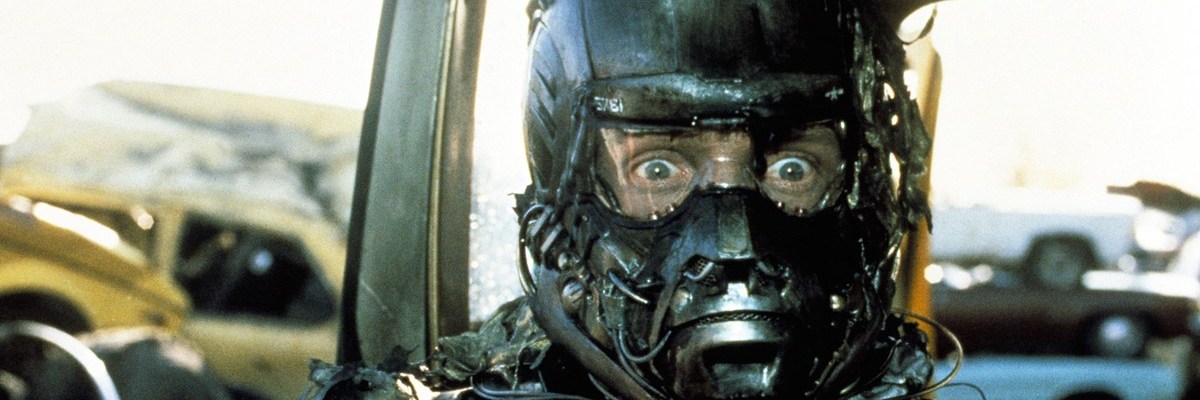
Matty picks apart a sci-fi actioner that’s intriguing in genesis and concept but clunky in execution.
Every now and then, cult film hubs on social media share that old Variety ad for ‘David Cronenberg’s Frankenstein’. Taken out in May 1980, during the protracted post of the notoriously difficult to make Scanners (1981), before Cronenberg had written a word of the screenplay, ‘Frankenstein’ was eventually junked in favour of Videodrome (1982). The project has since become one of genre cinema’s great ‘what could’ve beens’.
And yet, in a sense, ‘David Cronenberg’s Frankenstein’ exists.
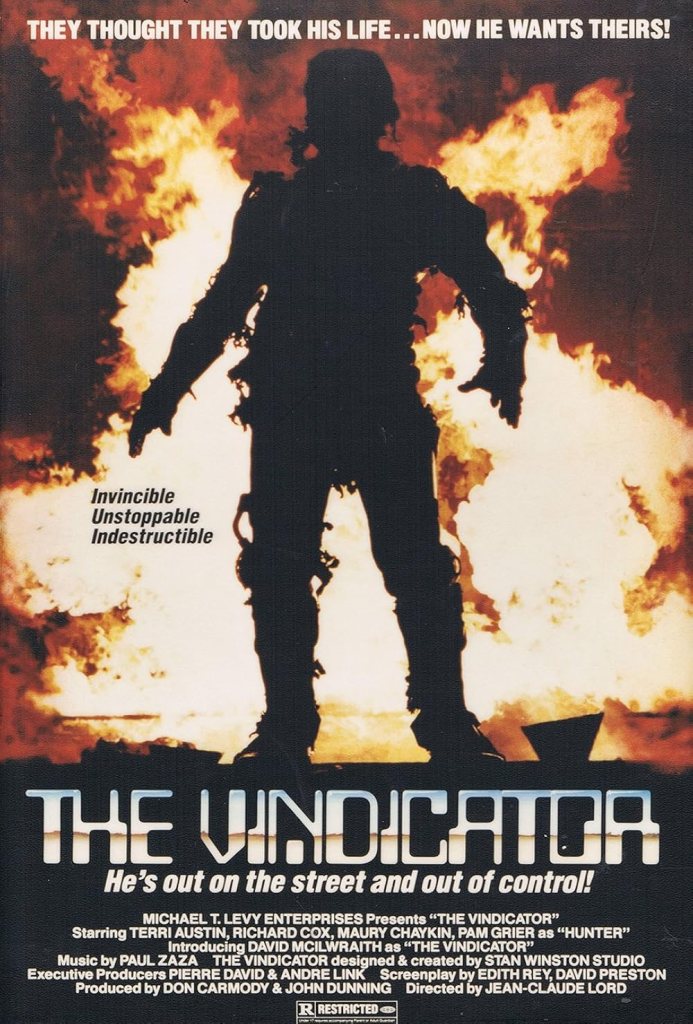
Hot on the concept, Cronenberg’s producer, Pierre David — who, in addition to Scanners and Videodrome, also spearheaded The Brood (1979) — twisted it into THE VINDICATOR (1986).
Scripted as ‘The Frankenstein Factor’, sometimes known as ‘Frankenstein ‘88’, and given its final name to cash-in on the success of The Terminator (1984), David co-produced The Vindicator with fellow Canadian B heroes Cinépix and Hollywood major 20th Century Fox. Fox chipped in a sizable chunk of the film’s budget and were insistent on hiring The Terminator’s Stan Winston to design and create the impressive and appropriately awe-inspiring robot effects.
Despite The Vindicator’s contemporaneous status as “a fairly blatant Terminator clone” [1], it’s closer in step to Paul Verhoeven’s subsequent RoboCop (1987). Though the lumpen script is swollen with stodgy dialogue and flaccid characters, The Vindicator’s core premise as well as numerous scenes, themes, ideas and flourishes preempt beats and notions in Verhoeven’s satirical masterpiece — and, funnily, even the Dutch auteur’s later romp, Hollow Man (2000). Alas, irrespective of such fascinating similarities – and, indeed, irrespective of the film’s bridge position within the evolution of robo-schlock; a subgenre essentially built from The Terminator and RoboCop – The Vindicator feels like what it is:
Temu Cronenberg.
As demonstrated across his ‘Berg-less Scanners sequels (Scanners II: The New Order (1991), Scanners III: The Takeover (1991)) and spin-offs (Scanner Cop (1994) and Scanner Cop II (1995)), Pierre David is capable of noodling in the body horror king’s sandbox but he can’t fashion a castle. They and The Vindicator are permissible facsimiles at best. They’re decent enough replicas, but they lack the smarts and artistic heart of Cronenberg’s singular vision.
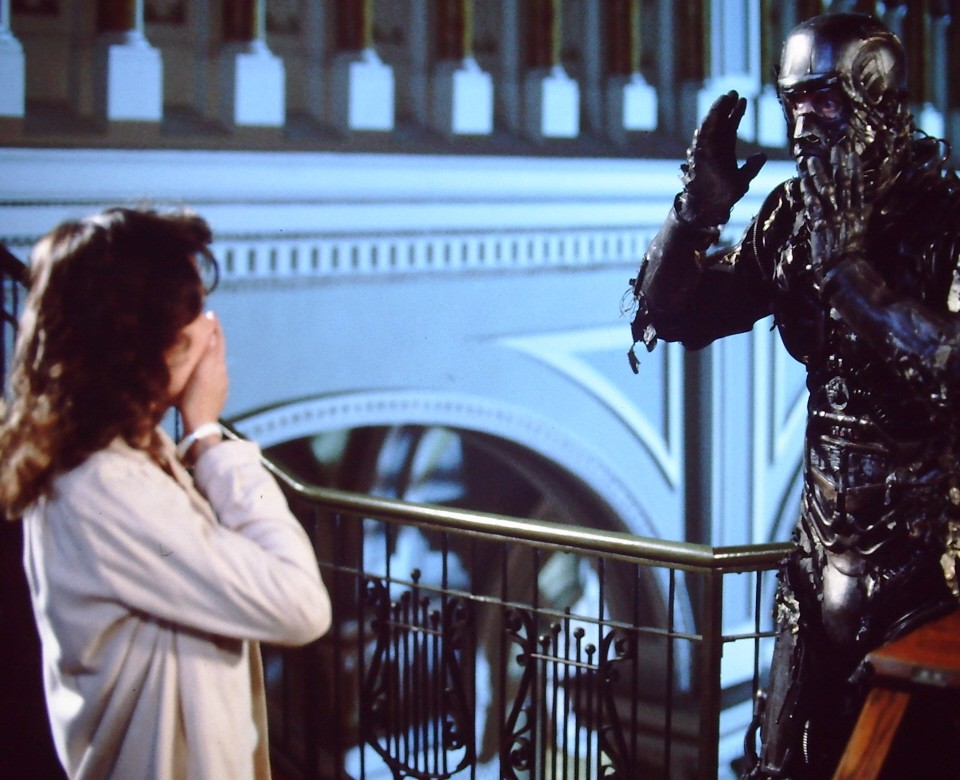
Leisurely paced and awkward in structure, The Vindicator struggles due to an inordinate amount of moments that add nothing to the propulsion of the narrative; primarily, the passages which contain the so-called ‘drama’. Unlike RoboCop, the film’s emotional centre is skewed, and, as already stated, its verisimilitude is undercut by the fact that the humans living through the plot’s blend of mad science and conspiracy thriller are almost unanimously boring. Whereas Murphy in RoboCop is a well-rounded and fully fleshed out individual prior to his titular transformation, The Vindicator’s lead, Carl (David McIlwraith – who, fittingly, would go on to feature in Claudio Fäh’s Verhoeven-presented Hollow Man II (2006)), is an anus from the get-go, rendering his existential plight as he navigates what it is to be both a man and a machine tough to care about. Thankfully, the mighty Pam Grier provides a dollop of comic book swagger as an androgynous mercenary. A deranged decision in retrospect, the blaxploitation icon declined a role in William Friedkin’s To Live and Die in L.A. (1986) to star in The Vindicator. She’d quickly attain another robo-schlock credit too, cropping up as a murderous educational enforcement unit in Mark L. Lester’s barnstorming Class of 1999 (1990).
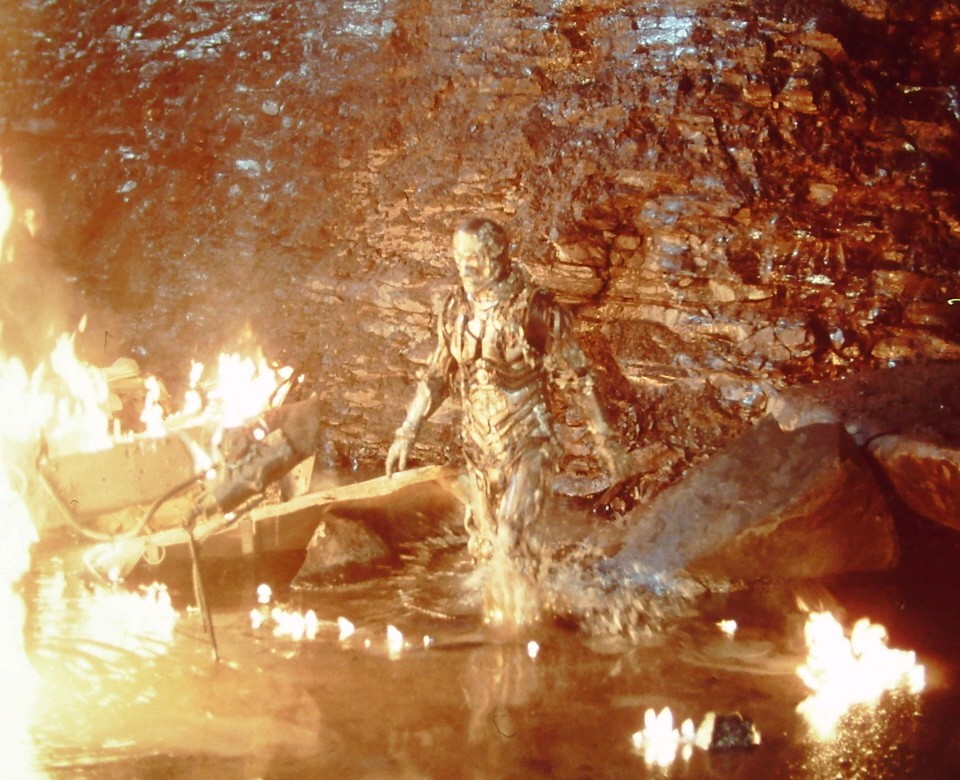
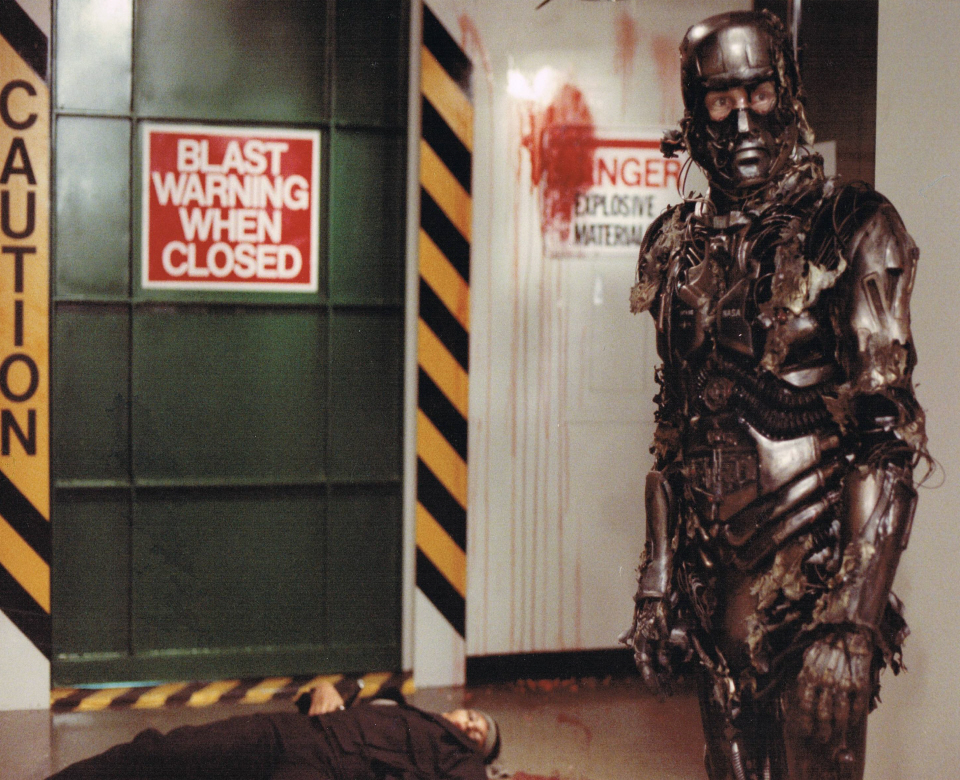
A la his and producer David’s earlier pairing, the overlong, mid-tier slasher flick Visiting Hours (1982), The Vindicator’s journeyman director, Jean-Claude Lord, tackles matters with his usual meat and potatoes efficiency. Lord isn’t much of a stylist. However, he unleashes several cool and memorable images, particularly when Carl – in his awesome, Winston-rendered Frankenstein garb [2] – is on screen. Carl’s big, fiery reveal has a suitably epic feel, and Lord sports a fine eye for FX money shots. And when he allows himself to truly cut loose and harmonise with the film’s (disappointingly scant) action sequences, The Vindicator lurches to life and exhibits a modicum of imagination. The sewer chase, for instance, is excellent – and, as it happens, curiously in sync with the search and destroy set piece in Aliens (1986). Perhaps it was a little homage, James Cameron and Stan Winston paying tribute to The Vindicator because it, quite obviously, tips its hat to them?
Lensing in various Montreal locations over October and November 1984, its production commencing a fortnight ahead of The Terminator’s stateside premiere on 26th October, The Vindicator caused havoc during the Baie-D’Urfe leg of its shoot. Denizens of the suburb were furious at the heavy traffic and noise, with the staging of gunfire and nuisance parking of equipment vehicles among their complaints to the local council. The townsfolk were still livid deep into 1985 and protested the production of Liza Minnelli TV movie A Time to Live (1985) with equal fervour.
Playing at the Coronado 6 and M Plaza 5 in Albuquerque, New Mexico for a week beginning on 14th February 1986, The Vindicator surfaced on tape in the U.S. via Fox subsidiary Key Video the following November. It hit cassette in the U.K. via PolyGram at the start of ‘87.
[1] Phantom Phocus, The Phantom of the Movies, New York Daily News, 30th November 1986.
[2] Winston’s effects were supervised on set by George Erschbamer and Bill Orr.
 The Schlock Pit