
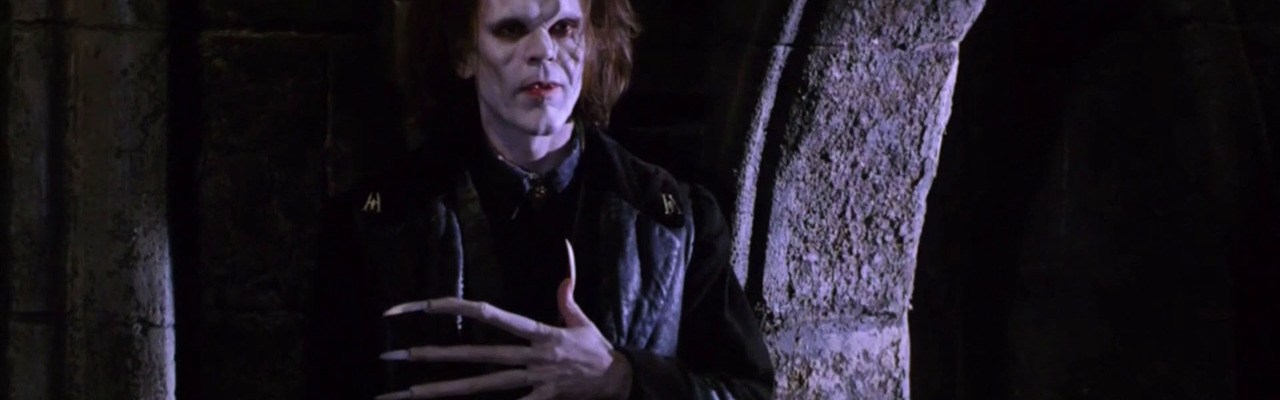
Matty celebrates one of the finest and most important films from one of the finest and most important filmmakers on Charles Band’s payroll.
In his 2021 memoir Confessions of a Puppet Master, Charles Band playfully refers to Ted Nicolaou as his “test subject”. If a film needed doing or a floundering project needed a blast of fresh energy, Nicolaou was the man Band brought in for the job; doubly so if the assignment involved peculiar or difficult circumstances. Nicolaou’s flair for troubleshooting, taste for adventure, and — most importantly — willingness to go along with Band’s hare-brained schemes extends to:
Using his editorial know-how to tart-up The Alchemist (1983); orchestrating a single, gruelling all night shoot for Savage Island (1985) in order to get wraparound footage to connect the two movies it was spliced together from; bolstering the script for Assault of the Killer Bimbos (1988) and very nearly being handed its directorial reins a few days into shooting; finishing the majorly underfunded Magic in the Mirror (1996) and its sequel with little more than goodwill and scotch tape; getting the long-gestating Ragdoll (1999) off the ground — and as the inaugural offering of Full Moon’s short-lived urban subdivision, Big City Pictures (née Alchemy), no less; rapidly assembling The Horrible Doctor Bones (2000) in a nine day frenzy after Ragdoll generated a fair whack of pre-release interest; contorting a genuine ghost-hunting documentary into a shameless Blair Witch Project (1999) cash-in with The St. Francisville Experiment (2000); and serving as tethering between a crestfallen Band and cable network SyFy on the latter’s non-canonical crossover flick, Puppet Master vs Demonic Toys (2004), despite his personal disdain for the Puppet Master series.
Nicolaou’s biggest challenge, however, remains SUBSPECIES (1991), when Band sent him to Romania to fashion a vampire flick mere months after the 1989 Romanian revolution. The place was violently unstable politically and economically, to the point where the usually indefatigable helmer was spooked. Nevertheless, Band encouraged Nicolaou to press on. First, because it was cheap (Subspecies was, in a sense, part-funded by the Romanian state government, who had studio space and a wealth of technicians on their payroll and at their disposal). Second, because the wily mogul liked the vision his Romanian co-producer, Ion Ionescu, pitched him at an early ‘90s film market; the idea of Subspecies being the first American production to lens in the country after decades of oppression under Nicolae Ceaușescu’s tyrannical rule.
No equipment. Horrific catering. Freezing temperatures. Endless delays. A slovenly local crew. A total lack of basic amenities. And, ultimately, Ionescu’s increasingly unpleasant attitude and interfering behaviour.
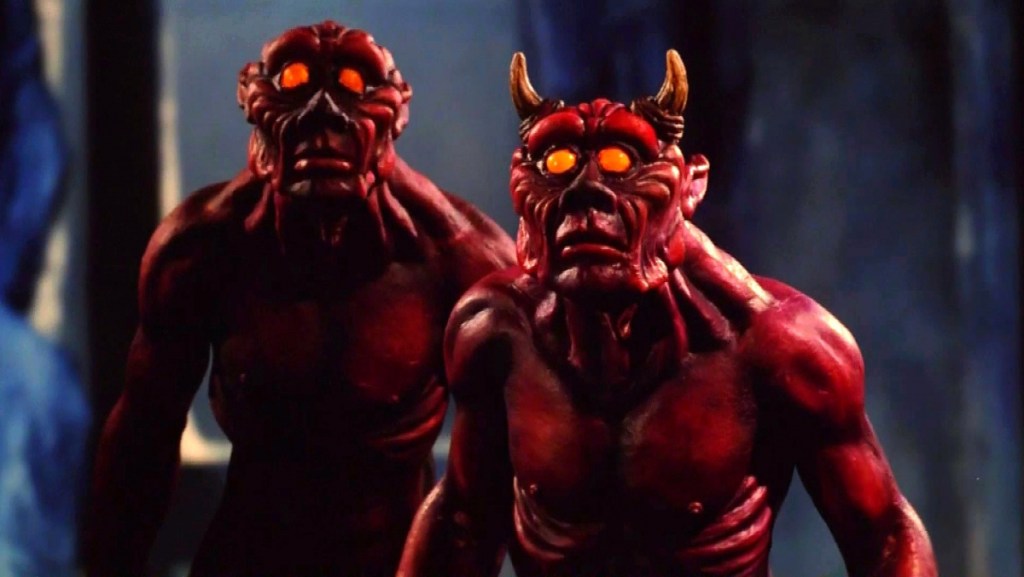
The problems continued even back in Los Angeles. Upon surveying the footage of the titular miniature demons – rendered, as Band historian and Schlock Pit pal Dave Jay says, through “the outmoded ‘50s trick of suiting up stuntmen and having them run amok on oversized sets” [1] – Nicolaou and Band determined the effect laughably bad, leading to longtime Band pal David Allen being recruited last minute to contribute some equally – and uncharacteristically – lame stop motion effects.

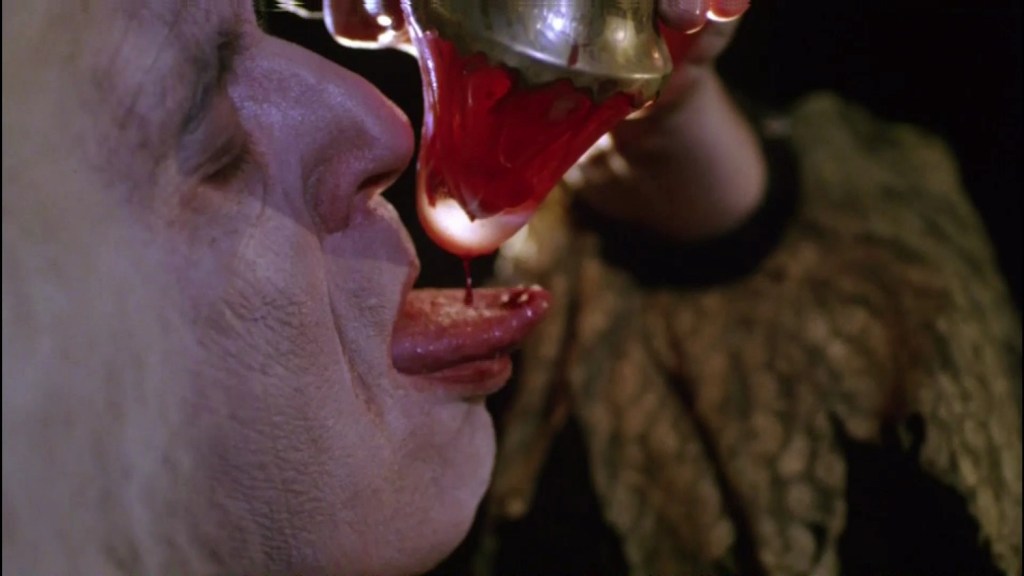
Thankfully, Nicolaou’s perseverance paid off. Though stricken with a few quibbles, Subspecies’ final form is, by and large, a top-tier bloodsucker romp. Moreover, it’s an extremely important film for both Band and Nicolaou.
For Band, the fact it was completed led to him shipping the lion’s share of Full Moon product to Romania which, in turn, resulted in him co-founding a studio — literally building it from scratch on two acres of farmland — with Subspecies’ talented and ambitious cinematographer, Vlad Păunescu. Despite Band’s involvement ceasing a quarter of a century ago, today the studio in question, Castel Film, is among the most prominent filmmaking hubs in Europe, hosting productions of all genres and budgets. Păunescu is still in charge.
For Nicolaou, Subspecies and its spawn — sequels Bloodstone (1993), Bloodlust (1994), Bloodstorm (1998) and Blood Rise (2023), and spin-off Vampire Journals (1998) — are the kind of classic, signature texts filmmakers dream of cultivating; an iconic series destined to sit between forename and surname — Ted ‘Subspecies’ Nicolaou — forevermore. And rightly so. While a key Band property (Subspecies and the Trancers and Puppet Master flicks are basically the B-movie impresario’s Holy Trinity, at least of his Full Moon wares), its artistic success rests squarely on the consistency fostered by Nicolaou being the driving force of every chapter, allowing him to maintain tonal and visual uniformity, and enabling him to cultivate an unwavering commitment to quality. Band might be the Barnum-esque showman nudging us towards Subspecies, but the uniformly excellent hexad is Nicolaou’s meticulously crafted world.

Watched in accordance with the rest of Nicolaou’s output, one gets the impression he was trying to prove something with Subspecies. It’d been five years since his feature length directorial debut, TerrorVision (1986), and he’d spent the intervening period either stuck in development hell (unmade films include: Empire’s ‘I Eat Cannibals’ and mooted early Full Moon caper ‘Zombie Hotel’) or ostensibly where his professional career began, in Band’s cutting room, editing Meridian (1990) and Crash and Burn (1990). By Nicolaou’s own admission, he was desperate to direct again.
Subspecies is in line with TerrorVision, packed as it is with disquieting incidentals and the same visual flourishes. But in response to TerrorVision’s disastrous critical reception, Nicolaou curbs his more outrageous tendencies, minimising the waggish air of kookiness he’d return to in Bad Channels (1992), Magic in the Mirror, and Puppet Master vs Demonic Toys. Subspecies is darker and maturer, and it’s defined by a rich, enveloping atmosphere. The ruinous Romanian locations add an immeasurable amount of value, supplying the film with an appealing folkloric sensibility and a suitably crepuscular flavour in keeping with Păunescu’s dusky photography. A beautifully morbid opus, several moments — a street funeral; open coffins strewn around an attic; an extended sequence at a masked, Wicker Man (1973)-style festival — evoke strong, seat-shiftingly uncomfortable feelings of loss and sorrow, and Subspecies’ central premise — warring brothers — is, at its core, an engaging and relatable tale of jealousy and insecurity.
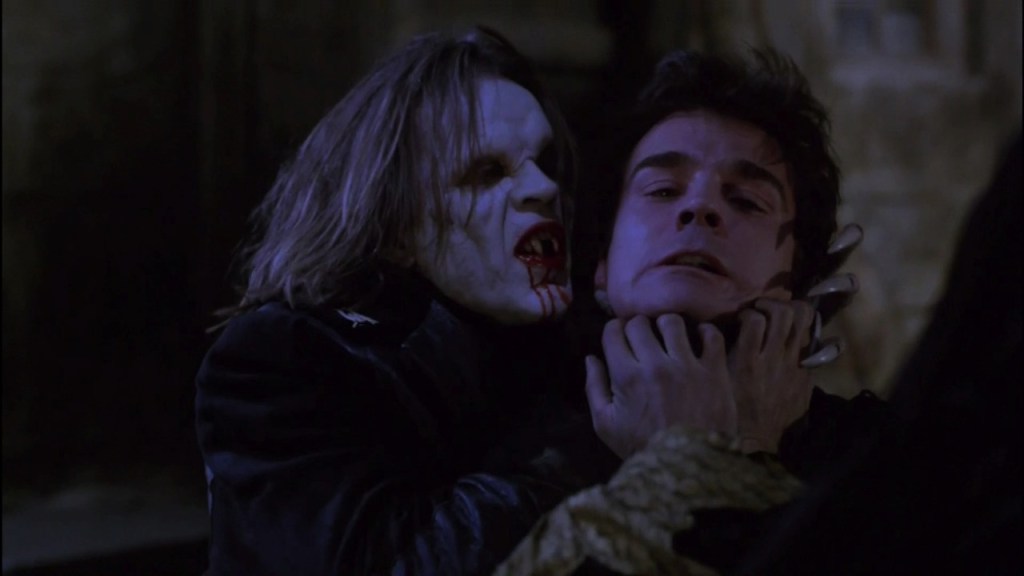
Flirting with elements of the epic family saga as the sequels rattle along (the six films owe as much to Dallas and Jackie Collins as they do Bram Stoker and Anne Rice), Subspecies’ plot sees estranged siblings Radu (Anders Hove) and Stefan (Michael Watson) — bad vampire and good vampire — fighting over The Bloodstone; an ancient heirloom that’s the source of all plasma-slurping power. Caught in their conflict are a trio of American students — Michelle (Laura Mae Tate), Lillian (Michelle McBride) and Mara (Irina Movila) — in town studying various mystical and arcane subjects. Initially slated to be penned by Dennis Paoli (Re-Animator (1985), From Beyond (1986), and the superficially similar Meridian), the original draft of the script wound up written by Dave Pabian. At Nicolaou’s insistence, it was rewritten by a screenwriter pal of his, Jack Canson (aka ‘Jackson Barr’), who conceived the whole Bloodstone business. Nicolaou himself conducted further rewrites on set, in order to better fit the Romanian landscape [2].
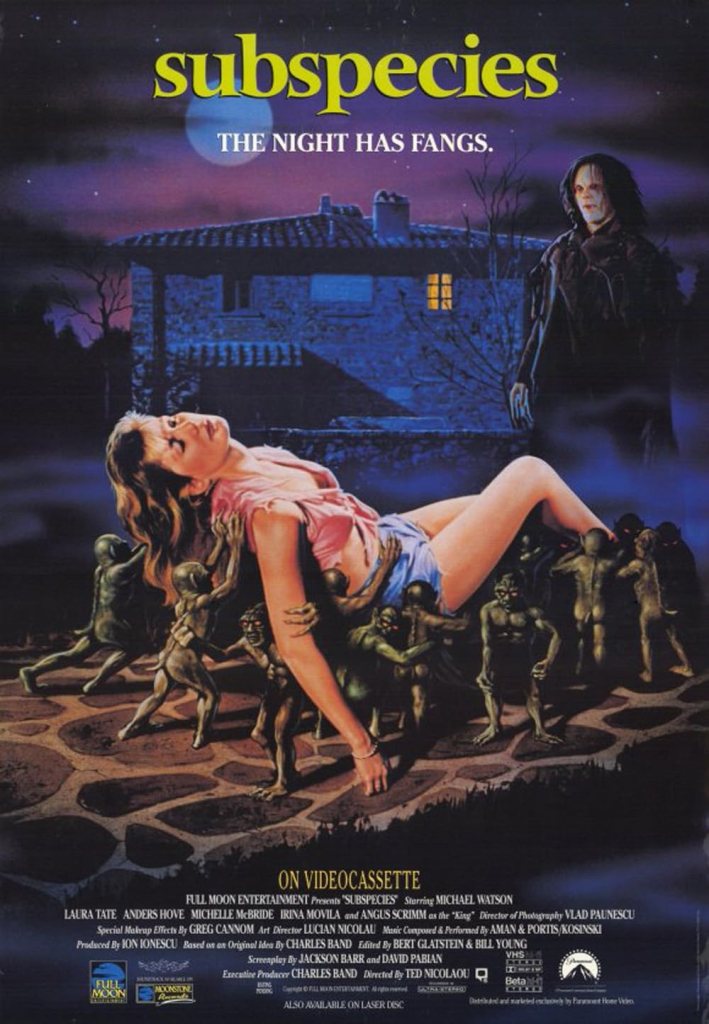
Narratively, the inclusion of the eponymous subspecies — the aforementioned miniature monsters, grown from Radu’s snapped digits — is superfluous. The little bastards are amusing, but, really, they have no impact on the story. They’re here to justify the poster art and title which, as is Band’s wont, existed long before the movie. Given their drastically reduced role across the franchise, I’ve always suspected Nicolaou hated them. Likewise the other shoddier aspects of Subspecies:
The chintzy Bloodstone looking like a Push Pop (mercifully, it was redesigned in later films); prologue-topping guest star Angus Scrimm’s terrible fright wig (Scrimm essays Radu and Stefan’s vamp-king father); Watson’s bland posturing; and Tate, a striking, raven-haired actress whose serviceable depiction of the fascinating Michelle is eclipsed by the aching magnificence of Denice Duff, who inhabits the part in totality from Subspecies II onwards.
Tellingly, in Subspecies, Nicolaou refuses to give them extraneous air time. Instead, he focuses on potent, evocative images — many of which deliberately draw from the expressionist horror classics of the silent era: The Cabinet of Dr. Caligari (1920), Waxworks (1924), and, of course, Nosferatu (1922) — and scenes of shuddery splendour and spectacle, such as a Hammer-aping finale with vampire brides and a sword fight.
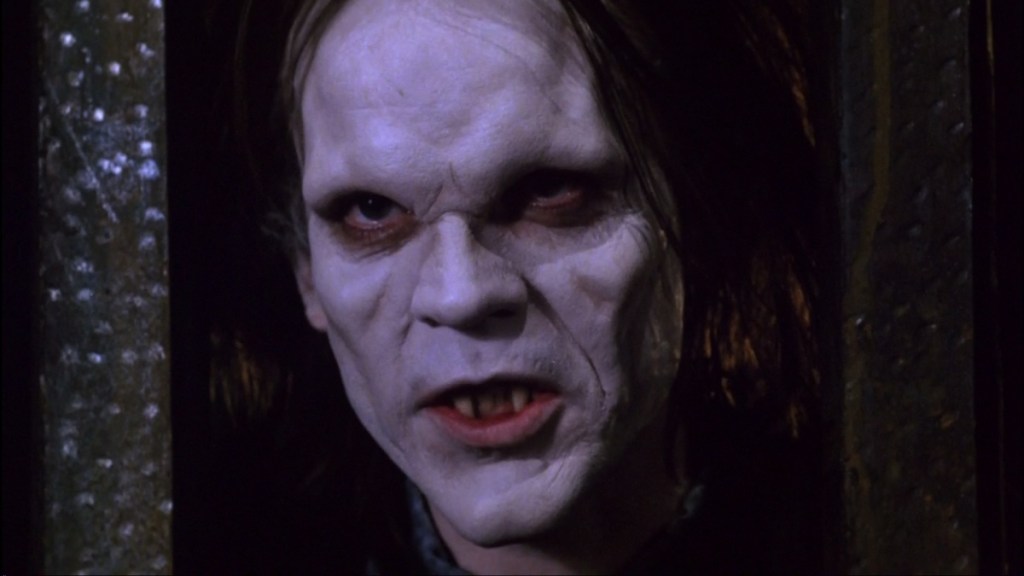
Nicolaou’s trump card is Hove’s Radu. Clad in some incredible Greg Cannom make-up effects (aesthetically, the character is among the most recognisable sights in the Full Moon universe), the Danish actor has a ball, unleashing a rasping, spidery turn that lends Subspecies pomp and creepiness in equal measure. A marvellous villain, there are traces of Lugosi, Lee, Kinski, and Schreck in Hove’s portrayal, but his timbre and gait has proven similarly influential, with Stephen Dorff, Thomas Ian Griffith, and Richard Roxburgh Radu-ing it to varying degrees in Blade (1998), John Carpenter’s Vampires (1998), and the much-maligned Van Helsing (2004).
No wonder Nicolaou summarily pushed Radu and a recast Michelle to the front of the Subspecies henceforth.
[1] It Came From the Video Aisle!: Inside Charles Band’s Full Moon Entertainment Studio by Dave Jay, William S. Wilson, Torsten Dewi… And me and Dave!
[2] Then on Roger Corman’s books thanks to Nowhere to Run (1988) and Body Chemistry (1990), Subspecies was Canson’s first Full Moon project. As the writer — who’d go on to script Trancers II (1991), Seedpeople (1992), Robot Wars (1993), Mandroid (1993), and Nicolaou’s Bad Channels — told me in 2015, “I got involved with Full Moon when my friend Ted Nicolaou called me. He was doing the first Subspecies and he’d worked at my film company in Austin and had edited a documentary I produced called Jive Ass, about a Memphis rock and roll band. And Ted is a brilliant editor by the way, just brilliant. And a helluva director too. He’d signed on with Full Moon to do a vampire movie and he called me up and said, “Would you be interested in writing this? But, you know, working with Charlie isn’t like working for Roger; he’s a little dicier, and you’ll never know from one day to the next whether the budget is there!”.”
 The Schlock Pit