

Matty looks at the good and bad in Chris Fisher’s flawed but interesting serial killer biopic.
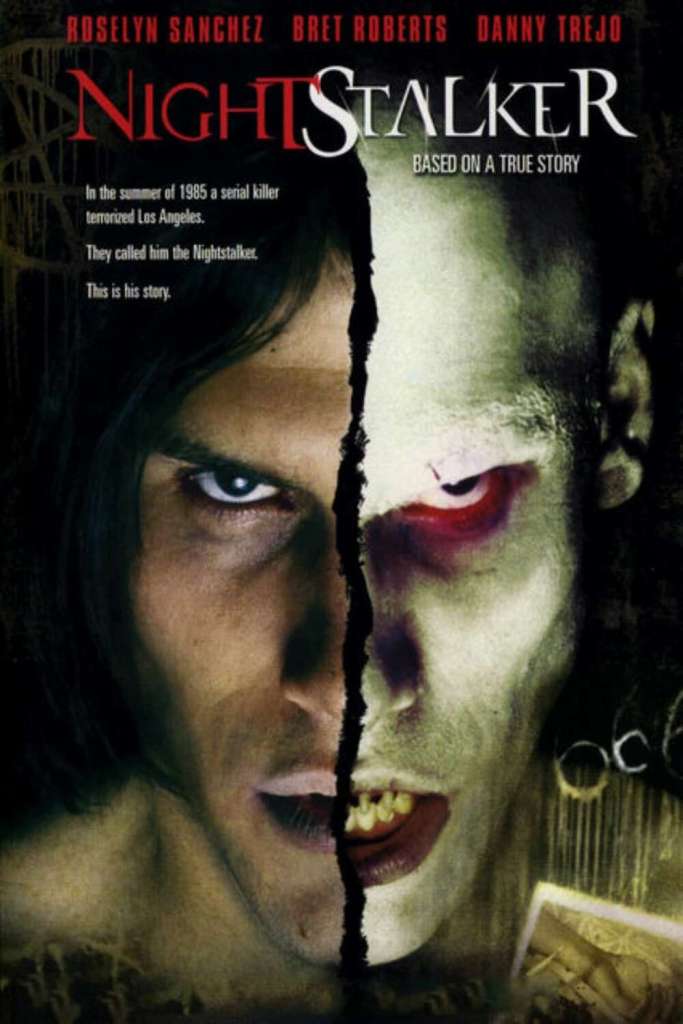
Right from the word go, serial killer biopic NIGHTSTALKER employs pounding heavy metal; Tony Scott-esque camera trickery; and juddering, Jacob’s Ladder (1990) style demon effects to get inside the disturbed headspace of its subject, Richard Ramirez.
The result is the very definition of a Marmite movie:
You’ll either love it and be sucked in or hate every second and want to fire the tape/disc out the window — but such a raucous, in-yer-face approach certainly achieves something…
It’s hard to call Nightstalker ‘authentic’ or ‘accurate’ given its fast and loose attitude to the facts of the Ramirez case. However, the film often feels in tune with how Ramirez and his exploits — burglary, rape, murder, satanism — were presented in the press at the time of his crimewave. During its best moments, Nightstalker exudes a real air of malevolence and chaos. It makes you feel as uneasy as the denizens of ‘80s Los Angeles when Ramirez was on the prowl.
Produced by B-movie hero Ash R. Shah — a founder of iconic shingle Imperial Entertainment, here operating under his Imperial Fish and Silver Nitrate banners — Nightstalker was mounted to cash-in on the success of rival indie producers Hamish McAlpine and Mike Muscal’s Ed Gein (2000). Taking the project’s reins was Chris Fisher; a young, practicing lawyer-cum-screenwriter who’d previously penned and/or co-produced two other Shah flicks, Taboo (2002) and cult druggie epic Spun (2002). Fisher’s directorial debut, Nightstalker typifies the upstart’s subsequent feature work. It’s a scrappy, interesting and confrontational number, and its ragged edges contrast nicely with the slicker, sanitised TV fare he’s exec’d in recent years (Person of Interest, Star Trek: Strange New Worlds).
The period details are shaky, and a lot of the supporting cast come across as if they’re cosplaying Law & Order. And though the socially-minded swings of Fisher’s script – the pokes at the racism, sexism and corruption that quietly assisted Ramirez – are weakened by trite dialogue and procedural cliches, Nightstalker is lifted by Roselyn Sánchez’s searing lead turn as the story’s non-psychotic centre, police woman Gabriella Martinez.
Like Spike Lee’s big budget serial killer chronicle, Summer of Sam (1999) – which used David Berkowitz’s ‘Son of Sam’ killings as the backdrop for an ensemble drama – Fisher uses Ramirez’s spree to chart Martinez’s progression from ambitious beat bobby to burnt out detective. Running the emotional gauntlet, Sánchez sinks her teeth into the part. Almost as impressive is future Shah favourite Danny Trejo (The Bad Ass Trilogy) as Martinez’s grizzled, coke-bumping partner. However, unlike, say, the aforementioned Ed Gein or, indeed, the other DTV serial killer biopics of the form’s first wave — Ted Bundy (2002), Dahmer (2002), Gacy (2003) et al — Nightstalker suffers a near-fatal blow in that Bret Roberts, the actor bringing to life its titular psycho, offers little besides a mop of black hair. Roberts reunited with Shah and Fisher on cop thriller Dirty (2005); maligned sequel S. Darko (2009); later serial killer tell-all Rampage: The Hillside Strangler Murders (2006); and more.
Nightstalker screened alongside Spun at Sundance 2003, and was among the few murder-dramas not acquired for U.S. release by the subgenre’s key peddler, DEJ Productions. Instead, the film was picked up for Stateside distribution by Columbia-TriStar — a frequent customer of Shah’s — and issued on video and DVD on 5th August 2003. It landed in the U.K. via Mosaic Entertainment in early 2004.
USA ● 2002 ● Biopic, Horror ● 93mins
Roselyn Sánchez, Bret Roberts, Danny Trejo ● Wr./Dir. Chris Fisher
 The Schlock Pit