

Matty looks back at Matthew Bright’s darkly comedic serial killer biopic.
Arguably the best known title of the early ‘00s DTV serial killer biopics due its ubiquitous presence on video store shelves, TED BUNDY (2002) is defined by a strange, humorous tone that essentially positions the eponymous maniac as a mischievous little scamp. Those who got their knickers in a knot about subsequent Bundy portrait, Extremely Wicked, Shockingly Evil, and Vile (2019), in 2018, when star Zac Efron and the film’s makers were branded ghouls in certain quarters of movie discourse (read: #FilmTwitter) for ‘exploiting’ the fiend’s notoriety, would have a fit watching this darkly comic number. However, the knockabout presentation is a way for helmer Matthew Bright — a talent specialising in outré subject matter (cf. his scripts for Richard Elfman’s Forbidden Zone (1980), Shrunken Heads (1994) and Modern Vampires (1998), and directorial projects Freeway (1996) and Freeway II: Confessions of a Trickbaby (1999)) — to probe Bundy’s warped mindset. Pitching much of the film from Bundy’s perspective, Bright depicting his violent urges as jocular, naughty boy shenanigans only emphasises how disturbed and dangerous he was. The ‘Oh, Teddy!’ hijinks are wholly in line with the showy, braggadocious behaviours the real-life psycho exhibited among acquaintances and at his highly publicised trial (which, curiously, isn’t featured despite Ted Bundy‘s otherwise fairly fidelitous chronology).
Bright discussed his quirky — if not entirely successful — approach in a chat with The Independent, as Ted Bundy geared up for its U.K. release:
“I wanted to do a horror movie about a historical figure and Bundy was the template for serial killers at a time when we really didn’t know about them… Writing the script made me physically sick, reading about this guy over and over again. I talked to one of his lawyers, who described him as a pure psychopath, capable of doing anything without getting excited. To me, this guy doesn’t even have a soul, he’s not a human being. He killed all these women, and in his heart he wondered why everyone was mad at him, because to him it was like, ‘Well, it’s just a girl; there’s plenty of girls.’.. I didn’t like most of the books that were written about Bundy, particularly this media creation by third-rate writers which made him look ‘normal’ – he wasn’t normal. He had a misshapen head; he was a chronic nose-picker; he never worked in his life; all his money came from shoplifting, purse-snatching, burglarising houses; he was a chronic peeper, staring in windows and jacking off all night, and he just progressed to walking up to women and hitting them over the head with a stick.” [1]

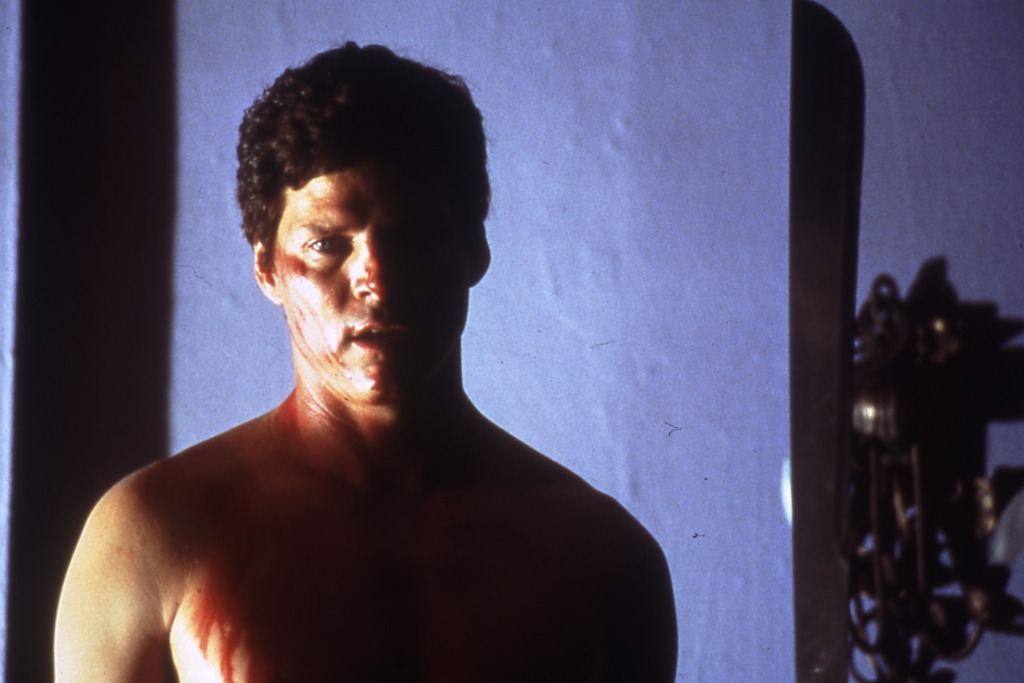
Fast-tracked by producers Hamish McAlpine and Michael Muscal after their first biographical slaughter saga, Ed Gein (2000), fared well on the festival circuit, Ted Bundy was earmarked for that film’s director, Chuck Parello. A scheduling conflict saw Bright drafted in, off the back of Freeway II being snapped up for British distribution by McAlpine’s Tartan Films [1]. Like Ed Gein — and, it should be noted, McAlpine and Muscal’s third and final true crime tell-all, The Hillside Strangler (2004) — Ted Bundy is anchored by a compelling lead performance. Michael Reilly Burke is excellent as Bundy, invoking an authentic sense of nastiness behind his preppy façade; a feeling that, beneath the handsome looks, career aspirations, and supposedly genial demeanour, there’s something awful raging inside him.
While tweaked for both dramatic effect and respect for the actual victims (names are changed, details mixed and matched), Bright and Burke’s bombastic reenactments of Bundy’s heinous activities — voyeurism, burglary, battery, rape, murder, necrophilia, all across a colourful ‘70s backdrop — are suitably lurid and distressing. It’s the quieter moments, though, where insidious and ruminative terror lurks, when Bundy’s mask of sanity slips in front of the normies, typically his long-suffering beau, Lee (Boti Bliss who, a la Burke, is brilliant). Alas, the thoughtfulness of Bright and Ed Gein holdover Stephen Johnston’s script occasionally sits at odds with the louder, transgressive passages; the aspects a lot of the more histrionic and sanctimonious reviews in the mainstream press were keen to blast Ted Bundy for during its brief theatrical run on either side of the Atlantic.
Some sample quotes:
“Drearily pointless… Rape, slash, rape, slash.” [3]
“Blindingly dreadful.” [4]
“Trashy, exploitative, and thoroughly unpleasant.” [5]
And:
“A repellent B-picture… As the body count mounts, the interest decreases.” [6]
Preceded by a few summer festival showings, Ted Bundy landed in U.S. cinemas on 13th September 2002 and hit British city screens (London, Manchester, Birmingham etc.) on 22nd November of the same year. In between, Ted Bundy played Sitges, Spain where, like Ed Gein, it received an awards nod for Best Film. All were vital in promoting the film’s ultimate — and intended — fate: that of a profitable home video property. It was issued on tape and disc in the states by First Look/DEJ on 1st October ‘02, and in the U.K. by High Fliers (in conjunction with McAlpine’s Tartan) in November ‘03.


[1] Matthew Bright: Peculiar Passions by Mark Kermode, The Independent, 9th November 2002.
[2] Parello went to Barcelona, to prep an unmade version of what would become Romasanta: The Werewolf Hunt (2003) under Paco Plaza’s stewardship.
[3] Bundy Review by Peter Bradshaw, The Guardian, 22nd November 2002.
[4] Cinema by Catherine Shoard, Sunday Telegraph, 24th November 2002.
[5] Film About Serial Killer Out of Kilter by Megan Turner, New York Post, 13th September 2002.
[6] Routine of a Serial Killer by Alexander Walker, Evening Standard, 21st November 2002.
 The Schlock Pit