

Matty hails one of the best – and one of the most important – DTV action flicks of the ‘90s.
Low budget films and big budget films — the As and the Bs — feed off each other.
Produced by Alan and Diane Mehrez’s FM Entertainment International, TRUE VENGEANCE (1997) was slung together during the ‘East meets West’ action boom of the mid-‘90s, when Hong Kong heroes John Woo, Ringo Lam, and Tsui Hark were poached by American studios to make their Hollywood debuts. The resulting flicks — Hard Target (1993), Maximum Risk (1996), and Double Team (1997) — were all vehicles for Jean-Claude Van Damme, whose catalogue FM plundered with their cut-price sequels, Cyborg 3: The Recycler (1994), Bloodsport II: The Next Kumite (1996), and Bloodsport III (1997).
In addition to this, one of Van Damme’s earliest collaborators, on the original Bloodsport (1988) and fellow classic Kickboxer (1989), was cinematographer/director David Worth. Though he never paired with Van Damme again, post Kickboxer Worth belted out a string of similarly minded biff-‘em-ups buoyed by a wealth of action icons: the Cynthia Rothrock starring Lady Dragon (1992) and Lady Dragon 2 (1993); a late-in-the-day Michael Dudikoff romp for Cannon, Chain of Command (1994); and American Tigers (1996), a kind of proto-Expendables (2010) featuring Rothrock, Sam J. Jones, Rorian Gracie, and Donald Gibb (the latter also appeared in Bloodsport 1 and 2). After American Tigers wrapped, Worth was signed by FM to helm — yep — True Vengeance.
Elsewhere, while, essentially, a take on primo Schwarzenegger caper Commando (1985), True Vengeance’s plot — in which FM contract player Daniel Bernhardt wreaks havoc against a crime syndicate after they kidnap his daughter — boasts an American/Asian thriller hangover. It flirts with the same Yakuza-based shenanigans found in the likes of Black Rain (1989) and Rising Sun (1993). However, the form’s straight-to-video stain — American Yakuza (1993), Blue Tiger (1994) et al — was ruled financially viable due to the video success of Showdown in Little Tokyo (1991); a film that, of course, was directed by Commando’s Mark L. Lester.
Lastly, today True Vengeance can be considered an important further step in the development of the 87eleven contingent (John Wick (2014), The Fall Guy (2024)). The film’s credits are a roll call of key contemporary action personnel. The script marks the debut of Kurt Johnstad (Atomic Blonde (2017)); the martial arts are choreographed by Chad Stahelski and Brad Martin, fresh from FM Entertainment’s Bloodsport instalments; and the Hong Kong-style gunplay and crackerjack stunt work is coordinated by another FM/Bloodsport alum, the mighty Philip Tan.
History, intertextuality, and the start of something.

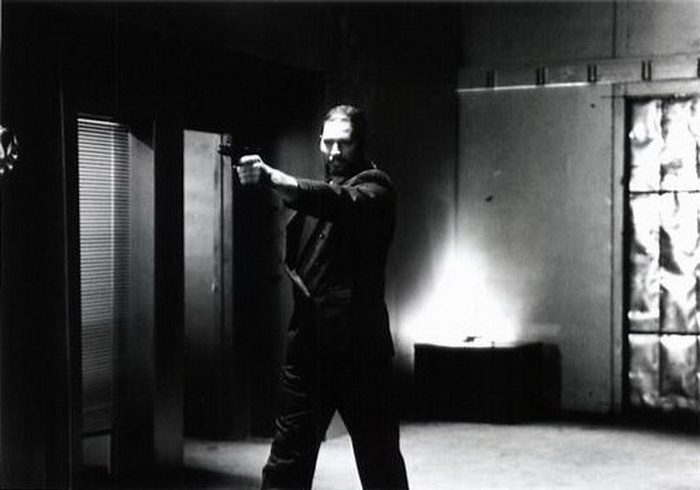
One of the best DTV action epics of its decade, True Vengeance is an exhilarating experience. Lensed in twenty-four days on FM’s usual chump change budget, the film transcends its obvious limitations — dodgy sets, hackneyed dialogue — with energy and technical bombast. A master craftsman capable of assembling a movie with little more than “scotch tape and chewing gum” (his words), Worth imbues True Vengeance with a vitality in keeping with its ‘race against the clock’ narrative framework, and unleashes numerous striking images; from explosive close-ups and outrageously composed cutaways, to ironic visual gags and mischievously blasphemous background flourishes.
Wanting to maximise the film’s dinky shooting schedule, and completely aware of the device’s power as a storytelling tool, Worth elects to cover as much as he can with a Steadicam. The result is some of the rig’s snazziest and most immersive use this side of Albert Pyun. Visually, it mirrors the dizzying inner turmoil of Bernhardt’s Navy SEAL-turned Yakuza henchman-turned widowed Dad.
The strongest of Bernhardt’s FM four pack (Bloodsport II, Bloodsport III, and — what else? — Bloodsport 4: The Dark Kumite (1999)), the Swiss scrapper submits a fine performance, bubbling with remorse and fury as he cuts down his daughter’s captors. George Cheung is enjoyably devilish as the main villain (he plays Bernhardt’s miffed ex-father in law); Miles O’Keeffe oozes poker-faced creepiness as an old foe on Cheung’s payroll; and Beverly Johnson and Jonathan Lutz are a fun chalk n’ cheese NCIS/LAPD coupling.
Naturally, it’s the contributions of Stahelski, Martin, and Tan that aid Worth in a visceral sense. The driving force of True Vengeance, the three were instrumental in establishing the film’s Woo/Lam/Hark élan and collaborated closely with Johnstad on the pragmatics of the script’s homagery and allusions long before the project was passed to Worth. The spectacle they lord over — different frame rates, exaggerated staging, double guns, gravity defying dives, and assorted other balletic movements — is electric, front to back. A stunningly orchestrated blow-out in a makeshift nightclub is the unequivocal highlight.
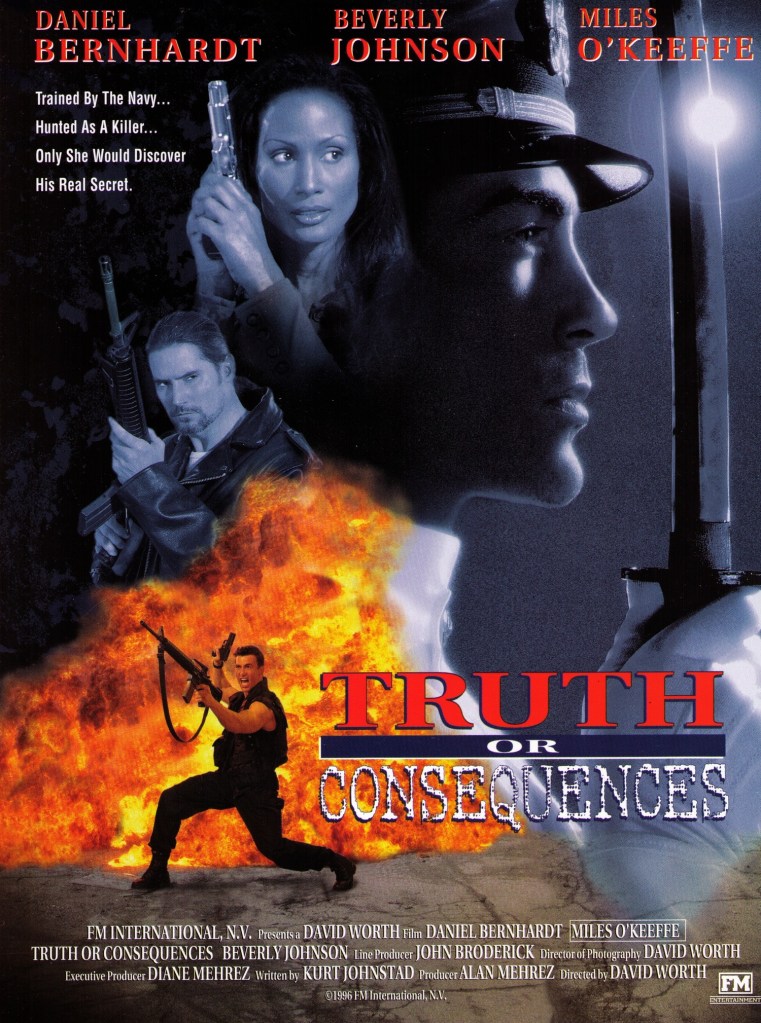
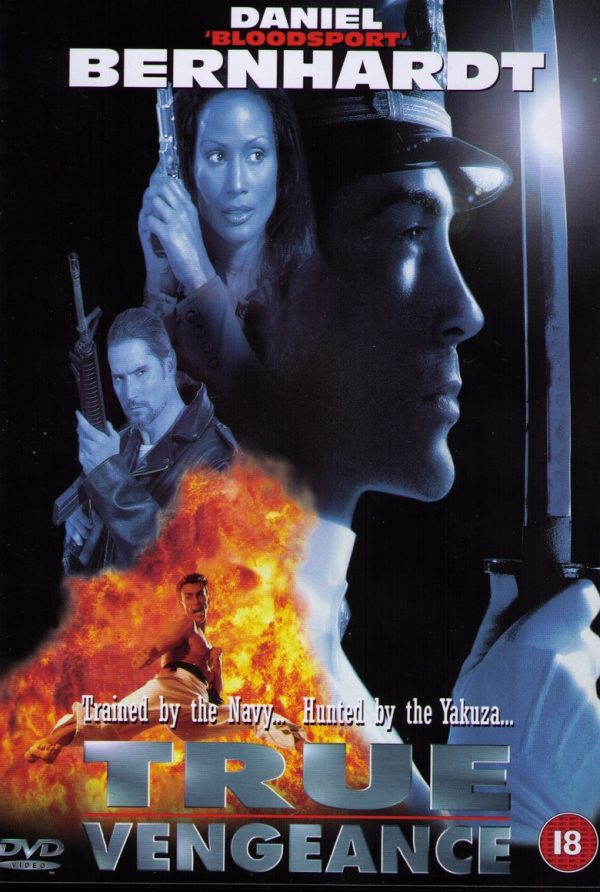
Shot and sold as ‘Truth or Consequences’ but retitled to avoid confusion with Kiefer Sutherland’s Tarantino-esque crime pic Truth or Consequences, N.M. (1997), True Vengeance was released on U.S. cassette by FM Entertainment’s home video division on 30th December 1997. Like Bloodsport III, it was nabbed for U.K. distribution by Third Millennium. Both landed within the same summer ‘98 time frame.
 The Schlock Pit