
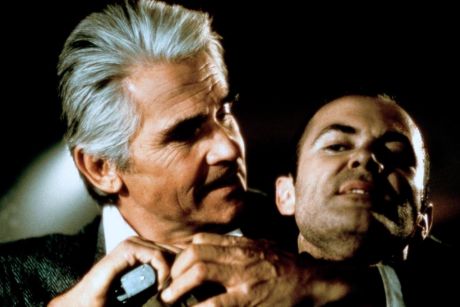
Dave chats to scripter Alex Simon about his Corman-backed IRA flick.
Roger Corman was never afraid to look outside the United States when it came to making movies. The Philippines, Argentina, and Peru were all utilised by the mogul, so when the Irish government reached out to Concorde-New Horizons in an attempt to lure Corman over to the Emerald Isle, he was only too happy to oblige.
Indeed, such was the enthusiasm for the late producer to set up a studio over there, a bidding war ensued between the Ministry of Industry and the Ministry of Arts. The latter sealed the deal with a particularly lucrative offer. As Corman himself said in the phenomenal documentary It Came from Connemara (2014), “There’s no way that would have happened in America! Arts outbidding industry?!”
Connemara was the location, a sedate region in County Galway with a population of thirty-two thousand and views that stretch out over the Atlantic. It also has the largest percentage of native Irish speakers in the country.
And then, one late September day in 1995, martial arts wiz Don ‘The Dragon’ Wilson was seen karate kicking down Augustine Street in Galway City…
Spawning just shy of two-dozen features, Corman’s invasion of Connemara certainly made an impact in the locality. A studio was built, and with Concorde-New Horizons typically only sending a handful of pros from the States, it was left to local technicians to pick up the slack in terms of carpentry, electrics, and make-up.
“I realised that I was literally teaching a bunch of students,” said actor James Brolin in the Corman/Connemara doc, regarding his feature length directorial debut MY BROTHER’S WAR (1997).
Despite the challenges Brolin faced with inexperienced personnel, his topical, IRA-themed drama is one of the highlights of Corman’s time in Ireland. It must be said, though, a large portion of its credibility lies at the feet of scripter Alex Simon, who delivers a believable screenplay capturing both the nuance and the history of The Troubles.
The whole project, however, began rather differently.
“It was supposed to be my directing debut,” asserts Simon. “I was having lunch with Rob Kerchner in Brentwood, and he mentioned Roger’s Galway acquisition and the fact that they needed Irish stories. I literally came up with the pitch right there: two English brothers in MI5, and two Irish brothers in the IRA slam together in a metaphorical collision. Rob loved the pitch and said it would be good enough to take to a major studio. I agreed but said that I’d let Concorde have it if I could direct. Rob shook my hand on the spot and said that he couldn’t see Roger objecting to the idea.”
“I went away and spent two or three months immersing myself in research for the script, watching every Irish movie I could get my hands on just to get the voices and lingo right in my head. When I’d finished writing it, I’m not too modest to say that it was the best work of my career to date. I was about twenty-nine at the time.”
“Cut to the chase: Rob and Mike Elliot had a huge falling out with Roger and were unceremoniously fired as executives at Concorde. As I was viewed as ‘Rob’s boy,’ my directing deal went with him – this is what I was told by many people who worked at Concorde, anyway. Roger had a made a deal with the actor James Brolin, whose star had recently been raised by dating Barbra Streisand, that he could direct his first feature if he acted in three Corman quickies in return. Brolin chose my script to direct but wanted me to rewrite it so he could play the lead. I worked with ‘Jim’ for a little over a month on the rewrite, changing the two British brothers to one American CIA agent avenging the death of his sister who was killed in an IRA bomb blast. Are you following this so far?”
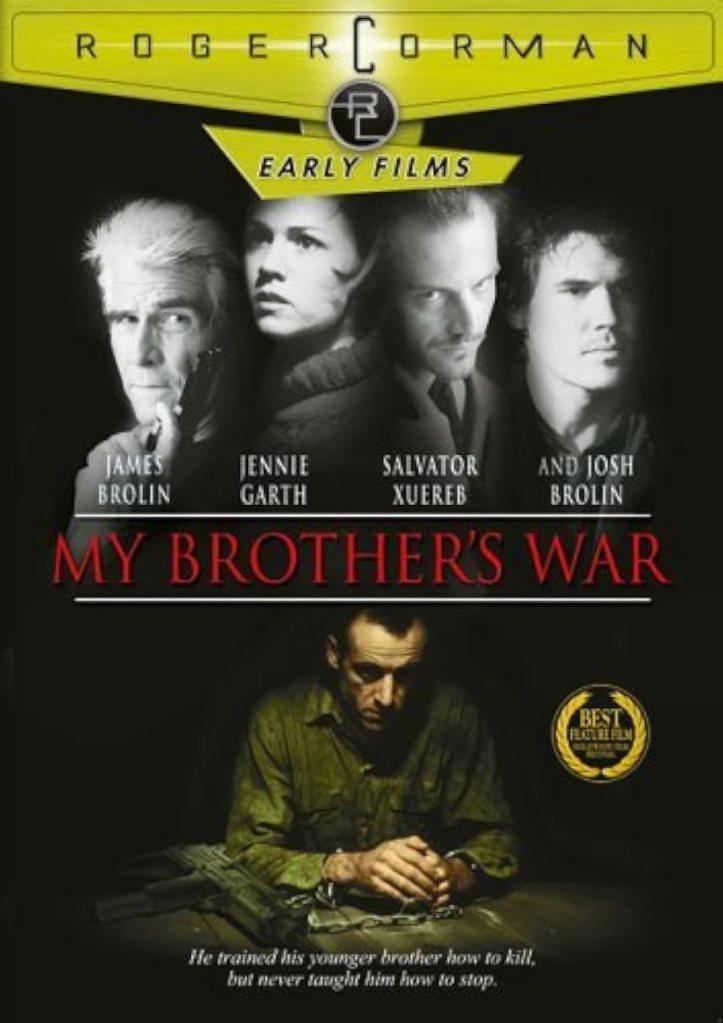
We are Alex, we are – although it’s important to add that, plot-wise, Brolin’s (retired) CIA agent’s principle job is to locate and neutralize Liam Fallon (Salvator Xuereb and his wavering accent): a dangerous, renegade IRA terrorist whose campaign of murder and mayhem was designed to put a block on the peace talks. Drafted in to assist Brolin’s character is Liam’s brother Gerry (the excellent Patrick Foy). He was convicted – well, set up – for killing Brolin’s sister (Cristi Conaway) in a bomb attack, but a path to freedom awaits if he’ll turn against his sibling and see to it that the rogue insurgent is put away for life.


If you weren’t au fait with the behind the scenes script shuffling on My Brother’s War, there’s every chance you’d be impressed by what it achieves in the face of a tight budget. Once you know the details, mind, the Brolin-mandated tweaks become a little more apparent, as do the whims of the Hollywood star on the set of a Corman movie.
The validity of Brolin’s character being requested to go to Ireland is a sticking point from the get-go, while the shoehorned inclusion of his actor son Josh takes extraneousness to a new level. As for the contrived nature of the ending, well, it certainly does its very best to undo Simon’s stoic construction of an intelligent and historically sound script.
Still, Brolin seemed to get what he wanted out of the project. My Brother’s War made an appearance at the inaugural Hollywood Film Festival in 1997 and scooped the prize for Best Feature Film while there. It surfaced on home video in America in December ’98, but bypassed rental stores in the U.K. Instead, My Brother’s War premiered anonymously on Sky Moviemax the same month, albeit under the title ‘Flashpoint’.
For Simon, the whole shebang is tainted by the prospect of what could have been and the duplicitous behaviour of those in charge:
“Yeah, ‘Jim’ said he felt bad for me that I lost my shot at directing and offered me the job of being his second unit director as a consolation prize. Of course, I jumped at it and agreed to his every change and suggestion. He couldn’t have been more affable and charming during this entire process, I might add. Then, when I turned in the final draft, ‘Jim’ said to get my passport in order to fly to Ireland in three to four weeks.”
“I never heard back from him.”
“When I called the new Head of Production to inquire as to what was happening, he said it was the first he’d heard that I was supposed to direct second unit and that they already had a week’s worth of film in the can.”
“I saw the finished version at its premiere, at The Hitchcock Theater on the Universal Lot, and while it wasn’t as painful as Bloodfist VIII: Trained to Kill (1995) [which Simon also wrote] and did have some genuinely affecting moments and terrific performances from its Irish cast, it still wasn’t what I had written. Thus is the life of a screenwriter.”
“Side note: I met one of the female leads from the film a few years later, who shall remain nameless). And she said that a certain Ms. Streisand showed up with ‘Jim’ and basically took over the production, including changing the title from ‘Brothers in Arms’ to My Brother’s War and directing all the second unit herself.”
As the diva herself said during a duet with Barry Gibb…
“Guilty!”
 The Schlock Pit