
Dave wonders how a handful of storied creatives could craft a feature that misses the mark by such a distance.
DEAD ON THE MONEY poses the type of conundrum that keeps people like me awake at night.
How can a film so stubbornly mediocre spawn from such an impressive array of creatives?
Where did it all go wrong?
Sadly, folk like director Mark Cullingham aren’t around anymore to fill in the blanks.
An Oxford graduate with a passion for theatre, Cullingham switched to television at the end of the ‘60s, with Dennis Potter’s Casanova (1971) being a notable high. However, industrial action among technical staff at the BBC, and a similar situation with ITV, frustrated him to such a degree that he felt a move to America might be in his best interest. U.S. network television never quite replicated the thrill of projects back home, a la Orson Welles’ Great Mysteries, and Dead on the Money was his final assignment before he succumbed to AIDS at the age of fifty-three.
Adapting Rachel Ingalls’ novella The End of Tragedy for the screen was Gavin Lambert, who attended Oxford a decade and a half prior to Cullingham but failed to graduate. He wrote film criticism for Sight and Sound, The Guardian, and The Sunday Times before heading across the Atlantic in the mid-‘50s to become the personal assistant to – and, some suggest, lover of – Nicholas Ray (Rebel Without a Cause (1955)). As well as writing the acclaimed biographies of several gay and lesbian figures in Hollywood, Lambert also became an in-demand screenwriter, securing Oscar nods for Sons and Lovers (1961) and I Never Promised You a Rose Garden (1978). Much like Cullingham, Dead on the Money was his last screen work.
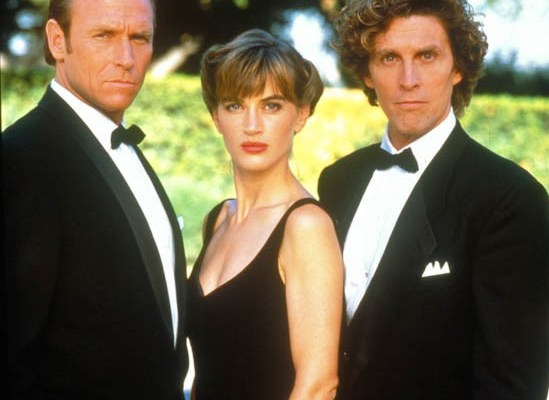
A Ted Turner production, Dead on the Money aired with virtual anonymity on TNT in the summer of 1991. Amanda Pays is Jennifer: an aspiring actress who’s just landed her first major part in a play thanks to her possessing a scream that could shatter glass. Each night, Jennifer spots the dashing Carter Matthews (Pays’ real-life husband Corbin Bernsen) giving her the eye from the stalls, which promptly leads to a budding romance. Carter has a secret, though: he suspects his cousin, Russell (John Glover), of stealing his former girlfriend in order to marry her, push her off the family yacht, and pocket a $2 million life insurance policy. Desperate to prove his suspicions, he enlists a reluctant Jennifer to join him for the weekend at Russell’s mansion, unprepared for the antics that ensue.
Toughened up, Dead on the Money would make an awesome neo-noir, of the sort that played on Cinemax or the USA Network. The peak of that particular trend is Past Tense (1994) with Scott Glenn, or Double Exposure (1994) with Dedee Pfeiffer. Alas, the film is diluted to the point of parody, and it’s played as a wannabe caper. Bernsen is the most measured of the ensemble. Pays spins a goofy Brit abroad shtick despite her character being born in the States, and Glover – who’s usually such a welcome presence – is unbearable as the kooky Russell. A mix of wealthy eccentric and genuine oddball, it makes you wonder what Lambert saw in the character in Ingalls’ original novella.
Ironically, Ingalls went the opposite way to Cullingham and Lambert. An Anglophile, the author left America to settle in England at the age of twenty-four. Maybe it’s this that offers the biggest clue towards the mish-mash nature of Dead on the Money.
“Oh Jennifer,” remarks doe-eyed bestie Maggie (Kathleen Wilhoite). “Love is the greatest role of all, and you don’t have to play it – you’re living it!”
It’s a line you’d hear rolling off the tongue of Jean Simmons in an Ealing flick from the ‘50s. With – arguably – three Brits as the key creative forces behind the picture, it suggests Dead on the Money simply being a film made in the wrong era, in the wrong place, and with the wrong cast.
A disappointing footnote to some immense careers.
USA ● 1991 ● Thriller, TVM ● 92mins
Corbin Bernsen, Amanda Pays, John Glover, Eleanor Parker, Kevin McCarthy ● Dir. Mark Cullingham ● Wri. Gavin Lambert, based upon the novella The End of Tragedy by Rachel Ingalls

 The Schlock Pit