
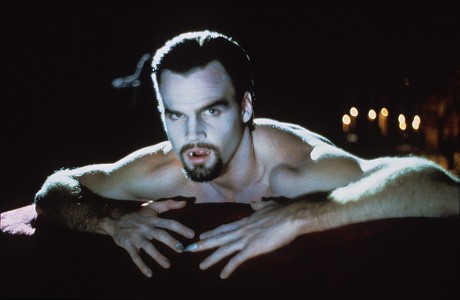
Matty sinks his fangs into a Corman riff on a classic tale of terror.
In an oft cited bit of Corman trivia, Frankenstein Unbound (1990) — the B-movie titan’s glorious return to the director’s chair after a near twenty year sabbatical — came about due to 20th Century Fox’s market research team learning that audiences were clamouring for a movie called ‘Roger Corman’s Frankenstein’. A lesser known nugget is that said audience failed to turn up when the resulting film hit the big screen, causing Corman and the author of its source novel, sci-fi icon Brian Aldiss, to nix plans for a sequel, which would have been an adaptation Aldiss’ own literary follow-up, Dracula Unbound.
Even lesser known than that is, a few years later, Corman relented and produced a Drac-centric Frankenstein Unbound companion piece, albeit without Aldiss and major studio backing, and at a fraction of the cost. Encouraged by Frankenstein Unbound’s video sales, and wanting to ride the cape-tails of Columbia’s incoming horror epic, Bram Stoker’s Dracula (1992) — by Corman protege Francis Ford Coppola, no less — the wily impresario slung together DRACULA RISING [1].
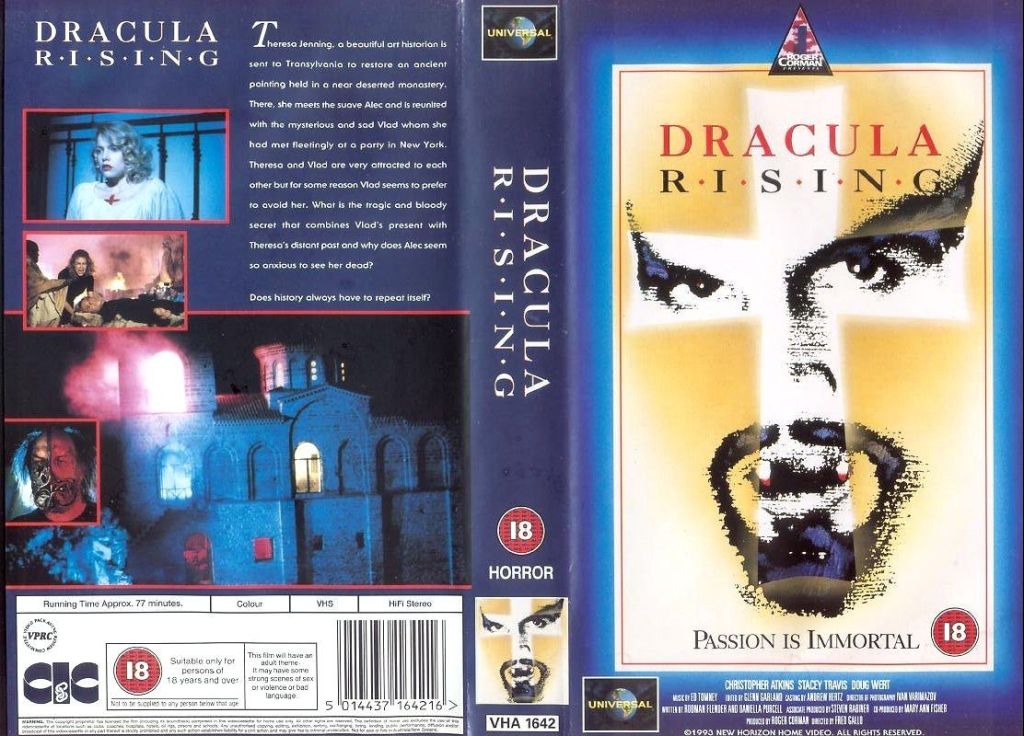
Lensed in Bulgaria on a budget roughly a quarter of Gary Oldman’s salary, Dracula Rising graced U.S. tape via Corman’s New Horizons on 24th March 1993, three months after Bram Stoker’s Dracula’s theatrical run (and, indeed, three months ahead of its stateside video release). It arrived on U.K. shores — sans Demeter, alas — through CIC/Universal in July ‘93. Coppola’s film had been bouncing around British cinemas since January; and though still booking big screen play dates, was weeks away from its rental VHS bow on 4th August, courtesy of 20:20 Vision.
Adhering to the usual past lives shtick, Stacey Travis — who’d round out her Corman tenure with Caroline at Midnight (1994) and Suspect Device (1995) — stars as Theresa: an American art restorer-cum-reincarnation of a lost love who ends up caught between a pair of brooding vampires — good guy Vlad (Christopher Atkins) and bad guy Alec (Doug Wert) — while plying her trade in a European monastery.
As with his other Corman assignments (Dead Space (1991), The Finishing Touch (1992) et al), Dracula Rising finds dependable helmer Fred Gallo slathering on the style. A sumptuous visual exercise in the manner of Jess Franco and Jean Rollin, the look of the film is typified by inky shadows, contrasting highlights, flickering candles, billowing curtains, rumpled satin bed sheets, and use of a dry ice machine so outrageous it could trigger an asthma attack. There’s some dynamic, dance-like choreography to the camerawork; a number of arresting images and subtly perturbing background flourishes; and several interestingly presented dialogue scenes that seemingly pay homage to the stage genesis of the classic Universal version of Stoker’s tale. Practically, a handful of the film’s more splendid locations lend it an incredible amount of production value — specifically, Vlad’s castle and two timeline-hopping visits to some catacombs.
Though attention-holding and functional, Dracula Rising stumbles in the script department. Its dreamy, flashback heavy structure becomes slightly draining despite the film’s snappy running time, and the clunkier passages of exposition aren’t helped by a miscast Atkins and his lack of charisma. Nevertheless, if you’re a ‘90s Corman nut, the fact Dracula Rising marks the penultimate collaboration between the producer and trusted lieutenant Rodman Flender is something to chew on; likewise it being the first of two Stoker-ish pictures that co-scribe Daniella Purcell penned for the mogul, ahead of Bram Stoker’s Burial of the Rats (1995) — itself inspired by Coppola’s Drac attack.
Also known as ‘Corman’s Dracula’ but ‘Roger Corman’s Subspecies (1991)’ or ‘Roger Goes a-Rollin’ are equally appropriate.
USA/Bulgaria ● 1993 ● Horror ● 76mins
Stacey Travis, Christopher Atkins, Doug Wert ● Wri. Rodman Flender and Daniella Purcell ● Dir. Fred Gallo
[1] Later, Coppola, of course, did the reverse: he gave his Dracula a sibling flick, producing Mary Shelley’s Frankenstein (1994). I’ve said it before, and I’ll say it again: the As feed the Bs, and the Bs feed the As.
 The Schlock Pit
Can’t blame any vampire for wanting to sink their fangs into the delectable Stacey Travis…
LikeLike