
Dave digs up a pair of critically reviled movies by Larry Bishop, and wonders if they’re finally ripe for reappraisal.
During the summer of 1996, Larry Bishop – son of Rat Pack comic Joey Bishop – was riding a wave of creativity. He had two star-studded films awaiting release and a series of appealing projects on the go. ‘The Rat Pack and Me’, a semi-autobiographical piece, had long been mooted as a small screen miniseries, but was now seemingly destined for the big screen; ‘Flying Bullets’ was pencilled in as his next directing gig, with a Tarantino cool Michael Madsen in the lead; and ‘Bad Men’, produced by the actor/scripter/director’s Beverly Hills High classmate, Richard Dreyfuss, was edging towards feature-dom.
Bishop was hot property.
Six months later TRIGGER HAPPY (1996) opened across America (as ‘Mad Dog Time’ in order to circumvent confusion with David Koepp’s The Trigger Effect (1996)).
The knives were out.
Roger Ebert said, “It’s the first movie I have seen that does not improve on the sight of a blank screen viewed for the same length of time.” [1]
More critics piled on. The Chicago Tribune called it the second worst film of the year, behind Pauly Shore’s Bio-Dome (1996), and the picture managed to recoup just one percent of its $8million budget during its theatrical run. UNDERWORLD (1996) fared a little better financially the following May, but only because it was so anonymous, having endured a fourteen month wait between the American Film Market and its smattering of big screen bookings. Meanwhile, Bishop’s other three aforementioned projects vanished into the ether, and the multi-disciplined talent shunned Hollywood for almost a decade.
Cinema history, though, is laden with growers that play in stark contrast to the universally adored showers.
Are Trigger Happy and Underworld misunderstood masterpieces, unfairly disregarded by the critical elite?
Well, no, quite frankly – but nor are they lepers deserving of obscurity.
Both are flawed and imperfect, but there are moments of immense wit and charm within Bishop’s trippy, oneiric universe; a tough, pulpy realm bursting with bullets, broads, and consequence free brutality.
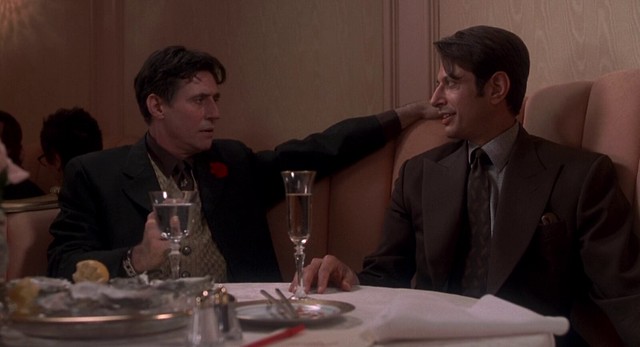
Of the pair, the Bishop-helmed Trigger Happy is the standout. Boasting a breathtaking ensemble of twenty iconic actors – any of whom you could spend the next three paragraphs extolling the virtues of – it takes place in ‘Vic’s World’; a quasi-dystopia with no law enforcement or daylight. A series of moody exchanges take place in increasingly oversized rooms where light bulbs are presumably in short supply, the topic of conversation revolving around the aforementioned Vic (Richard Dreyfuss). This eccentric mobster is about to be released from the loony bin – but before he reassumes his position of authority, he needs to clean up the power struggle that’s been taking place in his absence…
Once you make peace with Bishop’s bizarro domain of staccato speech and fleeting faces, then there’s room to appreciate the nuts and bolts that make Trigger Happy one of the most eye-catching films of its decade. Twin Peaks alum Frank Byers’ appropriately Lynchian cinematography paints a mysterious canvas. Dreyfuss shoulders much of the acting acclaim, with the appearance of his dressing gown clad hoodlum marking the moment the picture really ignites. Gabriel Byrne and Jeff Goldblum as his right hand men get a good chunk of screen time, with Byrne’s mangling of ‘My Way’ alongside its writer, Paul Anka, a highlight. Of the lesser-seen cast, there’s a divine moment between Burt Reynolds and Henry Silva that recreates the ending of Sharky’s Machine (1981), while Christopher Jones’ (Chubasco (1968)) return to the screen after a twenty-six year gap is quite something – as, for that matter, is Gregory Hines’ death scene; Michael J. Pollard’s shoes; Billy Idol’s natural charisma; and Richard Pryor’s gravitas.
Bishop wrote the script for Trigger Happy in 1988 after the quick sale of the still unproduced ‘Sweating Bullets’, which was optioned by the first producer he showed it to. However, it was only when Trigger Happy fell into the hands of good buddy Dreyfuss and his producing partner, Judith James, that it gained traction. The influence of the Jaws (1975) icon didn’t stop there either:
“If MGM had made this off their own back,” remarked Bishop to The Projection Booth Podcast, “Then it would have cost $35million. But here, because Ricky [Dreyfuss] was at the top of his game and did it for points, then everyone else in the cast followed suit.” [2]
That saving certainly prevented a box office disaster on the scale of Heaven’s Gate (1980), but Ebert’s mic drop of a review turned the film and Bishop’s reputation to mud. When Underworld shuffled in front of the press during summer ’97, their pencils were sharpened and ready – ding, ding – for round two.
“It’s very violent, very profane, and very bad,” wrote Paul Tatara for CNN. “There’s less killing at your local slaughterhouse, and the dialogue is probably sharper.” [3]
Shot two months before Trigger Happy (at one point, Bishop found himself flying between sets in Vancouver and L.A. to keep an eye on both movies simultaneously), Roger Christian directs Underworld and it’s certainly another unique entry in the Englishman’s resume – a CV that stretches from being a set decorator on Star Wars: Episode IV – A New Hope (1977), to making the infamous Battlefield Earth (2000).
In a deserted warehouse, a dozen men stand facing a wall with their hands above their heads. Moments later they’re dead, slain by a sharp-suited assassin by the name of Johnny Crown (Dennis Leary). Crown is fresh out of jail and he’s catching up with a few old enemies who shot his Dad to death just two years earlier. He’s not your typical cold-blooded killer though. He’s smart; he’s got style; and even when his finger’s on the trigger, he likes everyone to be happy. Along for the ride on Johnny’s vengeful mission is old pal and tough guy nightspot owner, Frank Gavilan (Joe Mantegna). With Frank looking on, Johnny races to complete his bloodthirsty quest by 1:57am – the exact moment his pop was killed.
Bishop refers to Underworld as a Freudian dream. And with its pervading oedipal themes (it’s even set on Father’s Day), there’s intricate layers to the script that extend beyond the simple ‘Tarantino knock-off’ moniker that it was summarily tarnished with. Leary is perfectly cast as Johnny – a compliment that was often difficult to make during the ‘90s (Two If by Sea (1996) anyone?) – and in Mantegna he has the ideal sparring partner to deliver Bishop’s deliberately excessive dialogue. The chamber piece nature of Underworld exposes the scripter’s flaws more starkly than Trigger Happy, but Bishop’s capability as a wordsmith cannot be understated.
It’s an assertion encapsulated by the final sequence, as the journey of the leads draw to a close. It’s the strongest singular moment across both films and suggests that, beneath the savage criticism and general elusiveness that surrounds these pictures, they’re simply rough-hewn diamonds that need more of an appreciative polish.


[1] Review, Mad Dog Time by Roger Ebert, Chicago Sun-Times, 29th November 1996.
[2] Special Report: Mad Dog Time, The Projection Booth Podcast, 20th August 2021.
[3] Review: Underworld by Paul Tatara, CNN, 12th June 1997.
 The Schlock Pit