

Dave chats to helmer John Shepphird about the time he came face to face with Jordan ‘The Wolf of Wall Street’ Belfort.
It was through Menahem Golan’s short-lived 21st Century Film Corporation that John Shepphird got his first break. Starting out in the editing suite on one of the company’s productions, Richard Gabai’s riotous Virgin High (1991), it wasn’t long before the iconic Israeli entrusted Shepphird and his writing partner, Steve Jankowski, to get their own project off the ground, Teenage Bonnie and Klepto Clyde (1993); a contemporary spin on the notorious criminal twosome. Golan’s bankruptcy did little to ensure that the film reached a wide audience, and the pair’s proposal to swap hats on their next feature (Shepphird scripting, Jankowski directing) was nixed.
For Shepphird, a fallow period served to broaden his contacts, and he soon found himself introduced to Jimmy Lifton. One of the youngest graduates of the Berklee School of Music and a composer by trade, Lifton had produced and scored Marina Sargenti’s Mirror Mirror (1990). When an opportunity arose at Hit Entertainment – a then recently launched outfit formed by South African father and son duo Harry and Brian Shuster and Jordan ‘The Wolf of Wall Street’ Belfort – Lifton was keen to see if his newfound friend wanted in.
“Jimmy had this project, which he said was a sci-fi, but he was toying with the idea of it becoming a crime picture,” recalls Shepphird. “So, I wrote the basic structure of the film, but penned it as a modern crime movie, and not a science-fiction one. He read it, but decided to go full-on sci-fi, so hired Nick Spagnoli to write the script. Jimmy was keen on me directing it, so we came up with a plan together, and I brought in a lot of my trusted collaborators, and it eventually became Firestorm (1996).”
“After we wrapped, I gave Hit my cut of the picture so they could take it to the American Film Market, but they told me it wasn’t long enough. We had to insert a few scenes, so we went over to the sets where they’d been shooting The Secret Agent Club (1996). They’d spent money on those sets! We did a hospital scene and a few things, which beefed it up to ninety minutes. I was looking around and going, “Why didn’t I get all these sets! Why did they give this to John Murlowski!?” [laughs]. I’m working my butt off, and they gave him all this and paid him more too! Then Jimmy Lifton said that they were going to be tearing them all down, and I was horrified! After spending a few years working for Roger Corman, I told them that they need to re-use these! I wasn’t even hinting that I should do it. I was simply suggesting what would be best.”
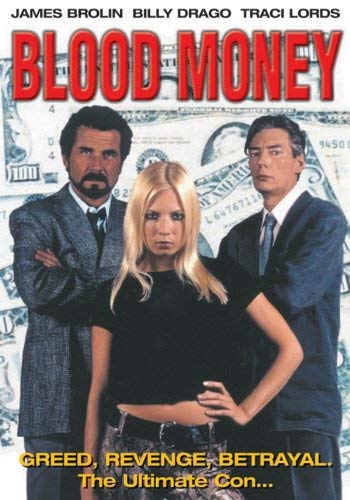
“They asked me what I would do, so I got my writing partner, Steve Jankowski, and he came over to look at the sets and nearby locations in Sun Valley, and we wrote a treatment for what became Blood Money. A neo-noir. They said if you can do the budget low enough, and as long as you can have it ready for the AFM in mid-January, then it’s all yours. Go ahead. Steve and I knuckled down and wrote a script in two weeks, then we were straight into pre-production and started casting. A lot of productions had tailed off between Christmas and New Year, so we figured that if we do it nearer the holiday season, we’d get some good rates on crew, and ultimately Hit Entertainment agree to do it.”
BLOOD MONEY (1996) is very much the film that every low budget, post-Tarantino crime-thriller aspires to be. It tells the story of Lester Grisam (Sonny Carl Davis), a two-bit hoodlum serving time for armed robbery and murder. After a negative parole hearing, he busts out of the joint with his dim-witted associates, Dexter (Bentley Mitchum) and Sabbit (Tony Pierce), and sets about getting revenge on Stuart (Dean Tarrolly), an ex-compatriot who turned state’s evidence and played a major role in sending him down. Lester’s plan is to make him embezzle $10 million from the bank where he now works – but as the clock ticks, the net grows tighter, and the dogged Lt. Kincaid (James Brolin) gets closer to catching his prey.
Shot for chump change on a schedule that would make even a seasoned B-movie director blush, Blood Money is a perfect imperfection. Technically there are a handful of flaws (just as Matty noted in his old write-up), but creatively it’s a tightly woven neo-noir that improves with each successive watch. Lensed with an immediacy that gives the picture a choking claustrophobia, it’s the cast that deserve huge recognition. By giving leads to relative unknowns (Tarrolly and Alison Moir – who plays Kelly, his fiancée), Shepphird allows the characters to breathe and become more believable, with the established actors dovetailing as the dressing.
“I must give credit to our casting director, Tom McSweeney,” says Shepphird. “The guy was so good. He was able to get James Brolin and Billy Drago, and Bentley came back in from Firestorm. I don’t think Traci Lords was cast until we’d begun shooting! Tom called me and asked what I thought of her, and I just replied how I thought she’d be fantastic. She’d read for a role in my first film, but she hadn’t done that John Waters film yet [Cry Baby (1990)]. Nevertheless, I was really excited about her coming onto Blood Money, and Hit were too because they knew it would be great for foreign sales.”
For the lead role, Shepphird turned to his friend Sonny Carl Davis. A native of Austin, Texas, the cult actor had got his first break in Eagle Pennell’s much-loved comedy-drama The Whole Shootin’ Match (1978) before Hollywood beckoned and he became a perennial ‘that guy’ with a host of supporting roles in the likes of Fast Times at Ridgmont High (1982) and Thelma & Louise (1991). However, it was a casting decision that interfered with the intentions of one of the higher-ups, and it brought the director face to face with you-know-who.
“Yeah, this is where I first met Jordan. It could be a movie in itself!”
“Jordan had a friend who was an actor. As we were putting the film together, they had this guy come in and audition because Jordan wanted his friend to have Sonny’s role! I met his friend, and he was awful. He liked the idea of acting, but he didn’t have the chops. We’re two or three days before principal photography, and I’m in a meeting with Brian, David [Silberg – Hit’s Head of Production], Jimmy and Jordan. I’d heard all these stories about him being this brilliant Wall Street guy. I’d lived in New York, so I was familiar with seeing all these guys out and about, but he seemed like a gangster. He didn’t seem like a ‘Wall Street Wizard’. He seemed like some kind of hood.”
“‘We want our guy in that role,’ he said. Now, this was December ’95. I already had a film set up and ready to go at Columbia-TriStar called Snowboard Academy. I already had another job. They weren’t paying me very much for Blood Money – but of course I had agreed to that. Anyway, I said no, and they said give us a few minutes. What they had failed to realise, though, was that I hadn’t signed the script over to them. They weren’t experienced producers you see. They were making offers on a script that they didn’t even have the rights to. I knew I had them over a barrel.”
“I said that I respect that you want to work with your friend, so how about you compromise, and I put him in this minor role – but they said no. So they called me back into the room after about twenty-five minutes, and I could see that Jordan was raging with anger. He was SO pissed off. He literally jumped up onto his feet, then went at me, poking his finger into my chest saying how insolent I was and that I’m going to do what he says. I couldn’t believe it! And I told him, as diplomatically as I could, I said ‘Look, I’m about to do something for Columbia-TriStar. I don’t need this movie. I’m doing it to work with everybody. I’ll put your friend in, but he’s not going to play the lead. There’s a lot of sacrifice in this picture. I’m not compromising. You guys need to figure it out.’ Well, he was like a monster once I’d said that, and he began screaming at me – ‘You’ll never work in this town again!’”
“Thing is, they had no choice. They had a pay or play with James Brolin, and once they’d figured that out, they finally relented. Jordan grabbed my shirt and said, ‘Ok, we’ll go with your guy, but I’m warning you, if this movie sucks, I’m gonna kick your ass.’ And he was serious! Two days later we started shooting the film – we did it in twelve days – and we had planned it well, so it went swimmingly. In fact, so many people I worked with on Blood Money, I still know today. Almost like a family. Jim Brolin was fantastic, Traci was wonderful, and all the talent were just great.”
Blood Money never made it to home video in America. Instead, it premiered on Cinemax in September 1997. It did, however, debut on British cassette twelve months earlier, via First Independent. Emboldened by the foreign sales and its solid domestic TV deal, Shepphird remains buoyant over the film’s success.
“Dollar in, dollar out, Blood Money was Jordan’s biggest hit. Santa with Muscles (1996), which they made after it, was called the worst film of all time! It’s the Heaven’s Gate (1980) of low budget movies. But that’s what they get for hiring John Murlowski!”
Interview originally conducted for Planet Hollywolf, a video essay by Matty & Dave
available on Arrow Video’s Blu-ray release of The Wolf of Wall Street (2013)
 The Schlock Pit