
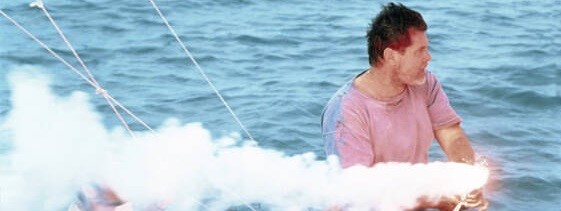
Never mind the treacherous depths of the Pacific, Dave has his work cut out trying to survive the running time of this drab telepic.
Spoiler alert.
They survived.
Well, if you’re familiar with Dougal Robertson’s 1973 book of the same name, you’ll know that anyway. For those of you in the dark, the aforementioned sailor-cum-author was a Navy man who, in the wake of the attack of SS Sagaing in World War II, opted for a more tranquil career in dairy farming. By the early ‘70s, his sea legs were pining for a return to the briny deep, so Robertson left his smallholding, and with his wife and four kids in tow, spent his life savings on a forty-three foot schooner called Lucette and set sail into the blue yonder.
For eighteen months Robertson and his family journeyed across the Atlantic, stopped at the Bahamas, and sailed along the Panama canal. However, during a voyage to the Galapagos Islands, disaster struck. A pod of killer whales left a hole in Lucette’s hull, sinking the vessel, and leaving the crew of six floating in a dinghy for thirty-eight days until a passing Japanese fishing trawler rescued them. Inevitably, the journal Robertson kept throughout the ordeal became the titular novel.
Fast forward nearly two decades, and the Scotsman’s epic fight for survival is deemed ready for primetime with a dramatic adaptation airing on ABC. Much of the narrative detail remains the same, especially with regard to personnel, although the tweaks to SURVIVE THE SAVAGE SEA stem – for the most part – from logistical necessity. For example, the coast of Queensland, Australia understandably forms the backdrop for much of the running time; but the switch from Robertson’s war hero to, well, Robert Urich, turns the bland factor up to eleven. Not that the Spenser: For Hire icon had a particularly good time filming it:
“It was without doubt the most uncomfortable thing I’ve ever done,” groaned the late actor to journalist Dan Rice. “We were always wet. It was winter there, and the water was not warm. It was a confined space, I’m a little claustrophobic, and it seemed like everybody was either stepping on you, or kicking you, or poking you in the face. I just found it really annoying.” [1]
If that’s how Urich found the shoot, then I’d hedge my bets on the audience reaction to his performance being mutual. On narration duty from the get-go, his voiceover is monotone and laboured, which leaves director Kevin James Dobson flailing in his attempt to conjure genuine tension.
It’s a similar situation on the boat, and it’s these confines in which we’re stranded (pun intended) for virtually a full hour of the duration. They had a great plot line to break it up too, with one of the kids jacking in the trip due to seasickness and getting a job on the mainland in the vicinity of a family friend. Dobson briefly comes ashore twice to amp up concern at the missing boat, but it’s not enough. Had the film swung between these two facets of the storyline, the drama would have been far more compelling. Instead, the desperate act of clinging on for life in the ocean becomes an endurance test for us to reach the end credits.
USA ● 1992 ● Drama, TVM ● 88mins
Robert Urich, Ali McGraw, Danielle von Zerneck, Peter Sumner ● Dir. Kevin James Dobson ● Wri. Fred Haines, Scott Swanton, based upon the book by Dougal Robertson

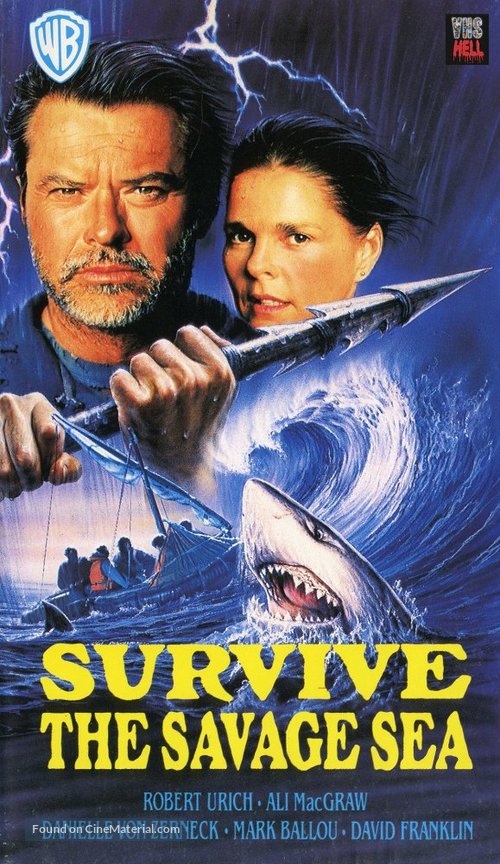
[1] Robert Urich and Son ‘Survive the Savage Sea’ by Dan Rice, The Selma Times-Journal, 3rd January 1992.
 The Schlock Pit