

Dave looks at the final movie from Jordan ‘The Wolf of Wall Street’ Belfort’s short-lived production company, Hit Entertainment. Featuring a few quick words with the shingle’s former VP of Production, David Silberg!
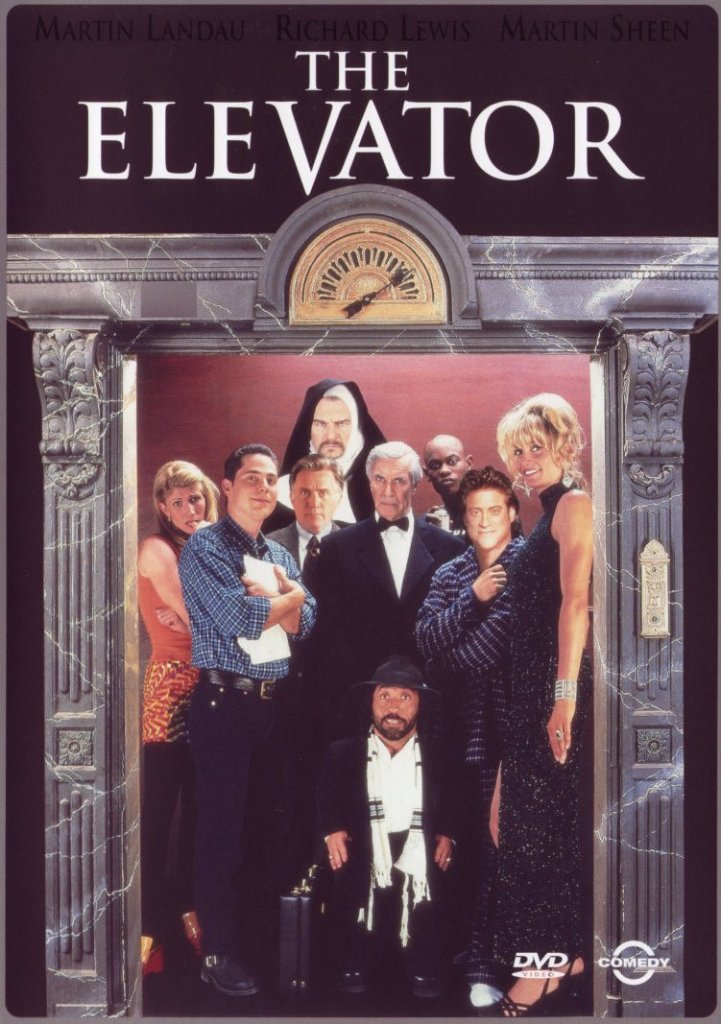
The sight of the six foot eight Richard Moll, dressed as a Nun, rapping alongside the diminutive Phil Fondacaro – who, incidentally, is kitted out as a Rabbi – might not have you heading to eBay in search of a copy of THE ELEVATOR (1996) – but behind this naff comedy-drama’s humourless whims lies the most arthouse entry in Wall Street broker-turned-conman Jordan Belfort’s brief run of B-movies.
For the uninitiated: Belfort had hooked up with South African father and son duo, Brian and Harry Shuster, a few years earlier with the intention of blowing some of his ill-gotten gains on carving out a career as a movie producer. Operating as Hit Entertainment they managed to forge a partnership with distributor Cabin Fever Entertainment, who agreed to help them get an initial slate of eight films out into the wild. A modicum of success was had, predominantly on home video with the likes of Hulk Hogan twofer Santa with Muscles (1996) and The Secret Agent Club (1996), but by the time The Elevator went in front of cameras, rumours were growing that the shine was fading on Belfort’s Hollywood star.
Conceived by writer Gabe Bologna after a real-life elevator incident, whereupon he was trapped mid-floor with Ron Howard, The Elevator sees the scripter playing a version of himself, an ambitious wannabe author. Through a moment of fate, Bologna’s left stranded in the titular floor-hopper firing pitches at hotshot producer Roy Tilden (played with gusto by Martin Landau, fresh from his Oscar-winning portrayal of Bela Lugosi in Tim Burton’s Ed Wood (1994)).
“I’m thinking a New York Stories (1989) kinda thing,” suggests Bologna’s character with a wink. “Three directors each doing their own thing” – and that’s exactly what The Elevator is: a three-part anthology where British pop video supremo Nigel Dick takes one segment; Arthur Borman another; and Canadian director Rafal Zielinski the third and wraparound.
A showcase for Bologna, the son of Hollywood golden couple Joe Bologna and Renee Taylor, The Elevator had been offered to Zielinski as a whole, but he despised the script and reluctantly agreed to shoot only a portion of it. The filmmaker rose to prominence off the back of a string of ‘80s comedies like Screwballs (1983) and Valet Girls (1987), but the ’90s had him pursuing more highbrow fare, most notably in the form of Fun (1994): a Sundance smash that caught the eye of the Shusters, and one that strikingly switched between monochrome and colour – a style that he echoed in his slices of The Elevator.
“I hated it and my sales team hated it,” says David Silberg, Hit’s former VP of Production at Hit – but the Shusters were keen. And with a place secured at the first-ever San Diego World Film Festival in June 1998 (which coincided with lifetime achievement award for Landau), it seemed that their intellectual impulse might have paid off, and that Jordan Belfort was on his way to becoming a producer of something avant-garde.
Alas, it didn’t quite work out that way. Avoided by critics, The Elevator bypassed video entirely, eventually debuting on Cinemax the following summer at the ungodly hour of 1AM. A whimper of an ending to a company spearheaded by three men whose lives were the total opposite.
Funnily, despite Belfort and the junior Shuster, Harry, facing potential incarceration for money laundering and securities fraud post The Elevator [1], Hit had started to raise the stakes just prior to their downfall, as Silberg explains:
“They kept telling me that we’re going to make more, and there was even a time when Jordan was going to take us public, where we all flew to New York to the Grand Havana cigar rooms – which the Shusters owned – and did a presentation for all the biggest brokers and money-raisers on Wall Street. We put on a great show: people afterwards came running up, saying “Who can I give my cheque to?” and so forth, but it wasn’t to be.”
[1] Belfort was arrested two months after the film’s San Diego premiere while Shuster was indicted eleven months later.
 The Schlock Pit