

Enduring a tough time in the ratings, CBS pinned a fair bit of hope on an action comedy series and its feature length pilot. Dave takes a look at what happened…
In late 1989, CBS appointed a new head, Jeff Sagansky – the former president of Tri-Star. Plagued by low ratings and having had no hits from the recent fall season, the network went into winter with only two shows in the Nielsen top ten, both of which (60 Minutes and Murder, She Wrote) were a world away from the demographic that they were keen to attract.
Major surgery was needed.
Snoops, a crime-comedy with real life husband and wife, Tim and Daphne Reid, was canned in favour of Max Monroe: Loose Cannon, and The Famous Teddy Z with Jon Cryer made way for Paul Haggis’ show, City – but first to go during Sagansky’s reign was Beauty and the Beast. Though a cult hit, part-way through its second season it was clear that the Ron Perlman led drama was beginning to falter in the ratings. Orders of twenty-two episodes were cut in half for its third outing, and by the middle of January 1990 it was yanked from the schedules after eight instalments. The remaining three episodes were pencilled in for a graveyard airing over the summer. Arguably the competition only served to facilitate its demise: the quirky fantasy had to face off against the perennially popular sitcoms Growing Pains and Head of the Class on ABC, and Unsolved Mysteries on NBC.
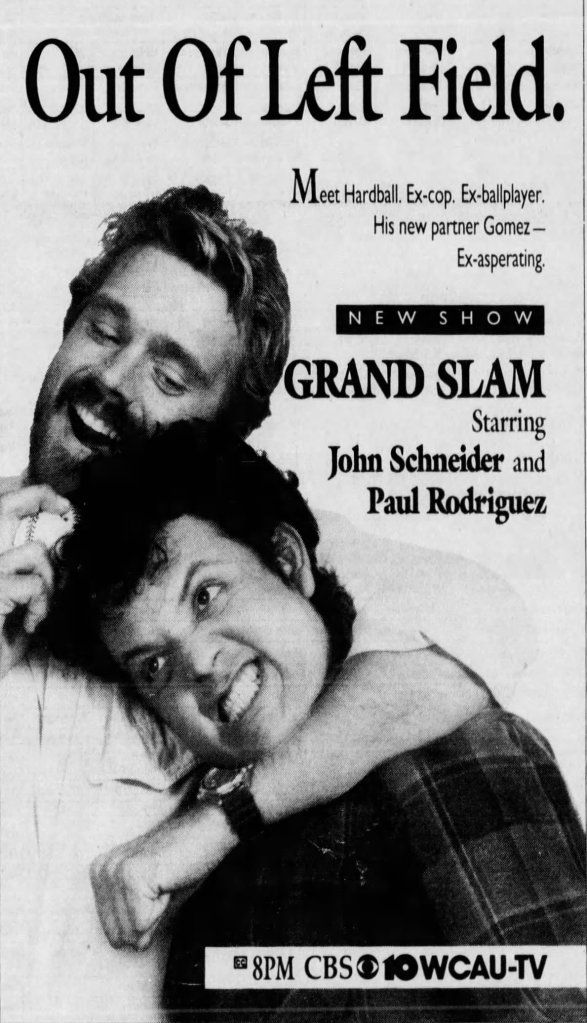
To that end, CBS elected to replace Beauty and the Beast with GRAND SLAM (1990): a buddy comedy about two bounty hunters employed by rival companies. Dennis ‘Hardball’ Bakelenekoff (John Schneider) wears ripped joggers, lives on a boat, and sleeps in his shades. He earned his nickname as a baseball player, and – eye roll at the ready – frequently resorts to taking down bad guys with the throw of a speedball. Pedro Gomez (Paul Rodriguez), meanwhile, is a compendium of every stereotypical Mexican character that you’ve ever seen, spending his time driving a low-rider and chowing down on burritos at the wheel.
The origins of Grand Slam as a series dates back to the mid-’80s when it was pitched to the studios as a vehicle for Cheech Marin. Snubbed at the time, some suit at CBS felt that it still had potential, but they’re greatly mistaken. Schneider and Rodriguez are an ill-matched pair and both look a little regretful at having to do this shtick. Padded more overtly than a sumo outfit at Halloween, exposition that should take minutes drags on interminably, and even a decent car chase that features the gratuitous use of a Gatling gun can’t begin to right so many wrongs.
“If Grand Slam is ‘the best and brightest’ that CBS has to offer,” wrote Robert P. Laurence shortly after its debut, “Then CBS is in deeper trouble than anyone imagined” [1]. With this original movie helping to establish the show’s premise, Grand Slam was given a mighty leg-up in terms of awareness by following on immediately after the Super Bowl – which attracts the biggest annual TV audience in America. But it was all in vain: a commission of eight episodes led to only six ever being aired, although the network did pull a few quid back by releasing it in different territories under the title ‘Dead Trouble’, where episodes were stitched together and passed off as sequels.
Bill Norton – writer/director of the excellent Cisco Pike (1971), and the son of the great William W. Norton (Day of the Animals (1977)) – suffers the ignominy of having Grand Slam tied to his resume. A rare stinker on a CV bursting with quality, he seems to have been excised from the pilot on IMDb and replaced by scripter, Steven Sears. However, as Sears confirmed to us recently, Norton did indeed write and direct Grand Slam‘s excruciating ninety minute opener, with The A-Team regular penning the last sight of the short-lived show, episode six, Byte the Bullet.
[1] Grand Slam Hits Foul Line by Robert P. Laurence, Copley News Service, 31st January 1990.
 The Schlock Pit